
A quality-by-design approach to improve process understanding and optimise the production and quality of CAR-T cells in automated stirred-tank bioreactors
Overview
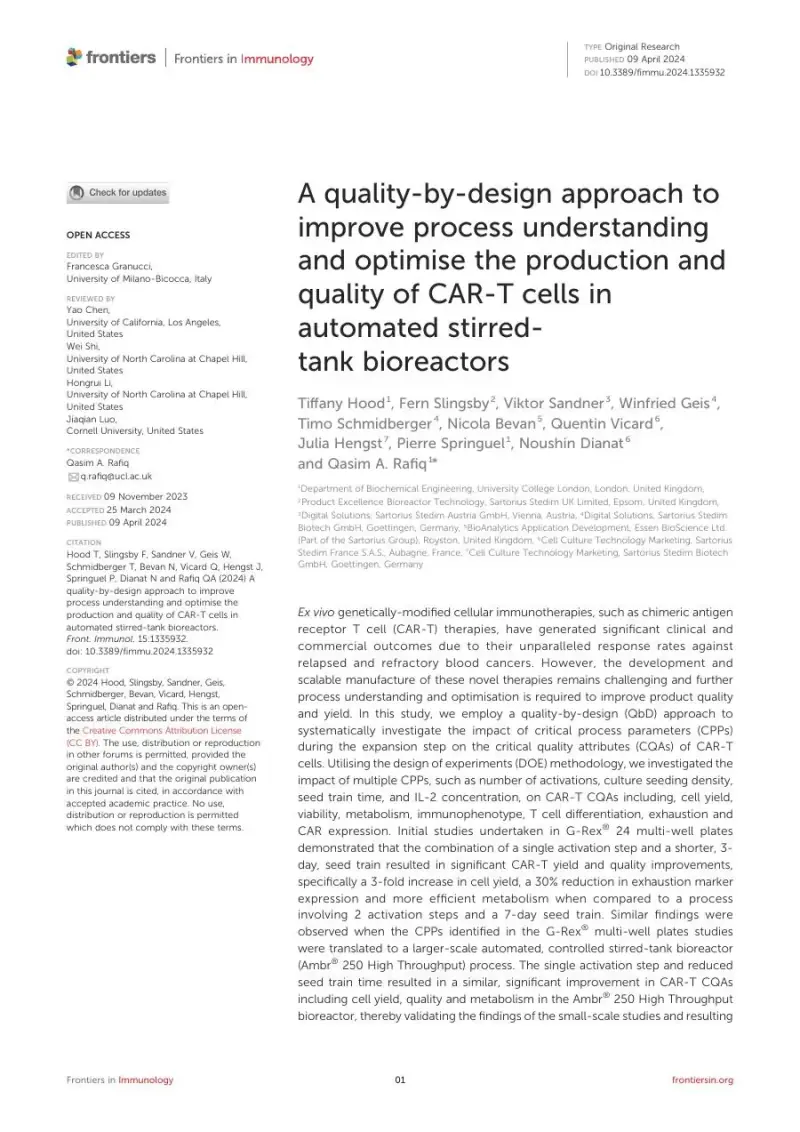
This study uses Quality-by-Design (QbD) and Design of Experiments (DOE) to optimize CAR-T expansion. Small-scale DOE studies were conducted in G-Rex® 24-well plates to identify optimal parameters (single activation, short seed train), which were then translated to Ambr 250 bioreactors.
What this paper found
A single activation combined with a 3-day seed train gave higher yield and better-quality CAR-T cells than two activations with a 7-day seed train. The team used a design-of-experiments approach in G-Rex® 24-well plates, varying activations, seed train time, seeding density and IL-2 from 30 to 100 IU/mL. Conditions activated once reached a mean cell fold of 28.7 versus 8.6 after seven days, and 48.5% versus 77.5% of cells co-expressed PD1 and LAG3. In flasks with three donors, cell fold was 93.8 versus 16.9. In the Ambr 250 High Throughput bioreactor, the optimised process reached 7.1e6 versus 4.6e6 cells/mL, with only 8% of cells CD3+PD1+LAG3+. IL-2 concentration did not significantly affect the optimum, so 30 IU/mL was chosen.
Note: In vitro study. Process parameters were screened with cells from one healthy donor in G-Rex® plates, then tested on three healthy donors in flasks and in the bioreactor.
The process involving two activation steps was shown to have the largest detrimental impact on CAR-T growth and CQAs compared to the other experimental factors tested. — Tiffany Hood, Fern Slingsby, Viktor Sandner, Winfried Geis, Timo Schmidberger, Nicola Bevan, Quentin Vicard, Julia Hengst, Pierre Springuel, Noushin Dianat, Qasim A. Rafiq, Frontiers in Immunology
Study details
- Authors
- Tiffany Hood, Fern Slingsby, Viktor Sandner, Winfried Geis, Timo Schmidberger, Nicola Bevan, Quentin Vicard, Julia Hengst, Pierre Springuel, Noushin Dianat, Qasim A. Rafiq
- Institution
- Department of Biochemical Engineering, University College London, London, United Kingdom · Product Excellence Bioreactor Technology, Sartorius Stedim UK Limited, Epsom, United Kingdom · Digital Solutions, Sartorius Stedim Austria GmbH, Vienna, Austria · Digital Solutions, Sartorius Stedim Biotech GmbH, Goettingen, Germany · BioAnalytics Application Development, Essen BioScience Ltd. (Part of the Sartorius Group), Royston, United Kingdom · Cell Culture Technology Marketing, Sartorius Stedim France S.A.S., Aubagne, France · Cell Culture Technology Marketing, Sartorius Stedim Biotech GmbH, Goettingen, Germany
- Journal
- Frontiers in Immunology
- Year
- 2024
- G-Rex® model(s)
- G-Rex®24 Well Plate
- Cell type(s)
- CAR T Cells
- Application area
- Hematologic malignancy
- Study phase
- Preclinical
How G-Rex® was used
Anti-CD19 CAR-T cells from one healthy donor were expanded in G-Rex® 24-well plates for 7 days to screen four process parameters. After a 3-, 5- or 7-day seed train, cells were seeded at 0.25, 0.5 or 0.75 × 10^6 cells/mL, with a second Dynabeads activation at a 1:1 cell-to-bead ratio in some conditions. Fresh IL-2 at 30, 65 or 100 IU/mL was added on days 3 and 5, and cells were counted on days 0 and 7. Conditions activated once reached a mean cell fold of 28.7, versus 8.6 for conditions activated twice.
Explore related

Full citation
Hood T, Slingsby F, Sandner V, et al. A quality-by-design approach to improve process understanding and optimise the production and quality of CAR-T cells in automated stirred-tank bioreactors. Front Immunol. 2024;15:1335932.
Building a similar workflow?
Talk to a ScaleReady specialist about how the G-Rex® platform can support your program — from process development to clinical-scale manufacturing.


