
Perfusion microbioreactor for CAR-Treg manufacturing
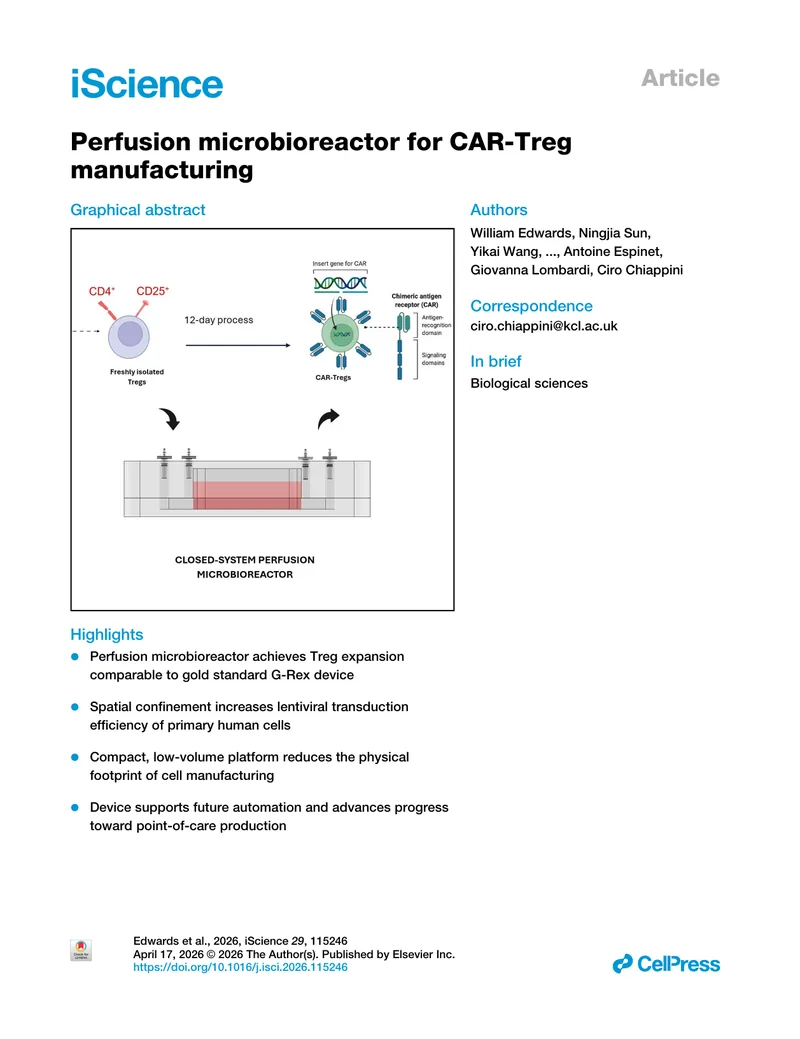
Overview
This study ran regulatory T cell expansion and lentiviral transduction inside a closed 1 mL perfusion microbioreactor. Over 12 days it took wild-type Tregs to 10-fold, as far as a G-Rex® 24-well plate did, on 5.1 mL of medium against 20 mL; CAR-Treg yield rose 92% over the plate.
What this paper found
A closed, 1 mL PDMS perfusion microbioreactor (K-MBR) expanded and lentivirally transduced primary human regulatory T cells, producing functional HLA-A2-specific CAR-Tregs. With an optimized daily feeding regime, wild-type Tregs expanded 10-fold over 12 days, matching a G-Rex® 24-well plate while using 5.1 mL of medium rather than 20 mL. In the CAR-Treg workflow, a 72-hour transduction at MOI 5 reached 67% efficiency and CAR-Treg yield rose 92% compared with a 24-well plate, with a 6-fold expansion. K-MBR-made CAR-Tregs suppressed effector T cell proliferation in an antigen-dependent manner as well as plate-made cells. Culture in the device did not alter cell viability or phenotype. All cells came from healthy donors, and in vivo performance was not evaluated.
Note: All experiments used healthy-donor cells and in vitro assays; the authors note that patient-derived cells, scale-out, automation, cGMP compatibility and in vivo behavior remain to be evaluated.
The perfusion microbioreactor supports high transduction efficiency and robust cell expansion, comparable with the G-Rex platform. — William Edwards, Ningjia Sun, Yikai Wang, Yuhan Lu, Cong Wang, Daniela Mastronicola, Cristiano Scottà, Marco Romano, Cesare M. Cejas, Antoine Espinet, Giovanna Lombardi, Ciro Chiappini, iScience
Study details
- Authors
- William Edwards, Ningjia Sun, Yikai Wang, Yuhan Lu, Cong Wang, Daniela Mastronicola, Cristiano Scottà, Marco Romano, Cesare M. Cejas, Antoine Espinet, Giovanna Lombardi, Ciro Chiappini
- Institution
- Centre for Craniofacial and Regenerative Biology, King's College London, London, UK · London Centre for Nanotechnology, King's College London, London, UK · Department of Bioengineering, Imperial College London, London, UK · Wenzhou Eye Valley Innovation Centre, Eye Hospital, Wenzhou Medical University, Wenzhou, China · Peter Gorer Department of Immunobiology, School of Immunology & Microbial Sciences, Faculty of Life Sciences & Medicine, King's College London, London, UK · Department of Biosciences, Centre for Inflammation Research and Translational Medicine, Brunel University, London, UK · MFX (MicrofluidX) Ltd., Stevenage Bioscience Catalyst, Stevenage, UK
- Journal
- iScience
- Year
- 2026
- G-Rex® model(s)
- G-Rex®24 Well Plate
- Cell type(s)
- CAR T Cells, Treg Cells
- Application area
- Other
- Study phase
- Preclinical
How G-Rex® was used
Wild-type Tregs were expanded in a G-Rex® 24-well plate as the benchmark for the K-MBR microbioreactor, using an optimized ScaleReady protocol. A total of 1 x 10^6 Tregs were seeded in 8 mL of X-VIVO 15 medium with 1,000 IU/mL IL-2 and 100 nM rapamycin, and 6 mL of medium was replaced on day 4 and day 8, for 20 mL in total over the 12-day culture (n = 2 devices). Expansion in the K-MBR was in line with the G-Rex®, with no impact on viability, and a density of 5.0 x 10^6 cells/cm² was reported for the G-Rex® platform.
Explore related

Full citation
Edwards W, Sun N, Wang Y, et al. Perfusion microbioreactor for CAR-Treg manufacturing. iScience. 2026;29(4):115246.
Building a similar workflow?
Talk to a ScaleReady specialist about how the G-Rex® platform can support your program — from process development to clinical-scale manufacturing.


