
Overview
This review models how oxygen reaches three-dimensional endocrine aggregates in culture. It is well established that in gas-impermeable plastic the medium over islets cannot exceed about 1.1-1.3 mm without starving their cores; the authors' own modeling adds that culture at low temperature cuts anoxia by a further 20-35%.
What this paper found
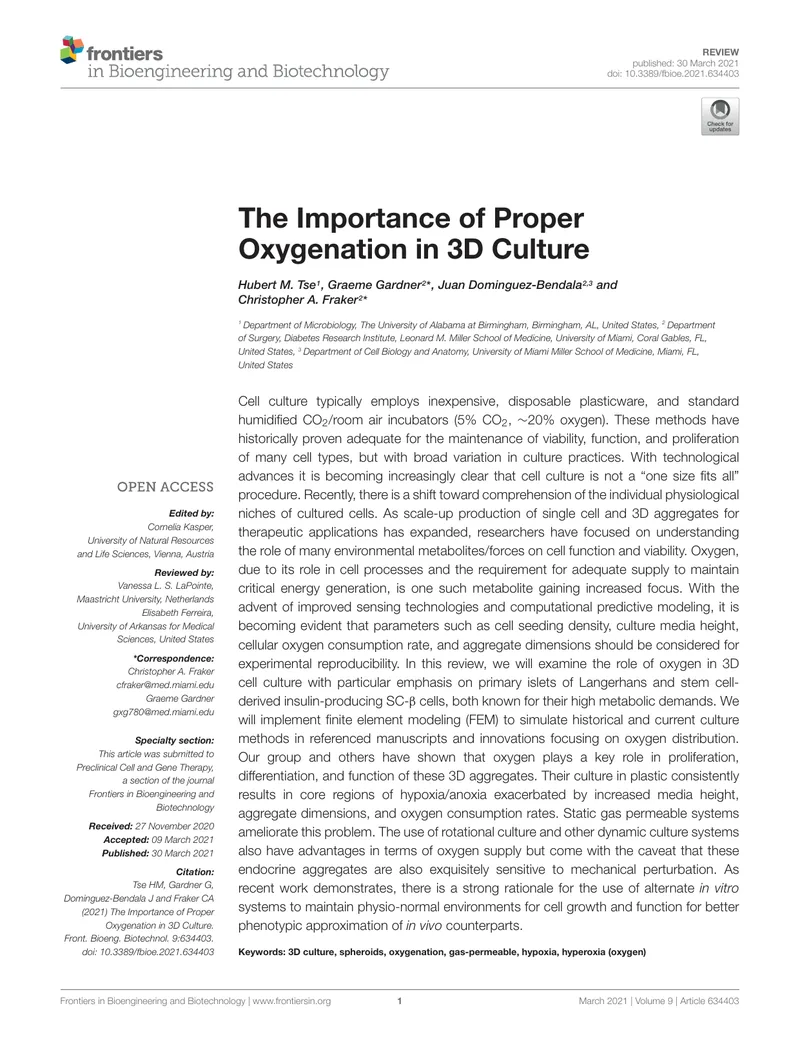
Culturing three-dimensional endocrine aggregates in standard gas-impermeable plastic produces oxygen-starved cores, and gas-permeable silicone-based static culture largely prevents this. Using finite element modeling of islets of Langerhans and stem cell-derived beta cells, the authors show that anoxia in plastic depends mainly on oxygen consumption rate and medium height, and less on seeding density. Islets are limited to roughly 3% of surface area coverage and a medium depth of about 1.3 mm. Silicone membrane culture abolished islet anoxia at densities up to about 4,400 IEQ/cm², nearly 25 times standard density. Low-temperature culture cut modeled anoxia by 20–35%, while rotational systems supply oxygen but expose aggregates to shear. Culture at physiological oxygen on gas-permeable platforms improved stem cell differentiation into endocrine cells.
Note: The oxygen profiles are finite element simulations of previously published culture protocols rather than new experiments.
Clearly, there is a balance of proper oxygenation where both too much and too little are detrimental, and the multiple variables involved further complicate efforts to adequately maintain endocrine clusters. — Hubert M. Tse, Graeme Gardner, Juan Dominguez-Bendala, Christopher A. Fraker, Frontiers in Bioengineering and Biotechnology
Study details
- Authors
- Hubert M. Tse, Graeme Gardner, Juan Dominguez-Bendala, Christopher A. Fraker
- Institution
- Department of Microbiology, The University of Alabama at Birmingham, Birmingham, AL, United States · Department of Surgery, Diabetes Research Institute, Leonard M. Miller School of Medicine, University of Miami, Coral Gables, FL, United States · Department of Cell Biology and Anatomy, University of Miami Miller School of Medicine, Miami, FL, United States
- Journal
- Frontiers in Bioengineering and Biotechnology
- Year
- 2021
- Cell type(s)
- Other
- Application area
- Regenerative medicine
Explore related
Full citation
Tse HM, Gardner G, Dominguez-Bendala J, Fraker CA. The Importance of Proper Oxygenation in 3D Culture. Front Bioeng Biotechnol. 2021;9:634403.
Building a similar workflow?
Talk to a ScaleReady specialist about how the G-Rex® platform can support your program — from process development to clinical-scale manufacturing.


