
c-JUN enhances CRISPR knockin anti-B7-H3 CAR T cell function in small cell lung cancer and thoracic SMARCA4-deficient undifferentiated tumors
Overview
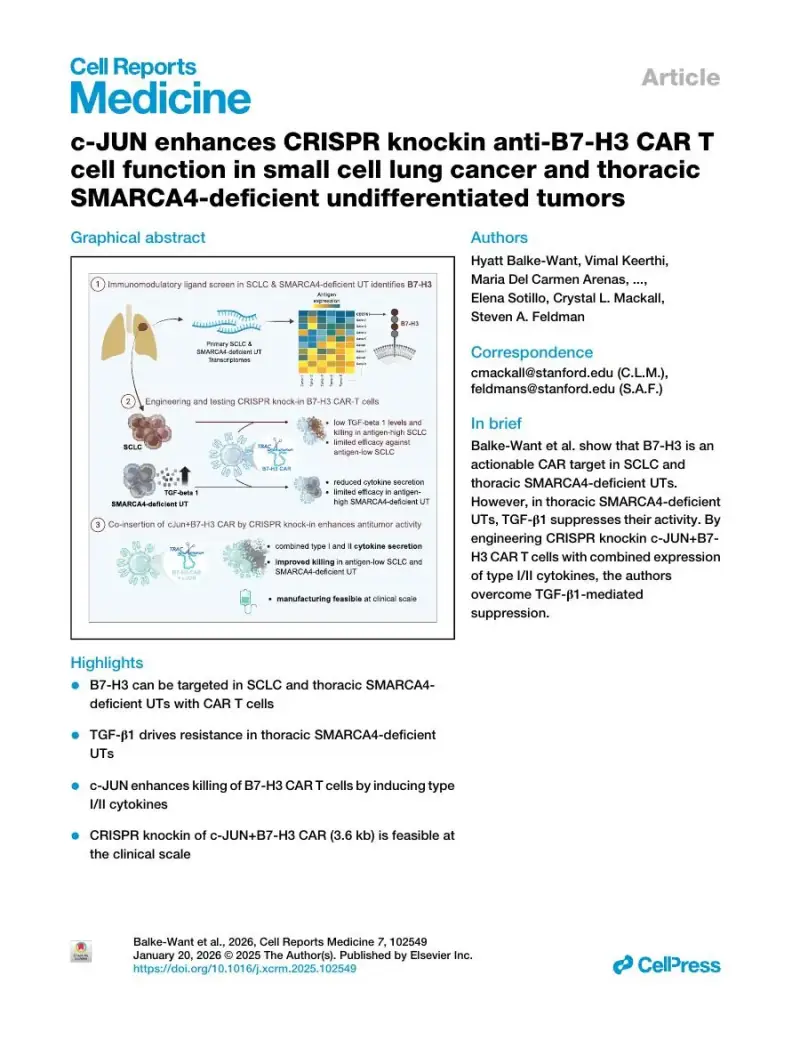
B7-H3 is an actionable CAR target in SCLC and thoracic SMARCA4-deficient tumors, where TGF-beta1 drives resistance. CRISPR knockin of c-JUN with a B7-H3 CAR boosts killing via type I/II cytokines. T cells were activated and expanded in G-Rex® vessels, supporting GMP clinical-scale manufacturing.
What this paper found
B7-H3 is an actionable CAR target in small cell lung cancer (SCLC) and thoracic SMARCA4-deficient undifferentiated tumors, and knocking c-JUN into the TRAC locus alongside a B7-H3 CAR improves CAR T cell activity in both. Of 23 cell lines, 22 expressed more than 1,000 B7-H3 molecules per cell, with a median of 2,966. TGF-β1 secreted by the SMARCA4-deficient H841 line suppressed B7-H3 CAR T cells; c-JUN co-expression limited TGF-β1-driven loss of type 1/2 cytokine gene expression and, versus CAR T cells without c-JUN, gave an average 40% tumor reduction in H841 xenografts. Scaled 25-fold with a MaxCyte GTx electroporator, three donors yielded 1.2–3.5 × 10^9 CAR+ T cells by day 14, with mono-allelic TRAC insertion.
Note: The work used tumor cell lines and xenograft models in immunodeficient mice; the authors note that clinical trials are needed to test B7-H3 CAR T cells with c-JUN co-expression in SCLC and SMARCA4-deficient tumors.
We also provide evidence that good manufacturing practice (GMP) clinical-scale manufacturing is feasible for c-JUN+B7-H3 CAR T cells. — Hyatt Balke-Want, Vimal Keerthi, Maria Del Carmen Arenas, Yiyun Chen, Meena Malipatlolla, Dorota D. Klysz, Peng Xu, Katie Ho, Kyle Asano, David Stahl, Jing Huang, Aidan Retherford, Sunny Patel, Carley Fowler, Lukas Maas, Nikolaos Gkitsas-Long, Qiaoshi Jiang, Xikun Liu, Roland Ullrich, Julie George, Sabine Heitzeneder, Ramya Tunuguntla, Julien Sage, Elena Sotillo, Crystal L. Mackall, Steven A. Feldman, Cell Reports Medicine
Study details
- Authors
- Hyatt Balke-Want, Vimal Keerthi, Maria Del Carmen Arenas, Yiyun Chen, Meena Malipatlolla, Dorota D. Klysz, Peng Xu, Katie Ho, Kyle Asano, David Stahl, Jing Huang, Aidan Retherford, Sunny Patel, Carley Fowler, Lukas Maas, Nikolaos Gkitsas-Long, Qiaoshi Jiang, Xikun Liu, Roland Ullrich, Julie George, Sabine Heitzeneder, Ramya Tunuguntla, Julien Sage, Elena Sotillo, Crystal L. Mackall, Steven A. Feldman
- Institution
- Center for Cancer Cell Therapy, Stanford Cancer Institute, Stanford University, Stanford, CA, USA · Department I of Internal Medicine, Center for Integrated Oncology Aachen Bonn Cologne Duesseldorf, University of Cologne, Medical Faculty and University Hospital Cologne, Cologne, Germany · Cancer Center Cologne Essen (CCCE), Cologne, Germany · Center for Molecular Medicine Cologne (CMMC), University of Cologne, Cologne, Germany · University of Cologne, Faculty of Medicine and University Hospital Cologne, Department of Translational Genomics, Cologne, Germany · Departments of Pediatrics and Genetics, Stanford University School of Medicine, Stanford, CA, USA · Weill West Coast Cancer Hub, Stanford, CA, USA · Parker Institute for Cancer Immunotherapy, San Francisco, CA, USA · Ludwig Center for Cancer Stem Cell Research and Medicine, Stanford University School of Medicine, Stanford, CA, USA · Division of Pediatric Hematology/Oncology and Division of Stem Cell Transplantation and Regenerative Medicine, Department of Pediatrics, Stanford University School of Medicine, Stanford, CA, USA · Division of Blood and Marrow Transplantation and Cell Therapy, Department of Medicine, Stanford University School of Medicine, Stanford, CA, USA · Laboratory for Cell and Gene Medicine, Stanford University School of Medicine, Stanford, CA, USA
- Journal
- Cell Reports Medicine
- Year
- 2026
- G-Rex® model(s)
- G-Rex®100M, G-Rex®6 Well Plate
- Cell type(s)
- CAR T Cells
- Application area
- Solid tumor
- Study phase
- Preclinical
How G-Rex® was used
Human CD4/CD8-enriched T cells from healthy-donor leukopaks were activated with TransAct and cultivated in G-Rex® vessels (a G-Rex® 6 Well Plate and a G-Rex® 100M are listed among the materials) until harvest and electroporation on day 2 after activation. The cells were then edited by CRISPR knockin at the TRAC locus and carried through a 14-day process, reaching 1.2–3.5 × 10^9 CAR+ T cells in the large-scale runs.
Explore related

Full citation
Balke-Want H, Keerthi V, Del Carmen Arenas M, et al. c-JUN enhances CRISPR knockin anti-B7-H3 CAR T cell function in small cell lung cancer and thoracic SMARCA4-deficient undifferentiated tumors. Cell Rep Med. 2026;7(1):102549.
Building a similar workflow?
Talk to a ScaleReady specialist about how the G-Rex® platform can support your program — from process development to clinical-scale manufacturing.


