
Preclinical development of an optimized manufacturing, CRISPR-edited, fully non-viral 1XX-enhanced anti-BCMA CAR-T therapy for multiple myeloma
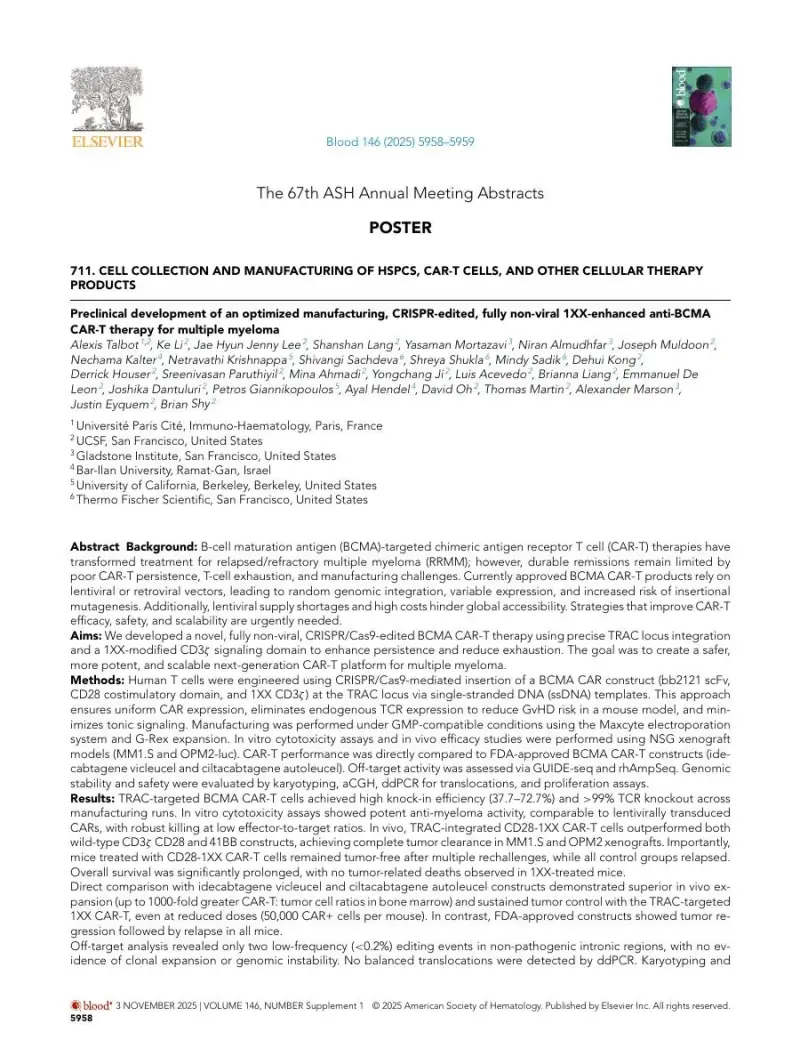
Overview
A fully non-viral, CRISPR-edited anti-BCMA CAR-T uses TRAC integration and a 1XX CD3z domain. It cleared tumors in myeloma xenografts and outperformed ide-cel and cilta-cel constructs. Manufacturing ran under GMP-compatible conditions with MaxCyte electroporation and G-Rex® expansion.
What this paper found
A fully non-viral anti-BCMA CAR-T product was built by using CRISPR/Cas9 to insert the CAR at the TRAC locus with single-stranded DNA templates, combining a CD28 costimulatory domain with a 1XX-modified CD3ζ domain. Across manufacturing runs, knock-in efficiency ranged from 37.7% to 72.7%, with more than 99% TCR knockout. In mouse xenograft models of myeloma, the CD28-1XX cells cleared tumors, stayed tumor-free after repeated rechallenge, and outperformed CD28 wild-type CD3ζ and 41BB constructs. They also kept controlling tumor at 50,000 CAR+ cells per mouse, where constructs modeled on idecabtagene vicleucel and ciltacabtagene autoleucel relapsed. Off-target editing was limited to two low-frequency events, and genomic integrity was confirmed. A first-in-human trial is planned.
Note: Preclinical study in cell-line xenograft mouse models; a first-in-human clinical trial is planned.
This next-generation platform addresses key limitations of currently approved CAR-T products and enables scalable, cost-effective manufacturing without reliance on viral vectors. — Alexis Talbot, Ke Li, Jae Hyun Jenny Lee, Shanshan Lang, Yasaman Mortazavi, Niran Almudhfar, Joseph Muldoon, Nechama Kalter, Netravathi Krishnappa, Shivangi Sachdeva, Shreya Shukla, Mindy Sadik, Dehui Kong, Derrick Houser, Sreenivasan Paruthiyil, Mina Ahmadi, Yongchang Ji, Luis Acevedo, Brianna Liang, Emmanuel De Leon, Joshika Dantuluri, Petros Giannikopoulos, Ayal Hendel, David Oh, Thomas Martin, Alexander Marson, Justin Eyquem, Brian Shy, Blood
Study details
- Authors
- Alexis Talbot, Ke Li, Jae Hyun Jenny Lee, Shanshan Lang, Yasaman Mortazavi, Niran Almudhfar, Joseph Muldoon, Nechama Kalter, Netravathi Krishnappa, Shivangi Sachdeva, Shreya Shukla, Mindy Sadik, Dehui Kong, Derrick Houser, Sreenivasan Paruthiyil, Mina Ahmadi, Yongchang Ji, Luis Acevedo, Brianna Liang, Emmanuel De Leon, Joshika Dantuluri, Petros Giannikopoulos, Ayal Hendel, David Oh, Thomas Martin, Alexander Marson, Justin Eyquem, Brian Shy
- Institution
- Immuno-Haematology, Université Paris Cité, Paris, France · UCSF, San Francisco, United States · Gladstone Institute, San Francisco, United States · Bar-Ilan University, Ramat-Gan, Israel · University of California, Berkeley, Berkeley, United States · Thermo Fischer Scientific, San Francisco, United States
- Journal
- Blood
- Year
- 2025
- Cell type(s)
- CAR T Cells
- Application area
- Hematologic malignancy
- Study phase
- Preclinical
How G-Rex® was used
G-Rex® expansion was used in the manufacturing of TRAC-edited anti-BCMA CAR-T cells, following Maxcyte electroporation to insert the CAR construct. Manufacturing was performed under GMP-compatible conditions. Across manufacturing runs, the process gave knock-in efficiency of 37.7–72.7% and more than 99% TCR knockout.
Explore related
Full citation
Talbot A, Li K, Lee JHJ, et al. Preclinical development of an optimized manufacturing, CRISPR-edited, fully non-viral 1XX-enhanced anti-BCMA CAR-T therapy for multiple myeloma. Blood. 2025;146(Supplement 1):5958-5958.
Building a similar workflow?
Talk to a ScaleReady specialist about how the G-Rex® platform can support your program — from process development to clinical-scale manufacturing.


