
Multi-antigen-targeting T cells in pediatric central nervous system tumors: a phase 1 trial
Overview
This phase 1 trial evaluates the safety and feasibility of multi-antigen-targeting T cells (TAA-T cells) in pediatric CNS tumors. The systemic therapy showed a favorable safety profile and preliminary efficacy. G-Rex®10 and G-Rex®100 devices are explicitly referenced for stimulating T cells during manufacturing.
What this paper found
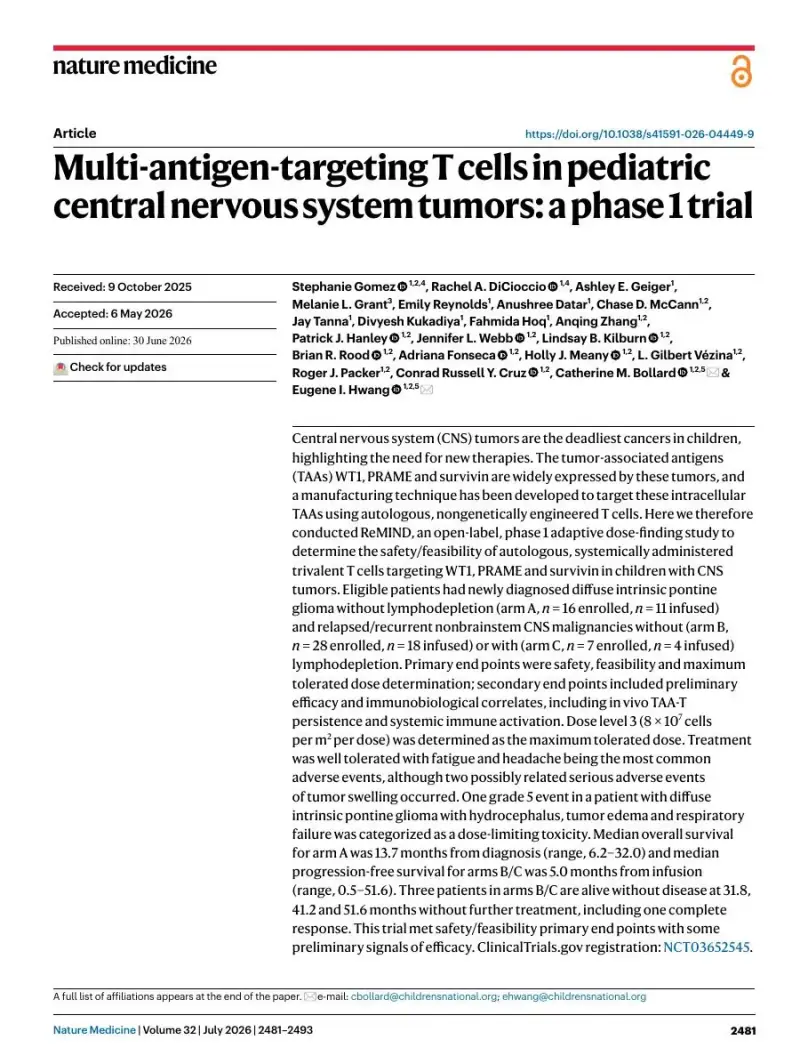
Intravenous autologous T cells targeting WT1, PRAME and survivin were feasible and generally well tolerated in mainly pediatric patients with high-risk central nervous system tumors in the ReMIND phase 1 trial. Of 48 patients who underwent blood procurement, 41 had products manufactured, and 33 were infused across three arms. Dose level 3, 8 × 10^7 cells per m2 per dose, was the model-estimated maximum tolerated dose; 88% of adverse events were low grade, and one grade 5 event in a patient with diffuse intrinsic pontine glioma was a dose-limiting toxicity. Median overall survival in the DIPG arm was 13.7 months from diagnosis. In relapsed arms, three patients were alive without disease at 31.8 to 51.6 months, including one complete response.
Note: Phase 1 study not powered for efficacy; the authors state that conclusions about clinical efficacy must await a more definitive trial.
In this trial, we demonstrated that an autologous multi-antigen TAA-T therapy can generally be manufactured using peripheral blood from pediatric patients with high-risk CNS malignancies. — Stephanie Gomez, Rachel A. DiCioccio, Ashley E. Geiger, Melanie L. Grant, Emily Reynolds, Anushree Datar, Chase D. McCann, Jay Tanna, Divyesh Kukadiya, Fahmida Hoq, Anqing Zhang, Patrick J. Hanley, Jennifer L. Webb, Lindsay B. Kilburn, Brian R. Rood, Adriana Fonseca, Holly J. Meany, L. Gilbert Vézina, Roger J. Packer, Conrad Russell Y. Cruz, Catherine M. Bollard, Eugene I. Hwang, Nature Medicine
Study details
- Authors
- Stephanie Gomez, Rachel A. DiCioccio, Ashley E. Geiger, Melanie L. Grant, Emily Reynolds, Anushree Datar, Chase D. McCann, Jay Tanna, Divyesh Kukadiya, Fahmida Hoq, Anqing Zhang, Patrick J. Hanley, Jennifer L. Webb, Lindsay B. Kilburn, Brian R. Rood, Adriana Fonseca, Holly J. Meany, L. Gilbert Vézina, Roger J. Packer, Conrad Russell Y. Cruz, Catherine M. Bollard, Eugene I. Hwang
- Institution
- Children's National Hospital, Washington, DC, USA · The George Washington University School of Medicine and Health Sciences, Washington, DC, USA · Emory University School of Medicine, Atlanta, GA, USA
- Journal
- Nature Medicine
- Year
- 2026
- G-Rex® model(s)
- G-Rex®10, G-Rex®100
- Cell type(s)
- CTL Cells
- Application area
- Solid tumor
- Study phase
- Phase I
How G-Rex® was used
From March 2021, the TAA-T manufacturing protocol stimulated T cells in G-Rex®10 or G-Rex®100 devices instead of 24-well plates, a change made to improve scalability and yield. This revised process was applied to the latter 18 of 48 procured patients (37.5%). Antigen-specific T cells were generated by co-culturing the nonadherent fraction of PBMCs with peptide-loaded dendritic cells at a 20:1–5:1 ratio, with later stimulations using IL-7 at 10 ng/mL and IL-2 at 100 U/mL. Across all procurement and manufacturing modifications, the median number of doses available at DL1 per run rose from 3.8 to 11.0.
Explore related

Full citation
Gomez S, DiCioccio RA, Geiger AE, et al. Multi-antigen-targeting T cells in pediatric central nervous system tumors: a phase 1 trial. Nat Med. 2026;32(7):2481-2493.
Building a similar workflow?
Talk to a ScaleReady specialist about how the G-Rex® platform can support your program — from process development to clinical-scale manufacturing.


