
Autologous Monocyte-Derived Dendritic Cells (MoDC) Manufactured in the Same Device as Antigen Presenting Cells (APC) for the Production of Tumor-Associated Antigen-Specific T Cells (TAAT) in the Same Device
Overview
This study demonstrates a process to manufacture Tumor-Associated Antigen-Specific T Cells (TAAT) by priming naïve T cells with MoDC directly in G-Rex® devices. This closed-system approach eliminates the need for MoDC harvest and restimulation, yielding clinical doses from small blood volumes.
What this paper found
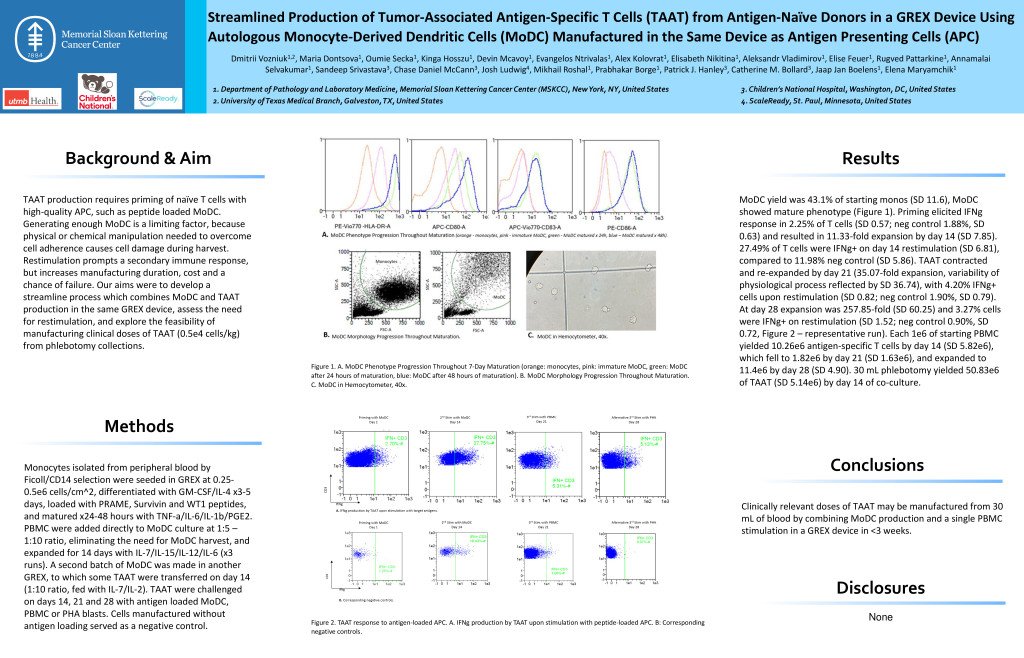
Monocyte-derived dendritic cells and tumor-associated antigen-specific T cells (TAAT) can be produced one after the other in a single GREX device, avoiding the harvest of adherent dendritic cells. Monocytes seeded at 0.25–0.5e6 cells/cm² were differentiated with GM-CSF/IL-4, loaded with PRAME, Survivin and WT1 peptides, and matured; PBMC were then added directly at a 1:5 to 1:10 ratio and expanded for 14 days. Dendritic cell yield was 43.1% of starting monocytes. T cells expanded 11.33-fold by day 14, with 27.49% IFNg-positive upon restimulation versus 11.98% in negative control. By day 28 expansion reached 257.85-fold. Thirty milliliters of blood yielded 50.83e6 TAAT by day 14, suggesting clinically relevant doses are possible in under three weeks.
Clinically relevant doses of TAAT may be manufactured from 30 mL of blood by combining MoDC production and a single PBMC stimulation in a GREX device in <3 weeks. — Dmitrii Vozniuk, Maria Dontsova, Oumie Secka, Kinga Hosszu, Devin Mcavoy, Evangelos Ntrivalas, Alex Kolovrat, Elisabeth Nikitina, Aleksandr Vladimirov, Elise Feuer, Rugved Pattarkine, Annamalai Selvakumar, Sandeep Srivastava, Chase Daniel McCann, Josh Ludwig, Mikhail Roshal, Prabhakar Borge, Patrick J. Hanley, Catherine M. Bollard, Jaap Jan Boelens, Elena Maryamchik
Study details
- Authors
- Dmitrii Vozniuk, Maria Dontsova, Oumie Secka, Kinga Hosszu, Devin Mcavoy, Evangelos Ntrivalas, Alex Kolovrat, Elisabeth Nikitina, Aleksandr Vladimirov, Elise Feuer, Rugved Pattarkine, Annamalai Selvakumar, Sandeep Srivastava, Chase Daniel McCann, Josh Ludwig, Mikhail Roshal, Prabhakar Borge, Patrick J. Hanley, Catherine M. Bollard, Jaap Jan Boelens, Elena Maryamchik
- Institution
- Department of Pathology and Laboratory Medicine, Memorial Sloan Kettering Cancer Center (MSKCC), New York, NY, United States · University of Texas Medical Branch, Galveston, TX, United States · Children’s National Hospital, Washington, DC, United States · ScaleReady, St. Paul, Minnesota, United States
- Year
- 2025
- Cell type(s)
- CTL Cells
- Study phase
- Preclinical
How G-Rex® was used
Monocytes isolated from peripheral blood by Ficoll/CD14 selection were seeded in a GREX device at 0.25–0.5e6 cells/cm², differentiated with GM-CSF/IL-4 for 3–5 days, loaded with PRAME, Survivin and WT1 peptides, and matured for 24–48 hours with TNF-a/IL-6/IL-1b/PGE2. PBMC were added directly to the dendritic cell culture at a 1:5 to 1:10 ratio and expanded for 14 days with IL-7/IL-15/IL-12/IL-6 in three runs. A second batch of MoDC was made in another GREX, to which some TAAT were transferred on day 14 at a 1:10 ratio and fed with IL-7/IL-2. Expansion reached 11.33-fold at day 14 and 257.85-fold at day 28.
Building a similar workflow?
Talk to a ScaleReady specialist about how the G-Rex® platform can support your program — from process development to clinical-scale manufacturing.


