
Clinical manufacture of CRISPR/ Cas9-based cytokine-induced SH2 protein knock-out tumor-infiltrating lymphocytes for gastrointestinal cancers
Overview
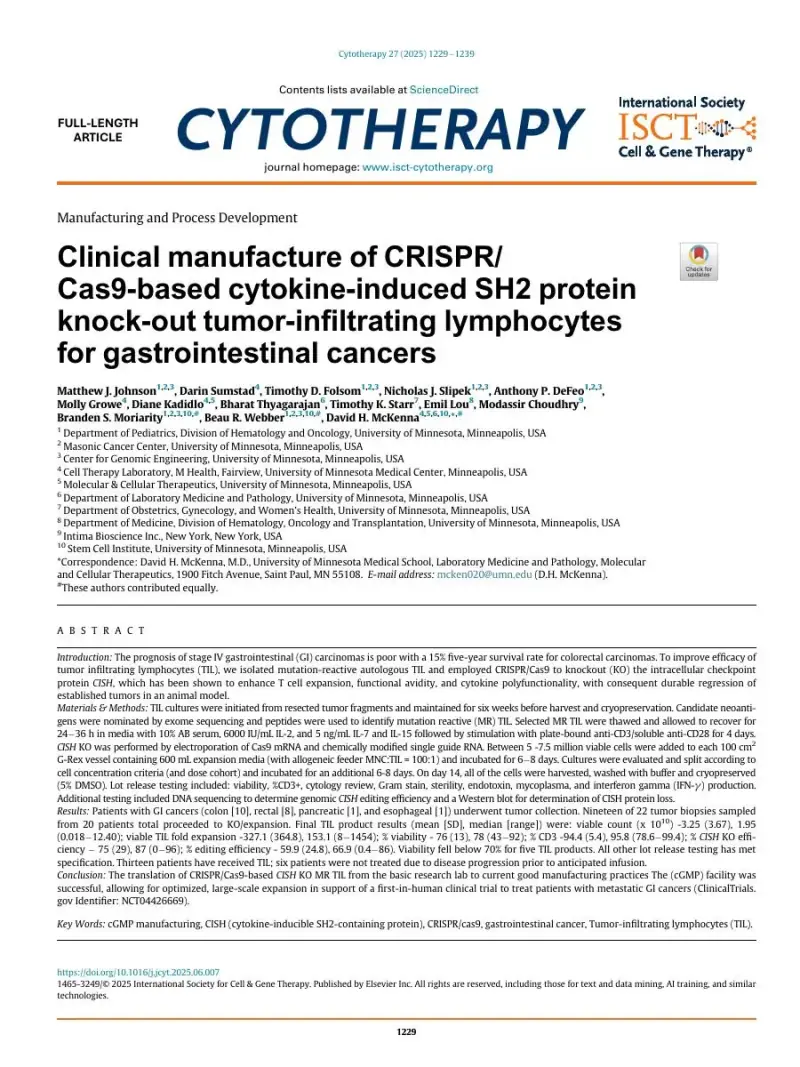
This paper details the GMP manufacturing of CISH KO TILs for GI cancers. Tumor fragments were outgrown in 24-well G-Rex® plates, and selected TILs were expanded in 100 cm² G-Rex® vessels. An automated liquid handling system was developed to perform media exchanges directly in the G-Rex® 24 plates.
What this paper found
Autologous tumor-infiltrating lymphocytes selected for mutation reactivity and edited by CRISPR/Cas9 to knock out the checkpoint protein CISH were successfully manufactured under cGMP for patients with metastatic gastrointestinal cancers. Tumor fragments were grown in 24-well G-Rex® plates for six weeks, screened for neoantigen reactivity, stimulated, electroporated with Cas9 mRNA and guide RNA, and expanded for 14 days with irradiated feeder cells in 100 cm2 G-Rex® vessels holding 600 mL. Nineteen of 22 tumor samples, from 20 patients, proceeded to editing and expansion, and 13 patients received TIL. Final products had mean viability of 76%, mean CD3 of 94.4%, and mean viable TIL fold expansion of 327.1; five products fell below 70% viability.
Note: Six patients were not treated because their disease progressed before the planned infusion.
Thus, when feasible a large section of tumor with high viability should be used for fragment generation. — Matthew J. Johnson, Darin Sumstad, Timothy D. Folsom, Nicholas J. Slipek, Anthony P. DeFeo, Molly Growe, Diane Kadidlo, Bharat Thyagarajan, Timothy K. Starr, Emil Lou, Modassir Choudhry, Branden S. Moriarity, Beau R. Webber, David H. McKenna, Cytotherapy
Study details
- Authors
- Matthew J. Johnson, Darin Sumstad, Timothy D. Folsom, Nicholas J. Slipek, Anthony P. DeFeo, Molly Growe, Diane Kadidlo, Bharat Thyagarajan, Timothy K. Starr, Emil Lou, Modassir Choudhry, Branden S. Moriarity, Beau R. Webber, David H. McKenna
- Institution
- Department of Pediatrics, Division of Hematology and Oncology, University of Minnesota, Minneapolis, USA · Masonic Cancer Center, University of Minnesota, Minneapolis, USA · Center for Genomic Engineering, University of Minnesota, Minneapolis, USA · Cell Therapy Laboratory, M Health, Fairview, University of Minnesota Medical Center, Minneapolis, USA · Molecular & Cellular Therapeutics, University of Minnesota, Minneapolis, USA · Department of Laboratory Medicine and Pathology, University of Minnesota, Minneapolis, USA · Department of Obstetrics, Gynecology, and Women’s Health, University of Minnesota, Minneapolis, USA · Department of Medicine, Division of Hematology, Oncology and Transplantation, University of Minnesota, Minneapolis, USA · Intima Bioscience Inc., New York, New York, USA · Stem Cell Institute, University of Minnesota, Minneapolis, USA
- Journal
- Cytotherapy
- Year
- 2025
- PMID / PMC
- PMID: 40673842
- G-Rex® model(s)
- G-Rex®100M, G-Rex®24 Well Plate
- Cell type(s)
- TIL Cells
- Application area
- Solid tumor
How G-Rex® was used
Tumor fragments were seeded at 1-2 per well in 24-well G-Rex® culture plates (up to 48 wells) and grown for six weeks to outgrow TIL. After mutation-reactive TIL were selected, thawed, stimulated and CISH-edited, 5-7.5 million viable cells with irradiated feeder cells were added to each 100 cm2 G-Rex® vessel containing 600 mL expansion medium and incubated for 6-8 days. Cultures were then split into 2 or 5 additional vessels with fresh medium according to cell density and incubated for a further 6-8 days, with harvest on day 14.
Explore related

Full citation
Johnson MJ, Sumstad D, Folsom TD, et al. Clinical manufacture of CRISPR/Cas9-based cytokine-induced SH2 protein knock-out tumor-infiltrating lymphocytes for gastrointestinal cancers. Cytotherapy. 2025;27(10):1229-1239.
Building a similar workflow?
Talk to a ScaleReady specialist about how the G-Rex® platform can support your program — from process development to clinical-scale manufacturing.


