
Good manufacturing practice production of an off-the-shelf CD34+ progenitor-derived NK cell product with preserved anti-tumor functionality post-infusion in NOD/SCID/IL2Rgnull mice
Overview
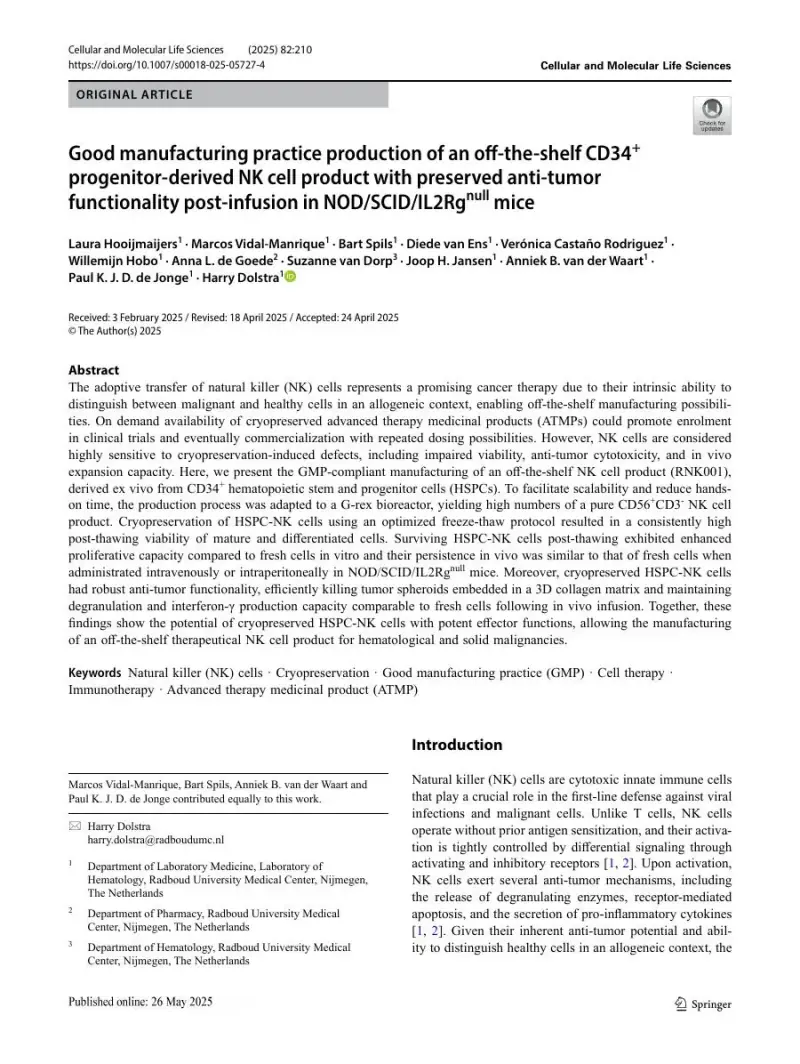
This study presents a GMP-compliant process for manufacturing off-the-shelf NK cells from CD34+ HSPCs. The protocol was adapted to G-Rex® 10M and 100M to facilitate scaling and reduce handling. The resulting NK cells showed high recovery, viability, and potent anti-tumor activity in vivo and in vitro.
What this paper found
Umbilical cord blood CD34+ progenitor-derived NK cells (RNK001) were produced under GMP in G-rex bioreactors and cryopreserved into an off-the-shelf product that kept anti-tumor function after infusion in mice. Cells were expanded in a G-rex 10M for nine days, then a G-rex 100M, with six medium additions, reaching a mean 767-fold expansion and 1.4–2.4 × 10^9 CD56+CD3- cells in the validation runs. After controlled-rate freezing in CryoStor CS10, mean post-thaw viability was 67% and recovery 75%. Thawed cells lysed SKOV-3 spheroids in 3D collagen comparably to fresh cells. In NXG mice, thawed cells persisted similarly to fresh cells after intraperitoneal or intravenous infusion and showed comparable IFNγ production, with higher degranulation.
Note: The in vivo experiments used non-tumor-bearing mice, and the authors note that cryopreservation reduced the viable HSPC-NK cell dosage.
Overall, these findings demonstrate that cryopreserved HSPC-NK cells exhibit in vivo persistence following both i.p. and i.v. administration. — Laura Hooijmaijers, Marcos Vidal-Manrique, Bart Spils, Diede van Ens, Verónica Castaño Rodriguez, Willemijn Hobo, Anna L. de Goede, Suzanne van Dorp, Joop H. Jansen, Anniek B. van der Waart, Paul K. J. D. de Jonge, Harry Dolstra, Cellular and Molecular Life Sciences
Study details
- Authors
- Laura Hooijmaijers, Marcos Vidal-Manrique, Bart Spils, Diede van Ens, Verónica Castaño Rodriguez, Willemijn Hobo, Anna L. de Goede, Suzanne van Dorp, Joop H. Jansen, Anniek B. van der Waart, Paul K. J. D. de Jonge, Harry Dolstra
- Institution
- Department of Laboratory Medicine, Laboratory of Hematology, Radboud University Medical Center, Nijmegen, The Netherlands · Department of Pharmacy, Radboud University Medical Center, Nijmegen, The Netherlands · Department of Hematology, Radboud University Medical Center, Nijmegen, The Netherlands
- Journal
- Cellular and Molecular Life Sciences
- Year
- 2025
- G-Rex® model(s)
- G-Rex®100M, G-Rex®100M-CS, G-Rex®10M, G-Rex®10M-CS
- Cell type(s)
- NK Cells
- Application area
- Hematologic malignancy · Solid tumor
- Study phase
- Preclinical
How G-Rex® was used
HSPC-NK cell manufacturing was adapted to G-rex bioreactors with six standardized medium additions. CD34+ HSPCs from umbilical cord blood were expanded for the first nine days in a G-rex 10M(-CS), then transferred to a G-rex 100M(-CS). The 35-day process was validated in one research-grade and three GMP runs, reaching a mean 767-fold expansion and 1.4–2.4 × 10^9 CD56+CD3- cells.
Note: Compared with bag culture, which needed medium additions every two to three days, the G-rex process needed only six additions over the whole culture.
Explore related

Full citation
Hooijmaijers L, Vidal-Manrique M, Spils B, et al. Good manufacturing practice production of an off-the-shelf CD34+ progenitor-derived NK cell product with preserved anti-tumor functionality post-infusion in NOD/SCID/IL2Rgnull mice. Cell Mol Life Sci. 2025;82(1):210.
Building a similar workflow?
Talk to a ScaleReady specialist about how the G-Rex® platform can support your program — from process development to clinical-scale manufacturing.


