
Proteasome inhibition enhances the anti-leukemic efficacy of chimeric antigen receptor (CAR) expressing NK cells against acute myeloid leukemia
Overview
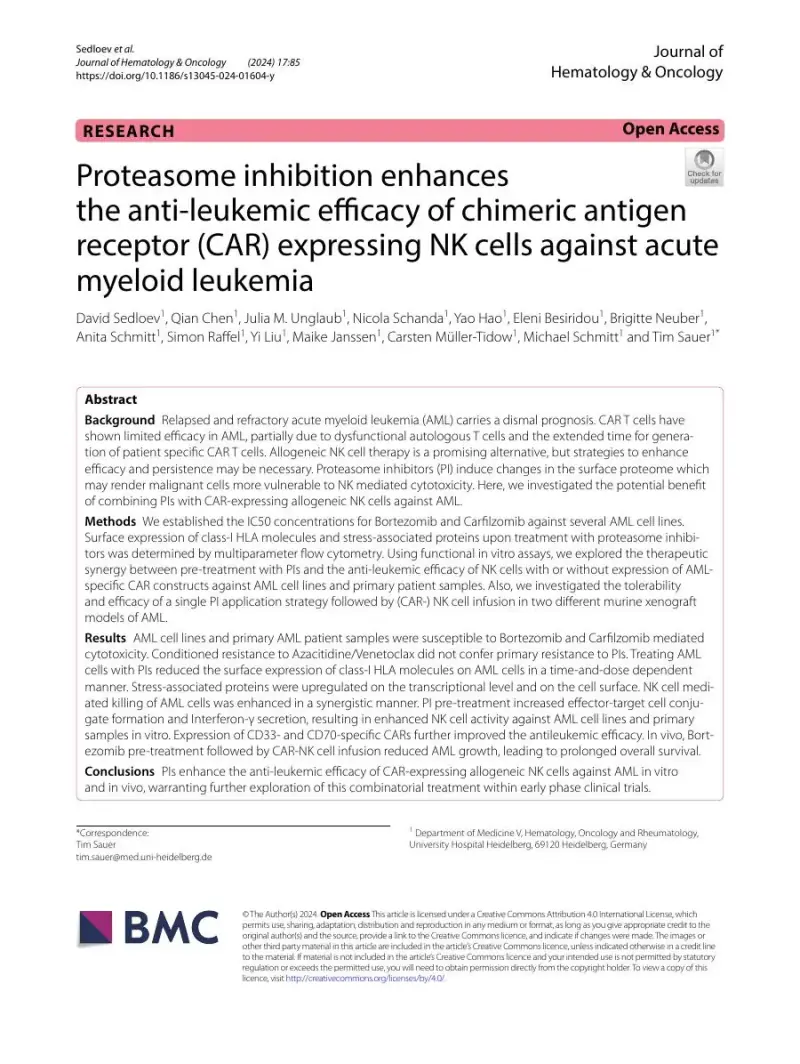
This study demonstrates that proteasome inhibitors sensitize AML cells to NK cell killing. NK cells were activated by co-culture with irradiated feeder cells in G-Rex® 10 vessels. The combination of bortezomib pre-treatment and CAR-NK infusion significantly delayed tumor growth and prolonged survival in xenograft models.
What this paper found
Pre-treating acute myeloid leukemia cells with the proteasome inhibitors Bortezomib or Carfilzomib made them markedly more vulnerable to killing by allogeneic, feeder-cell-activated NK cells, and adding a CD33- or CD70-directed CAR increased that effect further. Twenty-four hours of inhibitor exposure lowered class-I HLA surface expression, raised stress-associated protein transcripts and surface levels by 48 hours, and increased NK-AML conjugate formation and interferon-gamma release. Combinatorial indices above one confirmed synergy against cell lines and six primary patient samples. In murine xenografts, a single Bortezomib dose followed one day later by activated NK cells extended median survival from 18,5 to 33,5 days, and in two models Bortezomib pre-treatment plus CD33- or CD70-CAR-NK infusion outperformed CAR-NK cells alone.
Note: In vitro and murine study; the authors note that proteasome inhibitor treatment followed by a single CAR-NK cell infusion was not curative in any of their in vivo models, and that more durable responses would likely require an endogenous stimulating cassette, multiple NK infusions or both.
Our study provides evidence that pre-treatment of AML cells with proteasome inhibitors in combination with subsequent CAR-NK cell application is a novel and promising therapeutic strategy for patients with AML. — David Sedloev, Qian Chen, Julia M. Unglaub, Nicola Schanda, Yao Hao, Eleni Besiridou, Brigitte Neuber, Anita Schmitt, Simon Raffel, Yi Liu, Maike Janssen, Carsten Müller-Tidow, Michael Schmitt, Tim Sauer, Journal of Hematology & Oncology
Study details
- Authors
- David Sedloev, Qian Chen, Julia M. Unglaub, Nicola Schanda, Yao Hao, Eleni Besiridou, Brigitte Neuber, Anita Schmitt, Simon Raffel, Yi Liu, Maike Janssen, Carsten Müller-Tidow, Michael Schmitt, Tim Sauer
- Institution
- Department of Medicine V, Hematology, Oncology and Rheumatology, University Hospital Heidelberg, Heidelberg, Germany
- Journal
- Journal of Hematology & Oncology
- Year
- 2024
- G-Rex® model(s)
- G-Rex®10
- Cell type(s)
- NK Cells
- Application area
- Hematologic malignancy
- Study phase
- Preclinical
How G-Rex® was used
T-cell-depleted peripheral blood mononuclear cells were activated for four days in a G-Rex® 10 vessel by co-culture with irradiated K562-derived feeder cells, and were then transduced on RetroNectin-coated 24-well plates. rhIL-15 was added at regular intervals to a final concentration of 10 ng/ml and the growing cultures were split on days 7, 10 and 14 of production. The protocol expanded peripheral blood NK cells a median of 2200-fold within 14 days, and the resulting NK and CAR-NK products were used in functional assays between days 14 and 17.
Explore related

Full citation
Sedloev D, Chen Q, Unglaub JM, et al. Proteasome inhibition enhances the anti-leukemic efficacy of chimeric antigen receptor (CAR) expressing NK cells against acute myeloid leukemia. J Hematol Oncol. 2024;17(1):85.
Building a similar workflow?
Talk to a ScaleReady specialist about how the G-Rex® platform can support your program — from process development to clinical-scale manufacturing.


