
Assessing a single-cell multi-omic analytic platform to characterize ex vivo-engineered T-cell therapy products
Overview
This study utilized the Tapestri platform to characterize CRISPR-Cas9 engineered CD8+ T cells targeting TRAC and TRBC loci. Activated T cells were nucleofected and cultured in 24-well G-Rex® plates for 7 days. The analysis quantified on-target edits, off-target events, and translocations with single-cell granularity.
What this paper found
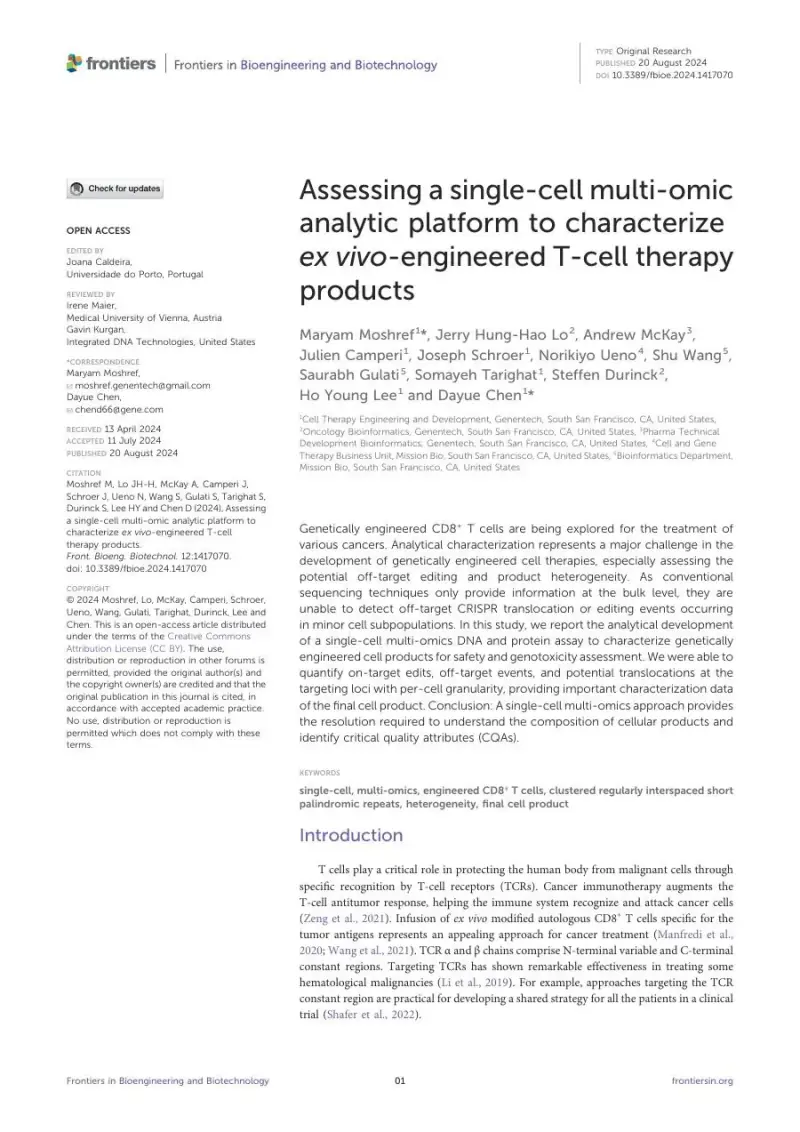
Single-cell DNA and surface-protein sequencing resolved on-target edits, off-target editing and chromosomal translocations cell by cell in CRISPR–Cas9-engineered CD8+ T-cell products. T cells from four healthy donors were edited to knock out TRAC, TRBC1 and TRBC2, expanded for 7 days and profiled on the Tapestri platform with 40 custom amplicons and 14 oligo-conjugated antibodies, sequencing at least 4,000 cells per run. TRAC editing ranged from 50% to 82% across donors, whereas triple mono-allelic and triple bi-allelic edits each occurred in only 2% to 5% of cells. One TRAC off-target site (TRAC-OT2) was edited more often in cells with bi-allelic TRAC edits. Four TRAC–TRBC translocations were detected, none in unedited controls, with most breakpoints inside the 20-bp editing windows. Edits were distributed across CD8 T-cell subsets without bias.
Note: In vitro study of edited T cells from four healthy donors; the authors note that the results are still an estimate of the true heterogeneity and that higher cell numbers, broader genome coverage and longer amplicons will be needed.
Most importantly, this study uncovered four putative translocations across the on-target loci, which is a direct safety attribute. — Maryam Moshref, Jerry Hung-Hao Lo, Andrew McKay, Julien Camperi, Joseph Schroer, Norikiyo Ueno, Shu Wang, Saurabh Gulati, Somayeh Tarighat, Steffen Durinck, Ho Young Lee, Dayue Chen, Frontiers in Bioengineering and Biotechnology
Study details
- Authors
- Maryam Moshref, Jerry Hung-Hao Lo, Andrew McKay, Julien Camperi, Joseph Schroer, Norikiyo Ueno, Shu Wang, Saurabh Gulati, Somayeh Tarighat, Steffen Durinck, Ho Young Lee, Dayue Chen
- Institution
- Cell Therapy Engineering and Development, Genentech, South San Francisco, CA, United States · Oncology Bioinformatics, Genentech, South San Francisco, CA, United States · Pharma Technical Development Bioinformatics, Genentech, South San Francisco, CA, United States · Cell and Gene Therapy Business Unit, Mission Bio, South San Francisco, CA, United States · Bioinformatics Department, Mission Bio, South San Francisco, CA, United States
- Journal
- Frontiers in Bioengineering and Biotechnology
- Year
- 2024
- G-Rex® model(s)
- G-Rex®24 Well Plate
- Cell type(s)
- T-Cells
- Application area
- Other
- Study phase
- Preclinical
How G-Rex® was used
After CRISPR–Cas9 nucleofection of activated CD8+ T cells (2 million cells per 20 μL reaction with TRAC and TRBC RNPs), the cells were rested for 15 min at room temperature and expanded for 7 days at 37 °C in a 24-well G-Rex® plate (Wilson Wolf). The expansion medium was PRIME-XV supplemented with 25 ng/mL IL-7 and 50 ng/mL IL-15. The expanded cells were then cryopreserved in CryoStor CS10 until single-cell library preparation.
Explore related

Full citation
Moshref M, Lo JH, McKay A, et al. Assessing a single-cell multi-omic analytic platform to characterize ex vivo-engineered T-cell therapy products. Front Bioeng Biotechnol. 2024;12:1417070.
Building a similar workflow?
Talk to a ScaleReady specialist about how the G-Rex® platform can support your program — from process development to clinical-scale manufacturing.


