
In silico and pharmacological evaluation of GPR65 as a cancer immunotherapy target regulating T-cell functions
Overview
The study evaluates GPR65 as a target. TCR-T cells (NY-ESO1 or MAGE-A4) were produced in G-Rex® 6 Well Plate systems.
What this paper found
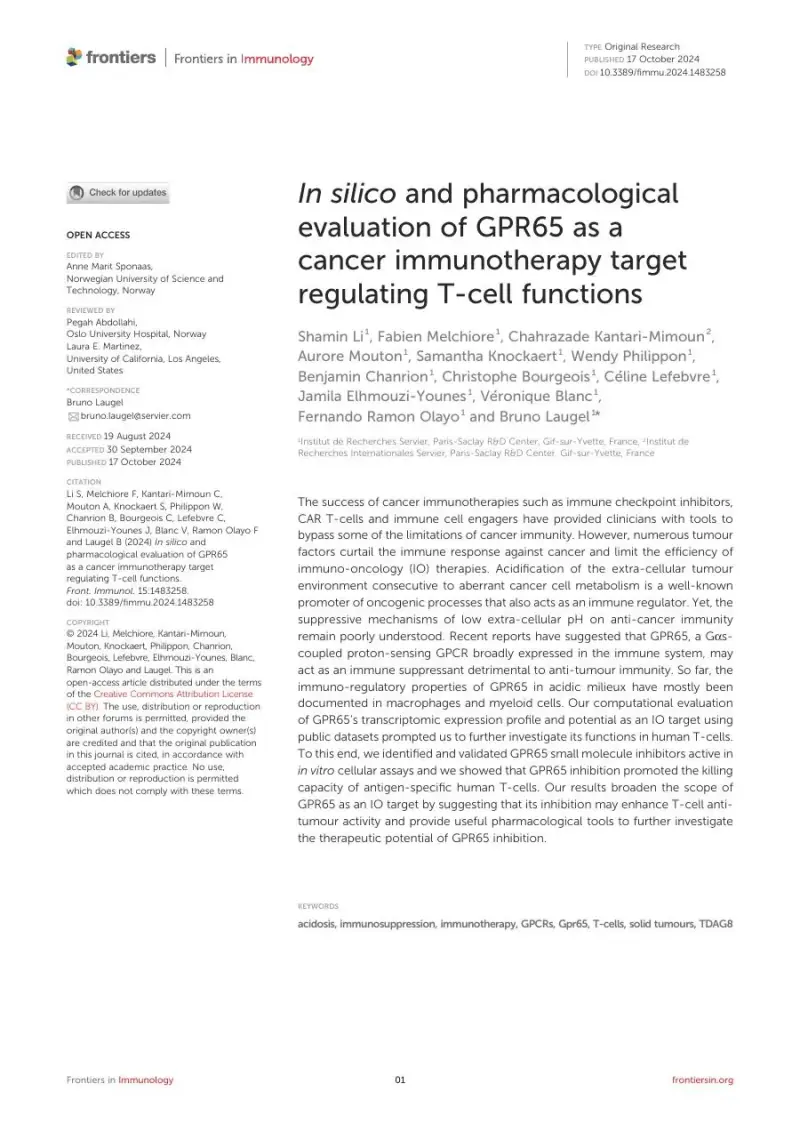
Inhibiting the proton-sensing receptor GPR65 enhanced the anti-tumour activity of antigen-specific human T-cells in vitro. Analysis of public TCGA and single-cell datasets showed that tumour-infiltrating CD8+ T-cells express GPR65 mRNA, and that homozygosity for the partial loss-of-function variant rs3742704 correlated with better survival in patients diagnosed at early stages. In co-cultures of NY-ESO1 or MAGE-A4 TCR T-cells with A375 melanoma cells, GPR65 agonists reduced killing. Four small-molecule antagonists were validated by blocking pH-dependent cAMP induction. SD2758 and SD2571 increased tumour cell killing, maintained over 10 days with rechallenges, and SD2758 raised IFN-γ and TNF-α secretion.
Note: The work is in vitro; the authors note that off-target effects of the antagonists cannot be fully excluded and that further validation, including genetic knock-out studies, is needed.
Our results broaden the scope of GPR65 as an IO target by suggesting that its inhibition may enhance T-cell anti tumour activity and provide useful pharmacological tools to further investigate the therapeutic potential of GPR65 inhibition. — Shamin Li, Fabien Melchiore, Chahrazade Kantari-Mimoun, Aurore Mouton, Samantha Knockaert, Wendy Philippon, Benjamin Chanrion, Christophe Bourgeois, Céline Lefebvre, Jamila Elhmouzi-Younes, Véronique Blanc, Fernando Ramon Olayo, Bruno Laugel, Frontiers in Immunology
Study details
- Authors
- Shamin Li, Fabien Melchiore, Chahrazade Kantari-Mimoun, Aurore Mouton, Samantha Knockaert, Wendy Philippon, Benjamin Chanrion, Christophe Bourgeois, Céline Lefebvre, Jamila Elhmouzi-Younes, Véronique Blanc, Fernando Ramon Olayo, Bruno Laugel
- Institution
- Institut de Recherches Servier, Paris-Saclay R&D Center, Gif-sur-Yvette, France · Institut de Recherches Internationales Servier, Paris-Saclay R&D Center, Gif-sur-Yvette, France
- Journal
- Frontiers in Immunology
- Year
- 2024
- G-Rex® model(s)
- G-Rex®6 Well Plate
- Cell type(s)
- TCR T Cells
- Application area
- Solid tumor
- Study phase
- Preclinical
How G-Rex® was used
NY-ESO1 and MAGE-A4 TCR T-cells were produced in the G-Rex® 6 Well Plate system. Peripheral blood T cells, enriched by CD14 depletion, were seeded on day 0 at 1E6 cells per ml in X-Vivo15 with 10% human AB serum, T-cell TransAct and 25 ng/ml IL-2. They were transduced on day 1 with lentivirus encoding the TCR. Medium was renewed two days later, and 25 ng/ml IL-2 was added on days 1, 5, 7, 9 and 12. TCR expression and phenotype were checked by flow cytometry on days 5 and 14 before killing assays or freezing.
Explore related

Full citation
Li S, Melchiore F, Kantari-Mimoun C, et al. In silico and pharmacological evaluation of GPR65 as a cancer immunotherapy target regulating T-cell functions. Front Immunol. 2024;15:1483258.
Building a similar workflow?
Talk to a ScaleReady specialist about how the G-Rex® platform can support your program — from process development to clinical-scale manufacturing.


