
synNotch-programmed iPSC-derived NK cells usurp TIGIT and CD73 activities for glioblastoma therapy
Overview
The study develops synNotch-programmed iPSC-NK cells to target CD155 and CD73 in glioblastoma. Cells were expanded for 2-3 weeks in G-Rex® 24 well plates using NK Xpander medium.
What this paper found
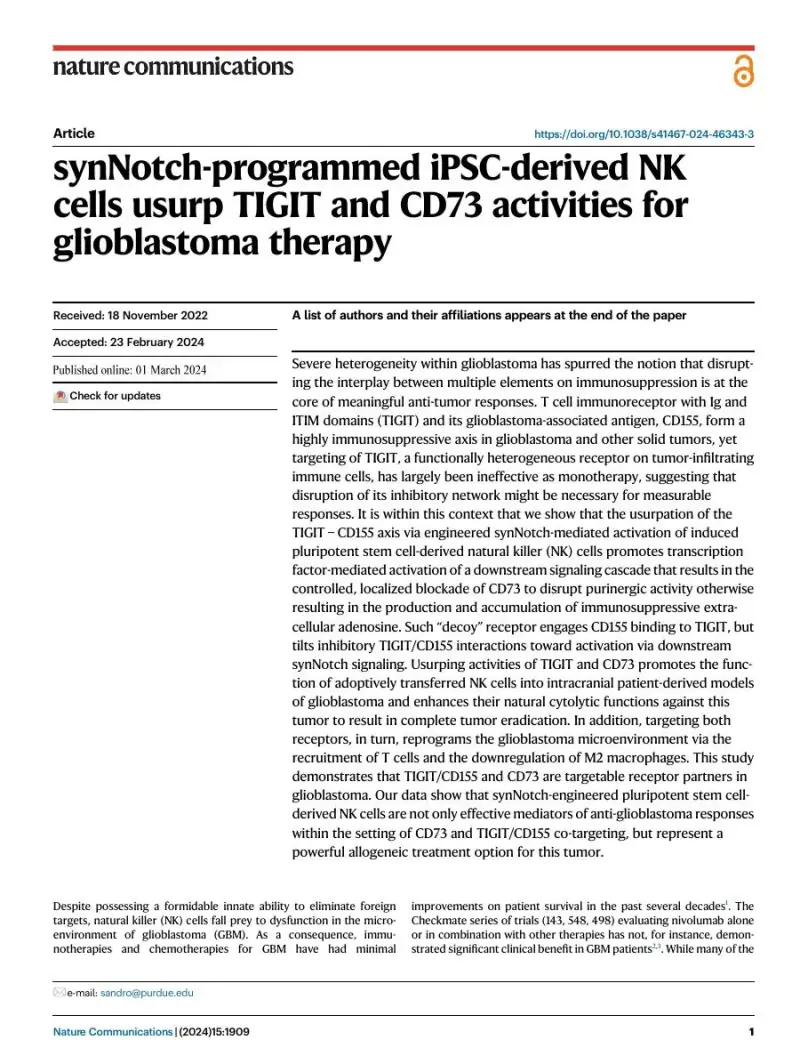
Induced pluripotent stem cell-derived NK cells engineered with a synNotch circuit that senses CD155 through a TIGIT ligand and releases an anti-CD73 scFv showed strong activity against glioblastoma in preclinical models. Engineered cells expanded at rates similar to unmodified cells and reached more than 80% NK purity after two weeks of expansion. In vitro, they lysed CD155+CD73+ GBM43 cells at significantly higher levels than unmodified iNK cells. In NSG mice carrying intracranial GBM43-luciferase tumors, three weekly intracranial doses of 2 × 10^6 engineered cells sharply reduced tumor growth and improved survival compared with PBS or unmodified cells. In immunocompetent mice, combined anti-CD155 and anti-CD73 antibodies slowed GL261 tumor growth more than either antibody alone.
Note: Preclinical mouse study; NK cells given intravenously were not detected in the brain tumor regions, so efficacy depended on intracranial administration.
This study demonstrates that TIGIT/CD155 and CD73 are targetable receptor partners in glioblastoma. — Kyle B. Lupo, Xue Yao, Shambhavi Borde, Jiao Wang, Sandra Torregrosa-Allen, Bennett D. Elzey, Sagar Utturkar, Nadia A. Lanman, MacKenzie McIntosh, Sandro Matosevic, Nature Communications
Study details
- Authors
- Kyle B. Lupo, Xue Yao, Shambhavi Borde, Jiao Wang, Sandra Torregrosa-Allen, Bennett D. Elzey, Sagar Utturkar, Nadia A. Lanman, MacKenzie McIntosh, Sandro Matosevic
- Institution
- Department of Industrial and Molecular Pharmaceutics, Purdue University, West Lafayette, IN, USA · Institute for Cancer Research, Purdue University, West Lafayette, IN, USA · Department of Comparative Pathobiology, Purdue University, West Lafayette, IN, USA · Histology Research Laboratory, Center for Comparative Translational Research, College of Veterinary Medicine, Purdue University, West Lafayette, IN, USA
- Journal
- Nature Communications
- Year
- 2024
- G-Rex® model(s)
- G-Rex®24 Well Plate
- Cell type(s)
- NK Cells
- Application area
- Solid tumor
- Study phase
- Preclinical
How G-Rex® was used
Engineered and non-engineered iPSC-derived NK cells were expanded in a 24-well G-Rex® plate (catalog 80192M) after 4 weeks of NK cell differentiation. Expansion ran for two to three weeks in CTS NK Xpander medium supplemented with 5% human AB serum, 1% penicillin/streptomycin and 500 IU/mL rhIL-2, and expansion was assessed by trypan blue staining. After 2 weeks of expansion, both engineered and wild-type iNK cells reached NK purity above 80%, and engineered cells expanded at rates similar to non-engineered cells while maintaining high viability. The expanded cells were then used in cytotoxicity, degranulation and cytokine assays.
Explore related

Full citation
Lupo KB, Yao X, Borde S, et al. synNotch-programmed iPSC-derived NK cells usurp TIGIT and CD73 activities for glioblastoma therapy. Nat Commun. 2024;15(1):1909.
Building a similar workflow?
Talk to a ScaleReady specialist about how the G-Rex® platform can support your program — from process development to clinical-scale manufacturing.


