
Generation of allogeneic CAR-NKT cells from hematopoietic stem and progenitor cells using a clinically guided culture method
Overview
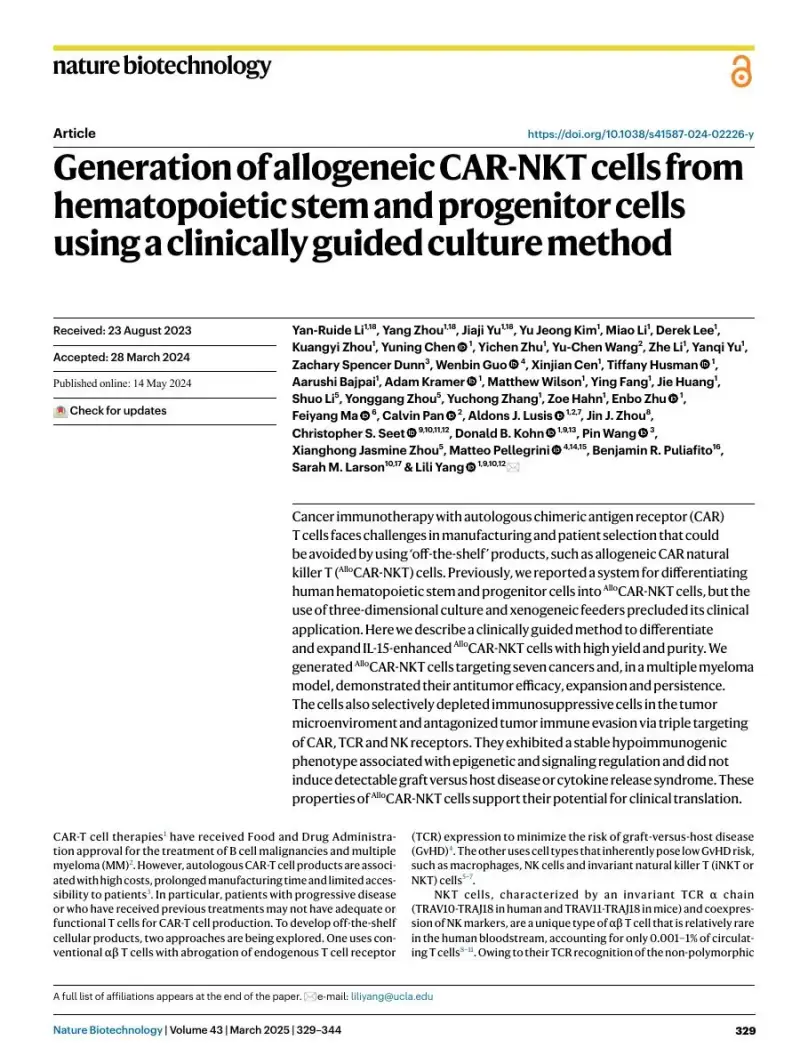
The paper describes a feeder-free method to generate AlloCAR-NKT cells from HSPCs. G-Rex® 6M well plates were used for the expansion stage (stage 4) of the NKT cell culture.
What this paper found
A feeder-free, serum-free, five-stage culture of about six weeks differentiates gene-engineered cord-blood CD34+ hematopoietic stem and progenitor cells into IL-15-enhanced allogeneic CAR-NKT cells, with more than a 10^6-fold expansion from input HSPCs to mature cells. Cells were generated from 15 cord-blood donors with CARs against BCMA, CD19, GD2, GPC3 and EGFRvIII. In a mouse multiple myeloma xenograft model, a single dose of 10 × 10^6 BCMA-CAR cells with IL-15 eliminated tumor in nine of ten mice and all experimental mice survived beyond 80 days, whereas BCAR-T-treated mice died of tumor growth and GvHD. The cells selectively depleted tumor-associated macrophages and MDSCs, which express high CD1d, produced minimal IFNγ in graft-versus-host assays, and carried lower surface HLA-I and HLA-II than conventional CAR-T cells.
Note: Preclinical study in vitro and in mice; the authors note that MLR assays may not predict allorejection in the clinic and that clinical investigation is needed.
Under a heavy tumor load condition, a single administration of Allo15BCAR-NKT cells achieved tumor elimination in most (nine out of ten) experimental mice and long-term (>80 days) survival of all experimental mice — Yan-Ruide Li, Yang Zhou, Jiaji Yu, Yu Jeong Kim, Miao Li, Derek Lee, Kuangyi Zhou, Yuning Chen, Yichen Zhu, Yu-Chen Wang, Zhe Li, Yanqi Yu, Zachary Spencer Dunn, Wenbin Guo, Xinjian Cen, Tiffany Husman, Aarushi Bajpai, Adam Kramer, Matthew Wilson, Ying Fang, Jie Huang, Shuo Li, Yonggang Zhou, Yuchong Zhang, Zoe Hahn, Enbo Zhu, Feiyang Ma, Calvin Pan, Aldons J. Lusis, Jin J. Zhou, Christopher S. Seet, Donald B. Kohn, Pin Wang, Xianghong Jasmine Zhou, Matteo Pellegrini, Benjamin R. Puliafito, Sarah M. Larson, Lili Yang, Nature Biotechnology
Study details
- Authors
- Yan-Ruide Li, Yang Zhou, Jiaji Yu, Yu Jeong Kim, Miao Li, Derek Lee, Kuangyi Zhou, Yuning Chen, Yichen Zhu, Yu-Chen Wang, Zhe Li, Yanqi Yu, Zachary Spencer Dunn, Wenbin Guo, Xinjian Cen, Tiffany Husman, Aarushi Bajpai, Adam Kramer, Matthew Wilson, Ying Fang, Jie Huang, Shuo Li, Yonggang Zhou, Yuchong Zhang, Zoe Hahn, Enbo Zhu, Feiyang Ma, Calvin Pan, Aldons J. Lusis, Jin J. Zhou, Christopher S. Seet, Donald B. Kohn, Pin Wang, Xianghong Jasmine Zhou, Matteo Pellegrini, Benjamin R. Puliafito, Sarah M. Larson, Lili Yang
- Institution
- Department of Microbiology, Immunology and Molecular Genetics, University of California, Los Angeles, Los Angeles, CA, USA · Department of Medicine, Division of Cardiology, University of California, Los Angeles, Los Angeles, CA, USA · Mork Family Department of Chemical Engineering and Materials Science, University of Southern California, Los Angeles, CA, USA · Bioinformatics Interdepartmental Program, University of California, Los Angeles, Los Angeles, CA, USA · Department of Pathology and Laboratory Medicine, University of California, Los Angeles, Los Angeles, CA, USA · Department of Cell and Developmental Biology, Feinberg School of Medicine, Northwestern University, Chicago, IL, USA · Human Genetics, University of California, Los Angeles, Los Angeles, CA, USA · Department of Biostatistics, Fielding School of Public Health, University of California, Los Angeles, Los Angeles, CA, USA · Eli and Edythe Broad Centre of Regenerative Medicine and Stem Cell Research, University of California, Los Angeles, Los Angeles, CA, USA · Jonsson Comprehensive Cancer Centre, University of California, Los Angeles, Los Angeles, CA, USA · Department of Medicine, Division of Hematology/Oncology, University of California, Los Angeles, Los Angeles, CA, USA · Molecular Biology Institute, University of California, Los Angeles, Los Angeles, CA, USA · Department of Pediatrics, Division of Hematology/Oncology, University of California, Los Angeles, Los Angeles, CA, USA · Institute for Quantitative and Computational Biosciences—The Collaboratory, University of California, Los Angeles, Los Angeles, CA, USA · Department of Molecular, Cell, and Developmental Biology, University of California, Los Angeles, Los Angeles, CA, USA · Department of Hematology and Oncology, University of California, Los Angeles, Los Angeles, CA, USA · Department of Internal Medicine, University of California, Los Angeles, Los Angeles, CA, USA
- Journal
- Nature Biotechnology
- Year
- 2024
- G-Rex® model(s)
- G-Rex®6M Well Plate
- Cell type(s)
- NKT Cells
- Application area
- Hematologic malignancy · Solid tumor
- Study phase
- Preclinical
How G-Rex® was used
During the 2-week stage 4 expansion of AlloCAR-NKT cells, cultures were kept in 150 mm dishes or in G-Rex® 6M Well Plates (Wilson Wolf). Cells expanded with anti-CD3/CD28 antibodies, αGC-loaded PBMCs or K562-based aAPCs were transferred to G-Rex® 6M Well Plates as the cell number grew. Expansion was in serum-free CTS OpTmizer T Cell Expansion SFM or C10 medium with IL-7 and IL-15.
Explore related

Full citation
Li YR, Zhou Y, Yu J, et al. Generation of allogeneic CAR-NKT cells from hematopoietic stem and progenitor cells using a clinically guided culture method. Nat Biotechnol. 2025;43(3):329-344.
Building a similar workflow?
Talk to a ScaleReady specialist about how the G-Rex® platform can support your program — from process development to clinical-scale manufacturing.


