
Neoantigen-specific stimulation of tumor-infiltrating lymphocytes enables effective TCR isolation and expansion while preserving stem-like memory phenotypes
Overview
The study introduces "NeoExpand" to selectively expand neoantigen-reactive TILs. It compares this to rapid expansion protocols (REP). G-Rex® 24-well, 6-well, and 100 were used for the rapid expansion of T cells.
What this paper found
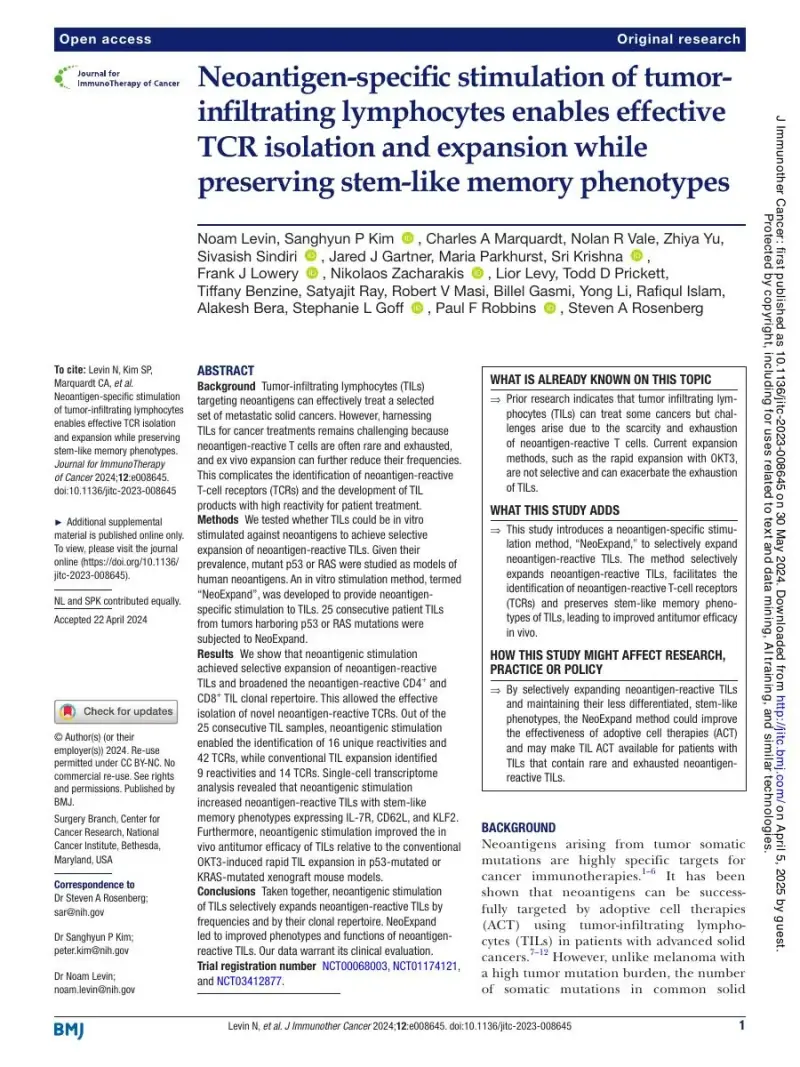
Stimulating tumor-infiltrating lymphocytes with neoantigen-loaded antigen-presenting cells, a method called NeoExpand, selectively expands neoantigen-reactive TILs and preserves stem-like memory features that conventional OKT3 rapid expansion depletes. Applied to 25 consecutive TIL samples from tumors with p53 or RAS mutations, NeoExpand identified 16 reactivities and 42 TCRs, versus 9 reactivities and 14 TCRs with conventional expansion. Rapid expansion gave higher total CD3+ fold-expansion, but NeoExpand gave greater fold-expansion of neoantigen-reactive cells across the tested samples. Single-cell RNA sequencing showed that reactive cells included a stem-like memory cluster expressing IL7R, KLF2, SELL and TCF7. In xenograft mice, NeoExpand-expanded TILs controlled tumor growth from p53- or KRAS-mutated cells, whereas rapid-expansion TILs did not. For shared neoantigens such as p53 or KRAS, the process takes about two weeks.
Note: Generating sufficient antigen-presenting cells for neoantigenic stimulation may be challenging; the authors note this needs to be addressed in future studies, and they call for clinical evaluation of NeoExpand.
Taken together, neoantigenic stimulation of TILs selectively expands neoantigen-reactive TILs by frequencies and by their clonal repertoire. — Noam Levin, Sanghyun P Kim, Charles A Marquardt, Nolan R Vale, Zhiya Yu, Sivasish Sindiri, Jared J Gartner, Maria Parkhurst, Sri Krishna, Frank J Lowery, Nikolaos Zacharakis, Lior Levy, Todd D Prickett, Tiffany Benzine, Satyajit Ray, Robert V Masi, Billel Gasmi, Yong Li, Rafiqul Islam, Alakesh Bera, Stephanie L Goff, Paul F Robbins, Steven A Rosenberg, Journal for ImmunoTherapy of Cancer
Study details
- Authors
- Noam Levin, Sanghyun P Kim, Charles A Marquardt, Nolan R Vale, Zhiya Yu, Sivasish Sindiri, Jared J Gartner, Maria Parkhurst, Sri Krishna, Frank J Lowery, Nikolaos Zacharakis, Lior Levy, Todd D Prickett, Tiffany Benzine, Satyajit Ray, Robert V Masi, Billel Gasmi, Yong Li, Rafiqul Islam, Alakesh Bera, Stephanie L Goff, Paul F Robbins, Steven A Rosenberg
- Institution
- Surgery Branch, Center for Cancer Research, National Cancer Institute, Bethesda, Maryland, USA
- Journal
- Journal for ImmunoTherapy of Cancer
- Year
- 2024
- G-Rex® model(s)
- G-Rex®100, G-Rex®24 Well Plate, G-Rex®6 Well Plate
- Cell type(s)
- TCR T Cells, TIL Cells
- Application area
- Solid tumor
- Study phase
- Preclinical
How G-Rex® was used
G-Rex® 24-well plates, G-Rex® 6-well plates and G-Rex® 100 flasks (alongside T-175 flasks) were used for the conventional rapid expansion comparator. T cells were incubated with 30 ng/mL OKT3, 3,000 IU/mL IL-2 and irradiated allogeneic feeders at 50 to 100 times the number of T cells. After 5 days, half the medium was replaced with fresh 50/50 medium containing 300 IU/mL IL-2 for TCR-engineered T cells or 3,000 IU/mL IL-2 for TILs. This rapid expansion served as the benchmark against NeoExpand for expansion, phenotype and xenograft efficacy of the TILs.
Explore related

Full citation
Levin N, Kim SP, Marquardt CA, et al. Neoantigen-specific stimulation of tumor-infiltrating lymphocytes enables effective TCR isolation and expansion while preserving stem-like memory phenotypes. J Immunother Cancer. 2024;12(5):e008645.
Building a similar workflow?
Talk to a ScaleReady specialist about how the G-Rex® platform can support your program — from process development to clinical-scale manufacturing.


