
Virus-Specific T-Cell Therapy for the Management of Viral Infections in the Immunocompromised
Overview
A review article discussing VST therapies for immunocompromised patients. It mentions that simplified manufacturing processes use G-Rex® culture devices for the selective activation and expansion of virus-reactive T cells.
What this paper found
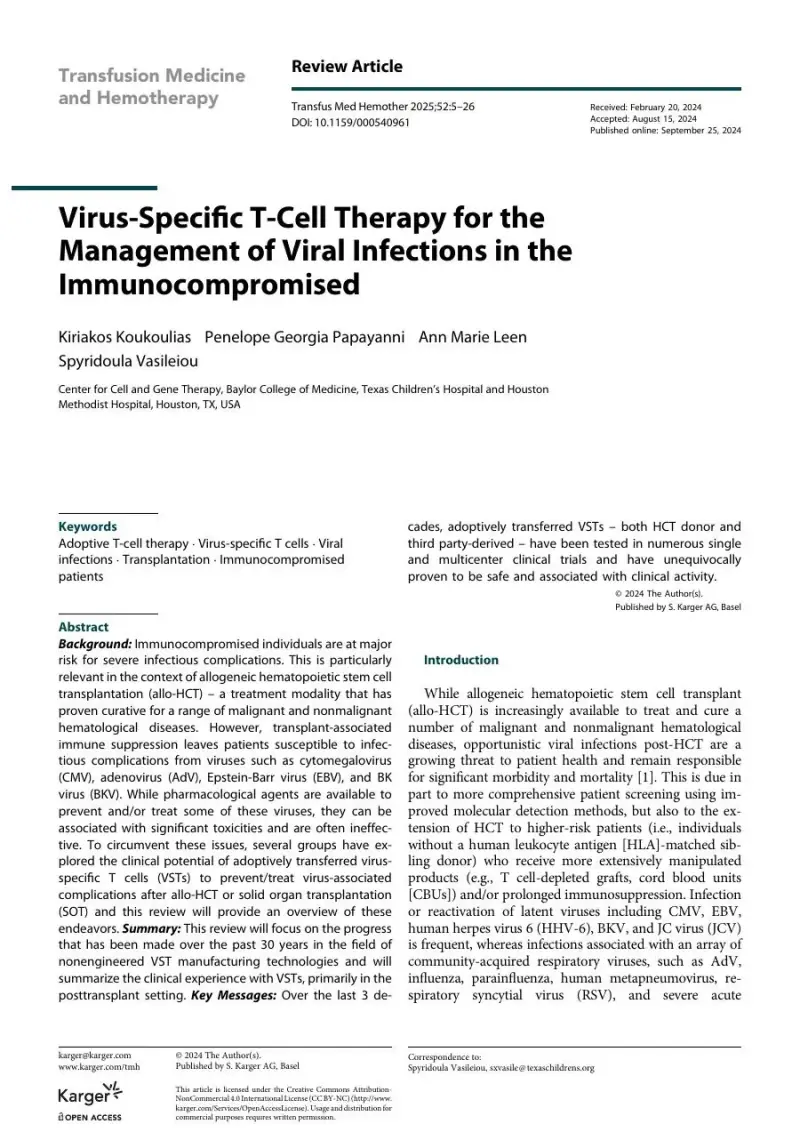
Over the past three decades, adoptive transfer of non-engineered virus-specific T cells (VSTs) has proven safe and clinically active against viral infections in immunocompromised patients, mainly after allogeneic stem cell transplantation. This review compares manufacturing routes: direct isolation by multimer selection or IFNγ capture, and ex vivo expansion with antigen-presenting cells, including multivirus products and cord blood-derived lines. Third-party banked VSTs offer rapid access; in a multicenter trial of 50 patients given banked lines, the cumulative response rate at 6 weeks was 74%. A retrospective comparison of 145 patients found similar response rates for stem cell donor-derived (65.6%) and third-party (62.7%) VSTs. Use is expanding to solid organ transplant, progressive multifocal leukoencephalopathy and COVID-19.
Note: The authors note that broad implementation will depend on large randomized, placebo-controlled trials powered to assess efficacy.
Three decades of clinical experience have demonstrated beyond doubt that adoptive T-cell therapy is safe and associated with the reconstitution of antiviral immunity and viral control in immunocompromised patients. — Kiriakos Koukoulias, Penelope Georgia Papayanni, Ann Marie Leen, Spyridoula Vasileiou, Transfusion Medicine and Hemotherapy
Study details
- Authors
- Kiriakos Koukoulias, Penelope Georgia Papayanni, Ann Marie Leen, Spyridoula Vasileiou
- Institution
- Center for Cell and Gene Therapy, Baylor College of Medicine, Texas Children's Hospital and Houston Methodist Hospital, Houston, TX, USA
- Journal
- Transfusion Medicine and Hemotherapy
- Year
- 2024
- Cell type(s)
- VST Cells
- Application area
- Infectious disease
How G-Rex® was used
The review describes the Baylor multivirus VST platform in which peripheral blood mononuclear cells are stimulated directly with clinical-grade pepmixes (15mers overlapping by 11 amino acids) covering 12 immunodominant antigens from EBV, CMV, adenovirus, BK virus and HHV-6. The stimulated cells are then cultured for approximately two weeks in a G-Rex® culture device in medium supplemented with IL-4 and IL-7, which selectively expands virus-reactive T cells while preserving multivirus specificity and polyclonality. Products made this way, including 11 stem cell donor-derived lines, were infused at 0.5 to 2 x 10^7 cells/m2. The article names only a "G-Rex® culture device" and gives no vessel size.
Explore related
Full citation
Koukoulias K, Papayanni PG, Leen AM, Vasileiou S. Virus-Specific T-Cell Therapy for the Management of Viral Infections in the Immunocompromised. Transfus Med Hemother. 2024;52(1):5-26.
Building a similar workflow?
Talk to a ScaleReady specialist about how the G-Rex® platform can support your program — from process development to clinical-scale manufacturing.


