
Expansion of tumor-infiltrating lymphocytes from head and neck squamous cell carcinoma to assess the potential of adoptive cell therapy
Overview
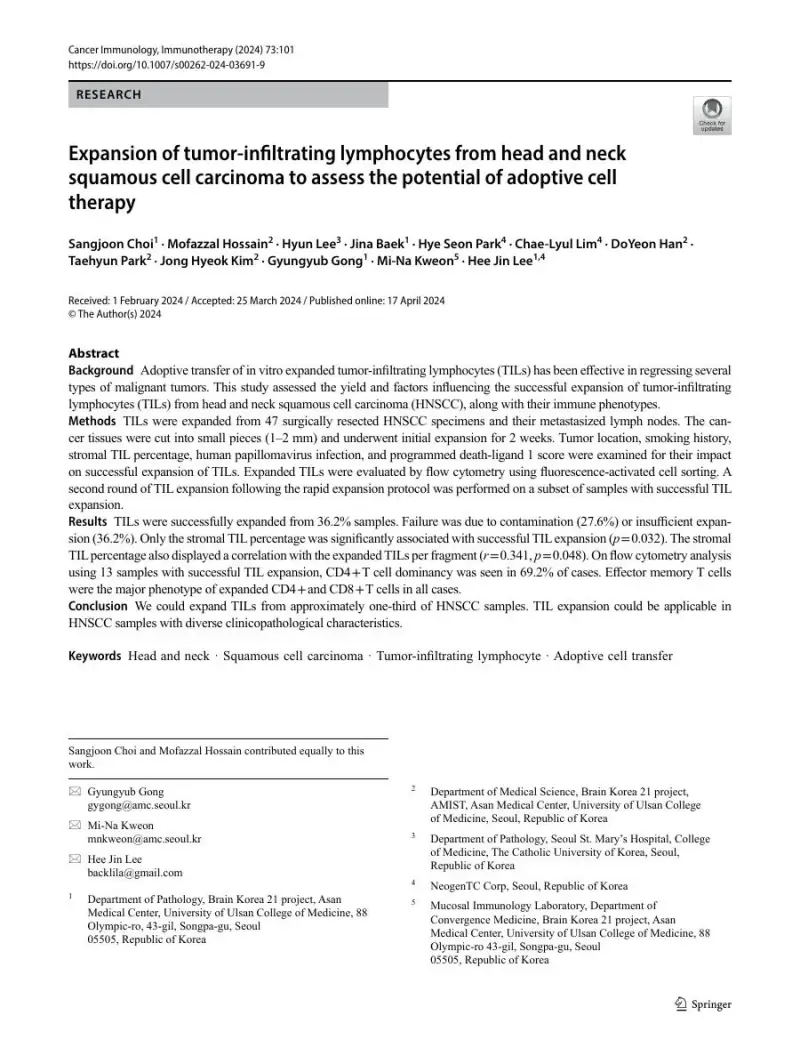
This study assesses TIL expansion from HNSCC samples, finding sTIL percentage as a key predictor. A subset of samples underwent a Rapid Expansion Protocol (REP) using either T-flasks or G-Rex® vessels, achieving high fold expansion.
What this paper found
Tumor-infiltrating lymphocytes (TILs) were expanded from about one-third of resected head and neck squamous cell carcinoma specimens, and higher stromal TIL percentage was associated with success. Fragments (1–2 mm) of 47 tumor and metastatic lymph node specimens from 33 patients were cultured for 14 days with 1,000 IU/mL IL-2. Seventeen specimens (36.2%) reached the cutoff of 0.8 × 10^5 TILs per fragment; 17 grew insufficiently and 13 (27.6%) were lost to contamination despite gentamicin. Successful cultures averaged 5.5 × 10^5 TILs per fragment and 36.6 × 10^6 total TILs. Among 13 analyzed cultures, CD4+ T cells dominated in 69.2%, and effector memory cells were the main subset in all. Rapid expansion of three samples in G-Rex® or T-flasks gave a mean fold change of 1708.
Note: Ex vivo study; the authors note that the efficacy of the expanded TILs was not tested in vitro or in xenograft mouse models.
These findings suggest that TIL culture from HNSCC samples is not confined to specific subtypes and is feasible across a diverse spectrum of HNSCC. — Sangjoon Choi, Mofazzal Hossain, Hyun Lee, Jina Baek, Hye Seon Park, Chae-Lyul Lim, DoYeon Han, Taehyun Park, Jong Hyeok Kim, Gyungyub Gong, Mi-Na Kweon, Hee Jin Lee, Cancer Immunology, Immunotherapy
Study details
- Authors
- Sangjoon Choi, Mofazzal Hossain, Hyun Lee, Jina Baek, Hye Seon Park, Chae-Lyul Lim, DoYeon Han, Taehyun Park, Jong Hyeok Kim, Gyungyub Gong, Mi-Na Kweon, Hee Jin Lee
- Institution
- Department of Pathology, Brain Korea 21 project, Asan Medical Center, University of Ulsan College of Medicine, Seoul, Republic of Korea · Department of Medical Science, Brain Korea 21 project, AMIST, Asan Medical Center, University of Ulsan College of Medicine, Seoul, Republic of Korea · Department of Pathology, Seoul St. Mary’s Hospital, College of Medicine, The Catholic University of Korea, Seoul, Republic of Korea · NeogenTC Corp, Seoul, Republic of Korea · Mucosal Immunology Laboratory, Department of Convergence Medicine, Brain Korea 21 project, Asan Medical Center, University of Ulsan College of Medicine, Seoul, Republic of Korea
- Journal
- Cancer Immunology, Immunotherapy
- Year
- 2024
- Cell type(s)
- TIL Cells
- Application area
- Solid tumor
- Study phase
- Preclinical
How G-Rex® was used
After the initial 14-day culture, TILs entered a rapid expansion protocol: they were cultured with irradiated (50 Gy) allogeneic peripheral blood mononuclear cells from one healthy donor in AIM-V medium with 3% serum, 2,000 IU/mL IL-2 and 30 ng/mL anti-CD3 (OKT3), in either a T-flask or a G-Rex® (Wilson Wolf), with medium replaced every 2 or 3 days for 14 days. Three samples went through this step, two of them in G-Rex®, with a mean fold change of 1708 across the three.
Note: G-Rex® was used only for the rapid expansion step; the initial outgrowth of TILs from tissue fragments took place in 24-well flat-bottom plates.
Explore related
Full citation
Choi S, Hossain M, Lee H, et al. Expansion of tumor-infiltrating lymphocytes from head and neck squamous cell carcinoma to assess the potential of adoptive cell therapy. Cancer Immunol Immunother. 2024;73(6):101.
Building a similar workflow?
Talk to a ScaleReady specialist about how the G-Rex® platform can support your program — from process development to clinical-scale manufacturing.


