
Stem cell-derived CAR T cells show greater persistence, trafficking, and viral control compared to ex vivo transduced CAR T cells
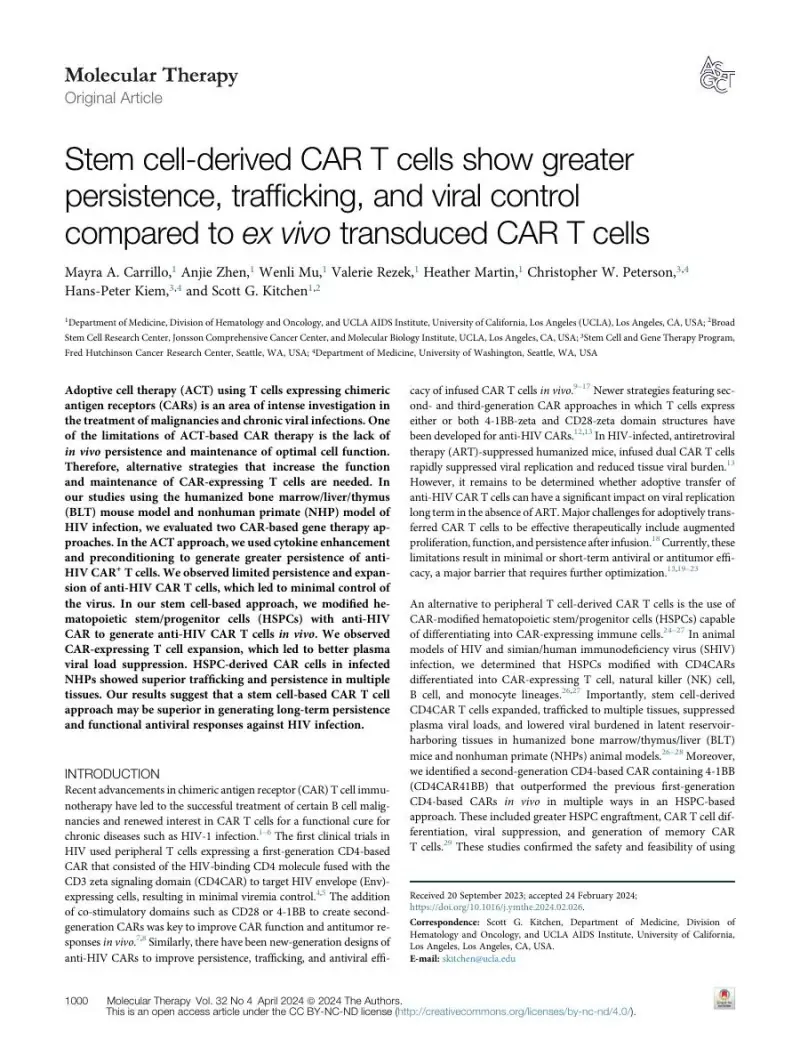
Overview
The study demonstrates that HSPC-derived CAR-T cells exhibit superior persistence and viral control compared to adoptively transferred T cells in HIV models. The adoptive CAR-T cell products were manufactured and expanded for ~7 days in G-Rex®.
What this paper found
In humanized BLT mice and SHIV-infected pigtail macaques, CD4-based anti-HIV CAR cells generated from modified hematopoietic stem/progenitor cells expanded, suppressed plasma viremia and reached more tissues than autologous peripheral CAR T cells, which declined within weeks of infusion. Mice received 10 million mock or CAR-transduced T cells per infusion; culturing those cells in IL-7 and IL-15 instead of IL-2 modestly improved persistence and maintained central memory and CD27 expression, while intraperitoneal IL-7 and IL-15 lowered immune activation and exhaustion markers without improving expansion or viral control. Second-generation CD4CAR41BB cells lowered spleen viral RNA relative to mock controls. In macaques, 30 mg/kg cyclophosphamide preconditioning improved T cell engraftment but caused severe hemolytic-uremic syndrome in two animals.
Note: Animal study in humanized mice and nonhuman primates; the authors note that further studies are needed to evaluate the safety of the stem cell-based CAR approach, including the concern for insertional mutagenesis.
Thus, the stem cell-based approach overcomes the limitations of adoptive CAR T cell where CAR-HSPCs would likely supply a lifetime source of HIV-specific immunity without the need to repeat T cell infusions. — Mayra A. Carrillo, Anjie Zhen, Wenli Mu, Valerie Rezek, Heather Martin, Christopher W. Peterson, Hans-Peter Kiem, Scott G. Kitchen, Molecular Therapy
Study details
- Authors
- Mayra A. Carrillo, Anjie Zhen, Wenli Mu, Valerie Rezek, Heather Martin, Christopher W. Peterson, Hans-Peter Kiem, Scott G. Kitchen
- Institution
- Department of Medicine, Division of Hematology and Oncology, and UCLA AIDS Institute, University of California, Los Angeles (UCLA), Los Angeles, CA, USA · Broad Stem Cell Research Center, Jonsson Comprehensive Cancer Center, and Molecular Biology Institute, UCLA, Los Angeles, CA, USA · Stem Cell and Gene Therapy Program, Fred Hutchinson Cancer Research Center, Seattle, WA, USA · Department of Medicine, University of Washington, Seattle, WA, USA
- Journal
- Molecular Therapy
- Year
- 2024
- Cell type(s)
- CAR T Cells, CD34 Cells
- Application area
- Infectious disease
- Study phase
- Preclinical
How G-Rex® was used
The autologous T cell products for the nonhuman primate arm were made by isolating total CD3+ cells and activating them for 3 days with anti-CD3/CD28 beads. After lentiviral vector transduction, the cells were expanded for about 7 days in G-Rex® flasks (Wilson Wolf) in medium containing IL-2. The resulting CD4CAR-expressing T cells were labeled with CellTrace Far Red and infused into SHIV-infected pigtail macaques, each of which received two T cell infusions.
Note: The G-Rex® expansion step belongs to the macaque arm of the study; the murine CAR T cells were transduced and expanded on retronectin-coated wells in RPMI medium with IL-2 or with IL-7 and IL-15.
Explore related
Full citation
Carrillo MA, Zhen A, Mu W, et al. Stem cell-derived CAR T cells show greater persistence, trafficking, and viral control compared to ex vivo transduced CAR T cells. Mol Ther. 2024;32(4):1000-1015.
Building a similar workflow?
Talk to a ScaleReady specialist about how the G-Rex® platform can support your program — from process development to clinical-scale manufacturing.


