
Pretreatment with IL-15 and IL-18 rescues natural killer cells from granzyme B-mediated apoptosis after cryopreservation
Overview
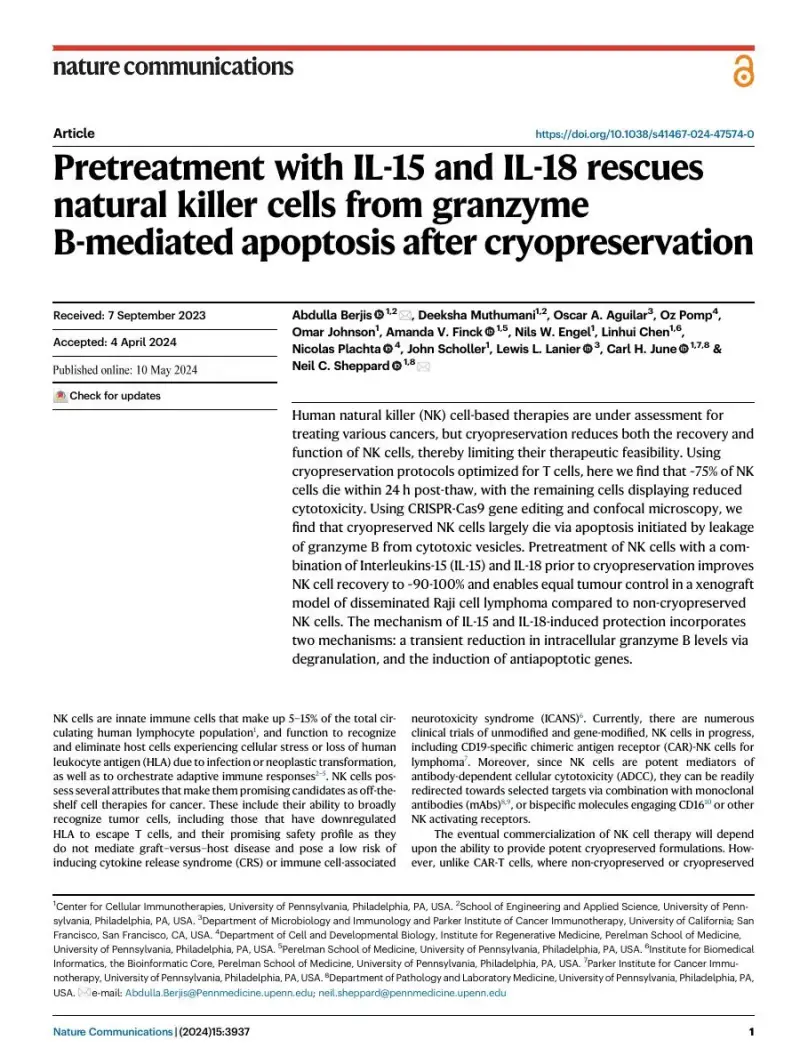
This study identifies that GZMB leakage causes apoptosis in cryopreserved NK cells and that IL-15/IL-18 pretreatment mitigates this. NK cells were isolated and expanded for 15-20 days in G-Rex® 6-well plates using irradiated K562 feeder cells.
What this paper found
Treating expanded human NK cells with IL-15 and IL-18 for 24 hours before freezing protected them from the cell death that otherwise followed thawing. Healthy-donor NK cells were expanded for 15–20 days in G-Rex® 6-well plates with IL-21-expressing K562 feeder cells and IL-2, then frozen in CryoStor CS5 or CS10. Without pretreatment, about 75% of cells died within 24 hours of thawing by apoptosis driven by granzyme B leaking from cytotoxic granules. Pretreatment with 50 ng/mL IL-15 and 250 ng/mL IL-18 temporarily lowered intracellular granzyme B through degranulation and raised expression of the antiapoptotic gene BCL2L1, giving 100% recovery 24 hours after thaw when frozen in a commercial controlled-rate freezer. In NSG mice with disseminated Raji lymphoma, pretreated cryopreserved cells were as potent as non-cryopreserved cells.
Note: Preclinical study using expanded NK cells from adult healthy donors; the authors note that wider use depends on whether the method also benefits NK cells derived from umbilical cord blood, CD34+ stem cells or induced pluripotent stem cells.
As this facile solution relies on readily available reagents and requires no specialist cryomedia or equipment, it may be readily implemented to enhance the NK cell therapy field. — Abdulla Berjis, Deeksha Muthumani, Oscar A. Aguilar, Oz Pomp, Omar Johnson, Amanda V. Finck, Nils W. Engel, Linhui Chen, Nicolas Plachta, John Scholler, Lewis L. Lanier, Carl H. June, Neil C. Sheppard, Nature Communications
Study details
- Authors
- Abdulla Berjis, Deeksha Muthumani, Oscar A. Aguilar, Oz Pomp, Omar Johnson, Amanda V. Finck, Nils W. Engel, Linhui Chen, Nicolas Plachta, John Scholler, Lewis L. Lanier, Carl H. June, Neil C. Sheppard
- Institution
- Center for Cellular Immunotherapies, University of Pennsylvania, Philadelphia, PA, USA · School of Engineering and Applied Science, University of Pennsylvania, Philadelphia, PA, USA · Department of Microbiology and Immunology and Parker Institute of Cancer Immunotherapy, University of California, San Francisco, San Francisco, CA, USA · Department of Cell and Developmental Biology, Institute for Regenerative Medicine, Perelman School of Medicine, University of Pennsylvania, Philadelphia, PA, USA · Perelman School of Medicine, University of Pennsylvania, Philadelphia, PA, USA · Institute for Biomedical Informatics, the Bioinformatic Core, Perelman School of Medicine, University of Pennsylvania, Philadelphia, PA, USA · Parker Institute for Cancer Immunotherapy, University of Pennsylvania, Philadelphia, PA, USA · Department of Pathology and Laboratory Medicine, University of Pennsylvania, Philadelphia, PA, USA
- Journal
- Nature Communications
- Year
- 2024
- G-Rex® model(s)
- G-Rex®6 Well Plate
- Cell type(s)
- NK Cells
- Application area
- Hematologic malignancy
- Study phase
- Preclinical
How G-Rex® was used
Healthy-donor NK cells were isolated and expanded for 15–20 days in G-Rex® 6-well plates (Wilson Wolf #80240M), seeded with irradiated K562 feeder cells expressing membrane-bound IL-21 at a 1:10 ratio in X-VIVO 10 medium with 10% human AB serum and 100 U/mL IL-2. Fresh medium was added every 3 days. These expanded and activated NK cells were the cells tested in the cryopreservation experiments.
Explore related

Full citation
Berjis A, Muthumani D, Aguilar OA, et al. Pretreatment with IL-15 and IL-18 rescues natural killer cells from granzyme B-mediated apoptosis after cryopreservation. Nat Commun. 2024;15(1):3937.
Building a similar workflow?
Talk to a ScaleReady specialist about how the G-Rex® platform can support your program — from process development to clinical-scale manufacturing.


