
CD8α Structural Domains Enhance GUCY2C CAR-T Cell Efficacy
Overview
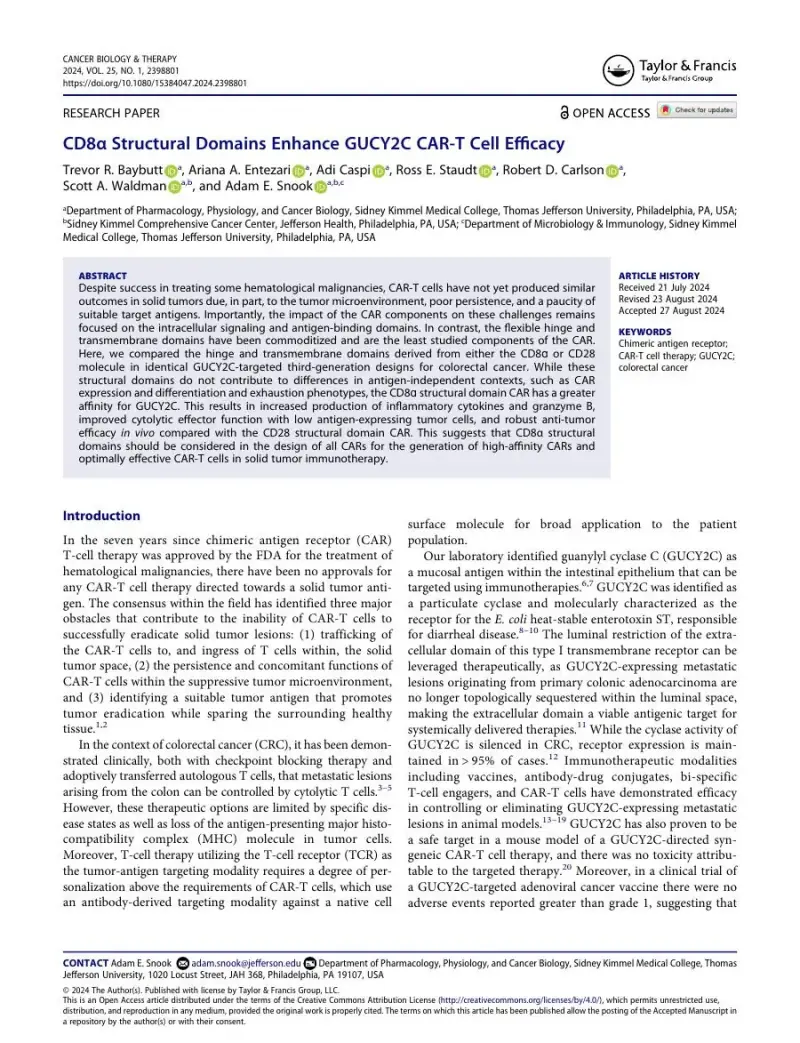
This paper demonstrates that the CD8α hinge/transmembrane domain improves GUCY2C CAR-T cell affinity and antitumor efficacy compared to CD28 domains. CAR-T cells were expanded ex vivo for 12 days using G-Rex® 6-well plates prior to cryopreservation.
What this paper found
Swapping only the hinge and transmembrane domains of a third-generation GUCY2C CAR, from CD28 to CD8α, improved anti-tumor potency against colorectal cancer. Both constructs shared the same scFv and CD28/4-1BB/CD3ζ signaling domains, and donor T cells transduced with either one expanded equally over 12 days, kept comparable viability, memory and exhaustion profiles, and displayed similar numbers of CAR molecules per cell. The CD8α version bound soluble GUCY2C with an EC50 of 7.78–8.26 nM versus 11.3–13.0 nM, released more IL-2, IFNγ and granzyme B after antigen exposure, and cleared low antigen-expressing LoVo cells significantly better. In mice bearing intraperitoneal T84 tumors, 70.6% of CD8α-treated animals cleared tumor against 11.8% of CD28-treated animals.
Note: The comparison was run with healthy-donor T cells in vitro and in an immunodeficient mouse model, and the authors list several mechanistic questions about the two receptors that remain open.
This suggests that CD8α structural domains should be considered in the design of all CARs for the generation of high-affinity CARs and optimally effective CAR-T cells in solid tumor immunotherapy. — Trevor R. Baybutt, Ariana A. Entezari, Adi Caspi, Ross E. Staudt, Robert D. Carlson, Scott A. Waldman, Adam E. Snook, Cancer Biology & Therapy
Study details
- Authors
- Trevor R. Baybutt, Ariana A. Entezari, Adi Caspi, Ross E. Staudt, Robert D. Carlson, Scott A. Waldman, Adam E. Snook
- Institution
- Department of Pharmacology, Physiology, and Cancer Biology, Sidney Kimmel Medical College, Thomas Jefferson University, Philadelphia, PA, USA · Sidney Kimmel Comprehensive Cancer Center, Jefferson Health, Philadelphia, PA, USA · Department of Microbiology & Immunology, Sidney Kimmel Medical College, Thomas Jefferson University, Philadelphia, PA, USA
- Journal
- Cancer Biology & Therapy
- Year
- 2024
- G-Rex® model(s)
- G-Rex®6 Well Plate
- Cell type(s)
- CAR T Cells
- Application area
- Solid tumor
- Study phase
- Preclinical
How G-Rex® was used
Seventy-two hours after activation, once the CD3/CD28/CD2 beads had been magnetically removed, the transduced T cells were transferred into 6-well G-Rex® plates (80240 M, Wilson Wolf). In these plates the cells received fresh medium supplemented with IL-7 and IL-15, cytokines were replenished every three days, a media exchange was performed on Day 9 post-activation, and the cells were collected on Day 12. Over this 12-day ex vivo expansion the CD8HTM and CD28HTM CAR-T products reached comparable fold expansion and viability.
Note: Culture began in conventional 6-well plates at 1 million cells per mL in 4 mL of medium, covering activation and lentiviral transduction, before the move into the gas-permeable plates.
Explore related

Full citation
Baybutt TR, Entezari AA, Caspi A, et al. CD8α Structural Domains Enhance GUCY2C CAR-T Cell Efficacy. Cancer Biol Ther. 2024;25(1):2398801.
Building a similar workflow?
Talk to a ScaleReady specialist about how the G-Rex® platform can support your program — from process development to clinical-scale manufacturing.


