
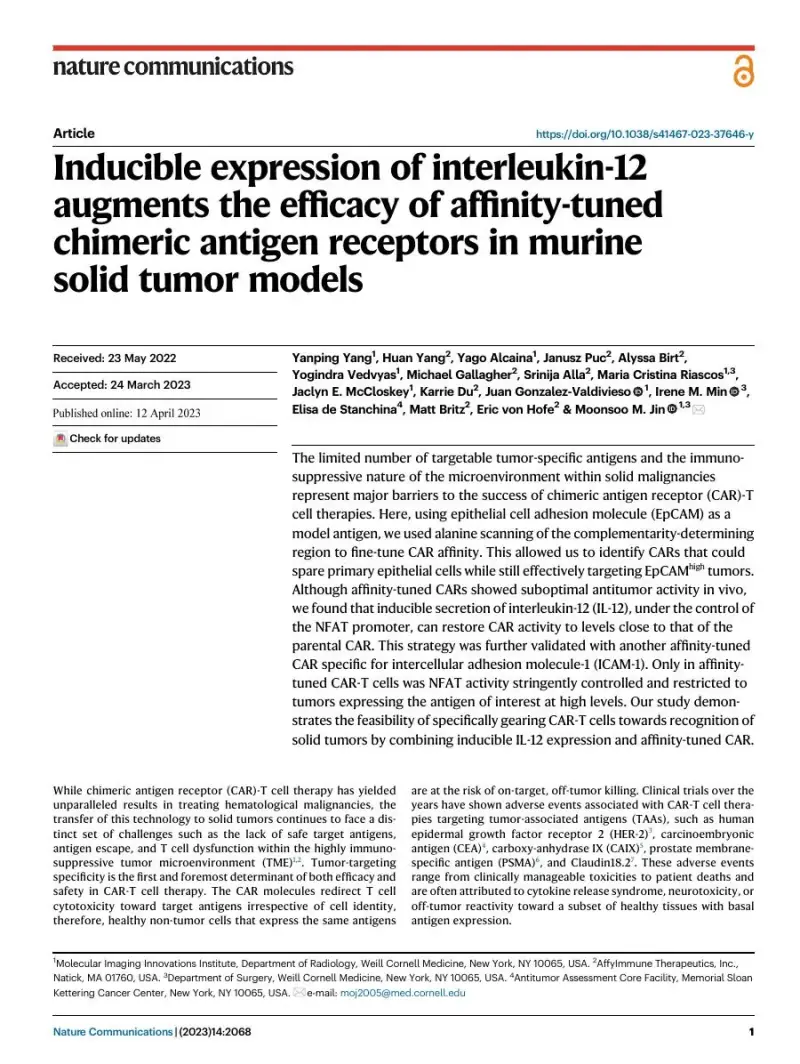
Inducible expression of interleukin-12 augments the efficacy of affinity-tuned chimeric antigen receptors in murine solid tumor models
Overview
This research combines affinity-tuned EpCAM/ICAM-1 CARs with NFAT-inducible IL-12 to enhance antitumor activity in solid tumors while minimizing toxicity. G-Rex® 6M well plates were employed to expand the CAR-T cell products after lentiviral transduction.
What this paper found
Lowering the affinity of an EpCAM-directed CAR spared primary human epithelial cells but weakened tumor control in vivo, and adding NFAT-driven inducible IL-12 to the same construct restored anti-tumor activity. Alanine scanning of CDR-H3 in the UBS54 scFv identified Tyr6 as the critical residue, and substituting valine gave a KD of 10.8 μM against 0.88 ± 0.19 μM for the parent. In subcutaneous SNU-638 gastric xenografts in NSG mice given 1 × 10^7 T cells, Y6V-iIL-12 suppressed growth significantly better than Y6V alone, leaving about 60% of mice below 300 mm³. With an ICAM-1 CAR, F292A-iIL-12 made all mice tumor-free, 1 of 16 relapsing, and serum IL-12 stayed far below 1 ng/ml.
Note: The authors note that their affinity tuning altered the equilibrium binding affinity between CAR and antigen without taking the on-rate and off-rate kinetics of binding into account.
Our results support the use of IL-12-armored affinity-tuned CAR-T cells to enhance anti-tumor immunity while preserving antigen specificity. — Yanping Yang, Huan Yang, Yago Alcaina, Janusz Puc, Alyssa Birt, Yogindra Vedvyas, Michael Gallagher, Srinija Alla, Maria Cristina Riascos, Jaclyn E. McCloskey, Karrie Du, Juan Gonzalez-Valdivieso, Irene M. Min, Elisa de Stanchina, Matt Britz, Eric von Hofe, Moonsoo M. Jin, Nature Communications
Study details
- Authors
- Yanping Yang, Huan Yang, Yago Alcaina, Janusz Puc, Alyssa Birt, Yogindra Vedvyas, Michael Gallagher, Srinija Alla, Maria Cristina Riascos, Jaclyn E. McCloskey, Karrie Du, Juan Gonzalez-Valdivieso, Irene M. Min, Elisa de Stanchina, Matt Britz, Eric von Hofe, Moonsoo M. Jin
- Institution
- Molecular Imaging Innovations Institute, Department of Radiology, Weill Cornell Medicine, New York, NY, USA · AffyImmune Therapeutics, Inc., Natick, MA, USA · Department of Surgery, Weill Cornell Medicine, New York, NY, USA · Antitumor Assessment Core Facility, Memorial Sloan Kettering Cancer Center, New York, NY, USA
- Journal
- Nature Communications
- Year
- 2023
- G-Rex® model(s)
- G-Rex®6M Well Plate
- Cell type(s)
- CAR T Cells
- Application area
- Solid tumor
- Study phase
- Preclinical
How G-Rex® was used
CAR-T cells were made from healthy-donor T cells activated with CD3/CD28 Dynabeads at a 1:1 bead-to-cell ratio on day 0 and transduced twice with lentivirus at a multiplicity of infection of 5, at 24 and 48 hours after activation. The transduced T cells were then expanded in a G-Rex® 6 M well plate (Wilson Wolf Manufacturing, cat. no. 80660 M). On day 10 the CAR-T cell products were harvested and cryopreserved in a 1:2 mixture of T cell complete growth medium and CryoStor CS10. After thawing, these cells were infused into tumor-bearing NSG mice by tail vein at 1 × 10^7 cells per mouse.
Note: T cells were cultured in TexMACS medium supplemented with 5% human AB serum, 12.5 ng/ml IL-7 and 12.5 ng/ml IL-15.
Explore related

Full citation
Yang Y, Yang H, Alcaina Y, et al. Inducible expression of interleukin-12 augments the efficacy of affinity-tuned chimeric antigen receptors in murine solid tumor models. Nat Commun. 2023;14(1):2068.
Building a similar workflow?
Talk to a ScaleReady specialist about how the G-Rex® platform can support your program — from process development to clinical-scale manufacturing.


