
Rapid and sustained T cell-based immunotherapy against invasive fungal disease via a combined two step procedure
Overview
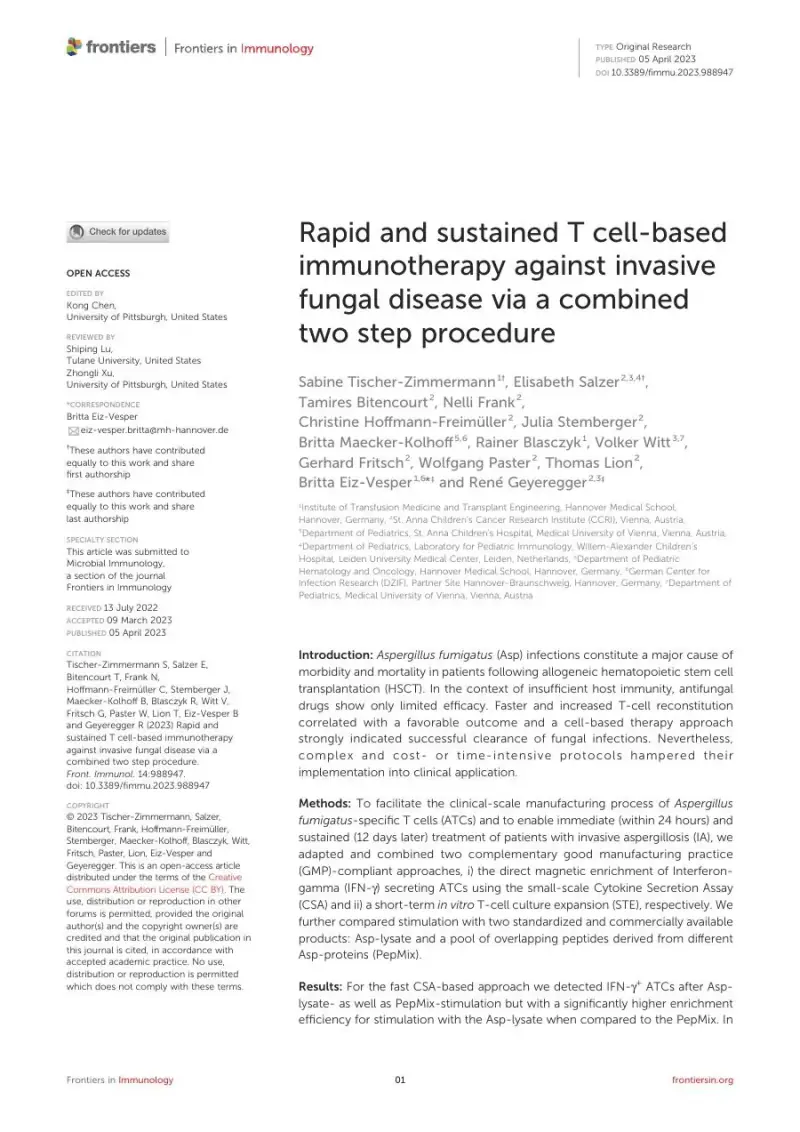
The paper describes a manufacturing strategy for Aspergillus-specific T cells (ATCs). A short-term expansion (STE) protocol using G-Rex® devices allowed for the generation of clinically relevant numbers of functional ATCs within 12 days.
What this paper found
Combining a rapid interferon-gamma secretion enrichment with a 12-day short-term expansion can generate Aspergillus fumigatus-specific T cells from the same donor blood for immediate and sustained treatment of invasive aspergillosis. Of 320 healthy donors screened, 65% had IFN-γ-secreting Aspergillus-specific T cells after lysate stimulation. Magnetic enrichment gave a mean 49.6% IFN-γ+ among CD3+ cells with Asp-lysate versus 35.3% with a peptide-pool mixture (PepMix). Twelve-day expansion met the release criterion of more than 80 spots per 10^5 cells in all donors tested, with mean responses of 863 (lysate) and 833 (PepMix) spots. Expanded cells were mainly Th1-polarized CD4+ memory cells and reduced fungal viability by about 35% (lysate) and 27% (PepMix) in vitro.
Note: In vitro study with cells from healthy donors; the authors note that prospective clinical trials are still needed.
Overall, both methods showed better reactivity and yield with the Asp-lysate. — Sabine Tischer-Zimmermann, Elisabeth Salzer, Tamires Bitencourt, Nelli Frank, Christine Hoffmann-Freimüller, Julia Stemberger, Britta Maecker-Kolhoff, Rainer Blasczyk, Volker Witt, Gerhard Fritsch, Wolfgang Paster, Thomas Lion, Britta Eiz-Vesper, René Geyeregger, Frontiers in Immunology
Study details
- Authors
- Sabine Tischer-Zimmermann, Elisabeth Salzer, Tamires Bitencourt, Nelli Frank, Christine Hoffmann-Freimüller, Julia Stemberger, Britta Maecker-Kolhoff, Rainer Blasczyk, Volker Witt, Gerhard Fritsch, Wolfgang Paster, Thomas Lion, Britta Eiz-Vesper, René Geyeregger
- Institution
- Institute of Transfusion Medicine and Transplant Engineering, Hannover Medical School, Hannover, Germany · St. Anna Children’s Cancer Research Institute (CCRI), Vienna, Austria · Department of Pediatrics, St. Anna Children’s Hospital, Medical University of Vienna, Vienna, Austria · Department of Pediatrics, Laboratory for Pediatric Immunology, Willem-Alexander Children’s Hospital, Leiden University Medical Center, Leiden, Netherlands · Department of Pediatric Hematology and Oncology, Hannover Medical School, Hannover, Germany · German Center for Infection Research (DZIF), Partner Site Hannover-Braunschweig, Germany · Department of Pediatrics, Medical University of Vienna, Vienna, Austria
- Journal
- Frontiers in Immunology
- Year
- 2023
- Cell type(s)
- Other
- Application area
- Infectious disease
- Study phase
- Preclinical
How G-Rex® was used
For short-term expansion, 2 × 10^7 PBMCs were cultured in G-Rex® devices in 2 mL AIM-V medium supplemented with L-glutamine, HEPES and 2% Octaplas AB. Cells were stimulated for 12 days with either Asp-lysate (50 µg/mL) or the PepMix of eight Aspergillus and Candida peptide pools. On day six, cells were washed, resuspended and restimulated as on day 0, and IL-15 (5 ng/mL) was added on day nine. On day 12 the cells were analyzed by flow cytometry and IFN-γ EliSpot; absolute cell numbers in the G-Rex® device were 3.2-fold lower after Asp-lysate and 2.5-fold lower after PepMix expansion.
Explore related
Full citation
Tischer-Zimmermann S, Salzer E, Bitencourt T, et al. Rapid and sustained T cell-based immunotherapy against invasive fungal disease via a combined two step procedure. Front Immunol. 2023;14:988947.
Building a similar workflow?
Talk to a ScaleReady specialist about how the G-Rex® platform can support your program — from process development to clinical-scale manufacturing.


