
Refining chimeric antigen receptors via barcoded protein domain combination pooled screening
Overview
This paper describes a pooled screening strategy for CAR domain combinations using DNA barcoding. G-Rex® plates were utilized for co-culturing transduced T cells with tumor cells during repeated antigen stimulation assays to identify CAR constructs with superior expansion and proliferation.
What this paper found
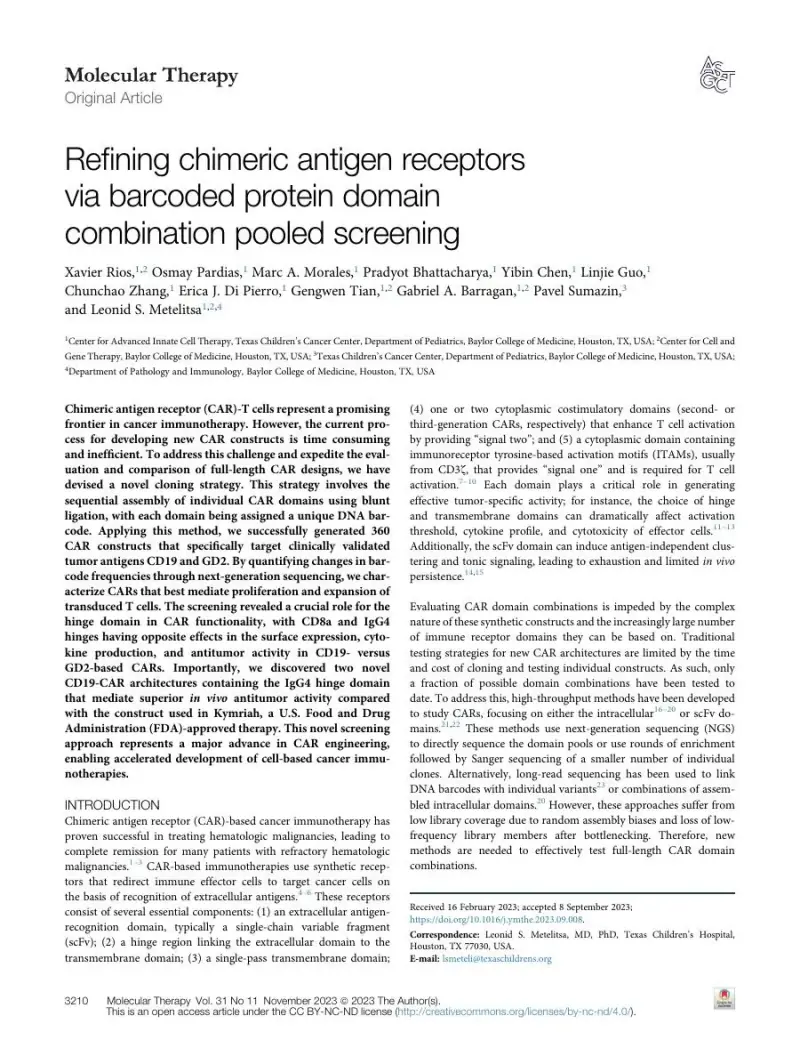
A blunt-ligation cloning method that gives every CAR domain its own DNA barcode allowed pooled screening of 360 full-length CAR designs against CD19 and GD2 and identified two CD19 architectures that outperformed the Kymriah construct in mice. Libraries of 180 CARs per antigen were transduced into primary T cells and ranked by barcode frequency after repeated antigen stimulation and CellTrace Violet dilution. The hinge domain acted differently by target: the IgG4 short hinge favored CD19-CAR expansion, whereas the CD8a hinge favored GD2-CARs. In a Daudi lymphoma model, IgG4.4-1BB and IgG4.4-1BB.CD28 CARs gave better tumor control than CD8a.4-1BB, and IgG4.4-1BB improved survival. Barcoding accuracy was 73% after transduction in Jurkat clones, and 88%–96% of expected library members were detected.
Note: The authors note that the screen was limited to cell-intrinsic phenotypes (persistence, proliferation) rather than cytokine secretion or cytotoxicity, and the antitumor findings come from mouse models.
Our combinatorial screen shows that CAR domains are not modular, and their effects can vary depending on the context. — Xavier Rios, Osmay Pardias, Marc A. Morales, Pradyot Bhattacharya, Yibin Chen, Linjie Guo, Chunchao Zhang, Erica J. Di Pierro, Gengwen Tian, Gabriel A. Barragan, Pavel Sumazin, Leonid S. Metelitsa, Molecular Therapy
Study details
- Authors
- Xavier Rios, Osmay Pardias, Marc A. Morales, Pradyot Bhattacharya, Yibin Chen, Linjie Guo, Chunchao Zhang, Erica J. Di Pierro, Gengwen Tian, Gabriel A. Barragan, Pavel Sumazin, Leonid S. Metelitsa
- Institution
- Center for Advanced Innate Cell Therapy, Texas Children’s Cancer Center, Department of Pediatrics, Baylor College of Medicine, Houston, TX, USA · Center for Cell and Gene Therapy, Baylor College of Medicine, Houston, TX, USA · Texas Children’s Cancer Center, Department of Pediatrics, Baylor College of Medicine, Houston, TX, USA · Department of Pathology and Immunology, Baylor College of Medicine, Houston, TX, USA
- Journal
- Molecular Therapy
- Year
- 2023
- G-Rex® model(s)
- G-Rex®6 Well Plate
- Cell type(s)
- CAR T Cells
- Application area
- Hematologic malignancy · Solid tumor
- Study phase
- Preclinical
How G-Rex® was used
Primary T cells transduced with the CAR library (20 × 10^6) were co-cultured in a 6-well G-Rex® plate with tumor cells at a 1:2 effector/tumor ratio for the CD69 activation assay. In the repeat-stimulation expansion screen, 20 × 10^6 library T cells were co-cultured in 6-well G-Rex® plates with irradiated tumor cells (1:2) and 200 U/mL IL-2 every other day, then restimulated with 40 × 10^6 irradiated tumor cells for four (GD2) or six (CD19) cycles. CellTrace Violet-labeled library cells were also placed in a 6-well G-Rex® plate with irradiated tumor cells for the proliferation screen.
Explore related

Full citation
Rios X, Pardias O, Morales MA, et al. Refining chimeric antigen receptors via barcoded protein domain combination pooled screening. Mol Ther. 2023;31(11):3210-3224.
Building a similar workflow?
Talk to a ScaleReady specialist about how the G-Rex® platform can support your program — from process development to clinical-scale manufacturing.


