
Persistence of spike-specific immune responses in BNT162b2-vaccinated donors and generation of rapid ex-vivo T cells expansion protocol for adoptive immunotherapy: A pilot study
Overview
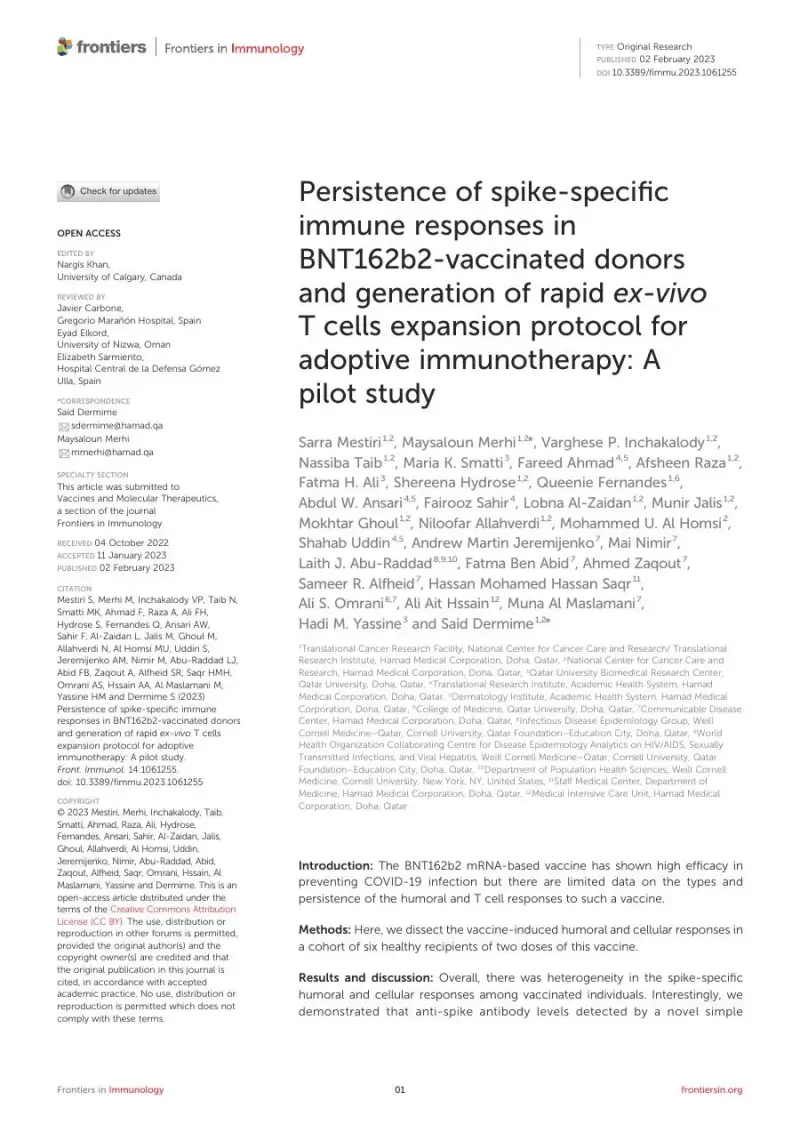
This study characterizes humoral and T cell responses to the BNT162b2 vaccine. It establishes a rapid 11-day ex-vivo expansion protocol for spike-specific T cells using G-Rex® 10 devices, demonstrating significant fold expansion and functional enhancement for potential adoptive immunotherapy.
What this paper found
Six healthy adults who received two BNT162b2 doses showed heterogeneous antibody and T cell responses, and a simple automated assay (Jess) tracked neutralizing activity closely. Anti-spike IgG measured by Jess correlated with pseudovirus neutralization (r=0.863, P<0.0001; 24 serum samples). Spike-specific T cells were detected in 4 of 6 participants after the first dose, in all six after the second dose, and in 4 of 6 five months after vaccination. Peripheral blood mononuclear cells collected at five months were stimulated with spike peptides and grown for 11 days in a G-Rex® 10 device, giving 9 to 13.7-fold expansion in three donors and 1.8-fold in a donor with few pre-existing spike-specific cells. Expanded cells showed higher spike-specific IFN-γ responses and higher activation and cytotoxic markers.
Note: Pilot study with six vaccinated participants (four in the expansion experiments); the authors note that larger studies are needed to confirm the results.
Overall, there was heterogeneity in the spike-specific humoral and cellular responses among vaccinated individuals. — Sarra Mestiri, Maysaloun Merhi, Varghese P. Inchakalody, Nassiba Taib, Maria K. Smatti, Fareed Ahmad, Afsheen Raza, Fatma H. Ali, Shereena Hydrose, Queenie Fernandes, Abdul W. Ansari, Fairooz Sahir, Lobna Al-Zaidan, Munir Jalis, Mokhtar Ghoul, Niloofar Allahverdi, Mohammed U. Al Homsi, Shahab Uddin, Andrew Martin Jeremijenko, Mai Nimir, Laith J. Abu-Raddad, Fatma Ben Abid, Ahmed Zaqout, Sameer R. Alfheid, Hassan Mohamed Hassan Saqr, Ali S. Omrani, Ali Ait Hssain, Muna Al Maslamani, Hadi M. Yassine, Said Dermime, Frontiers in Immunology
Study details
- Authors
- Sarra Mestiri, Maysaloun Merhi, Varghese P. Inchakalody, Nassiba Taib, Maria K. Smatti, Fareed Ahmad, Afsheen Raza, Fatma H. Ali, Shereena Hydrose, Queenie Fernandes, Abdul W. Ansari, Fairooz Sahir, Lobna Al-Zaidan, Munir Jalis, Mokhtar Ghoul, Niloofar Allahverdi, Mohammed U. Al Homsi, Shahab Uddin, Andrew Martin Jeremijenko, Mai Nimir, Laith J. Abu-Raddad, Fatma Ben Abid, Ahmed Zaqout, Sameer R. Alfheid, Hassan Mohamed Hassan Saqr, Ali S. Omrani, Ali Ait Hssain, Muna Al Maslamani, Hadi M. Yassine, Said Dermime
- Institution
- Translational Cancer Research Facility, National Center for Cancer Care and Research/Translational Research Institute, Hamad Medical Corporation, Doha, Qatar · National Center for Cancer Care and Research, Hamad Medical Corporation, Doha, Qatar · Qatar University Biomedical Research Center, Qatar University, Doha, Qatar · Translational Research Institute, Academic Health System, Hamad Medical Corporation, Doha, Qatar · Dermatology Institute, Academic Health System, Hamad Medical Corporation, Doha, Qatar · College of Medicine, Qatar University, Doha, Qatar · Communicable Disease Center, Hamad Medical Corporation, Doha, Qatar · Infectious Disease Epidemiology Group, Weill Cornell Medicine–Qatar, Cornell University, Qatar Foundation–Education City, Doha, Qatar · World Health Organization Collaborating Centre for Disease Epidemiology Analytics on HIV/AIDS, Sexually Transmitted Infections, and Viral Hepatitis, Weill Cornell Medicine–Qatar, Cornell University, Qatar Foundation–Education City, Doha, Qatar · Department of Population Health Sciences, Weill Cornell Medicine, Cornell University, New York, NY, United States · Staff Medical Center, Department of Medicine, Hamad Medical Corporation, Doha, Qatar · Medical Intensive Care Unit, Hamad Medical Corporation, Doha, Qatar
- Journal
- Frontiers in Immunology
- Year
- 2023
- G-Rex® model(s)
- G-Rex®10
- Cell type(s)
- VST Cells
- Application area
- Infectious disease
- Study phase
- Preclinical
How G-Rex® was used
Peripheral blood mononuclear cells from vaccinated donors, collected five months after vaccination, were pulsed with spike peptide pools (1 μg of antigen per 15 × 10^6 cells) for 30 minutes. They were then resuspended in virus-specific T cell medium (Advanced RPMI 1640, Click's medium, GlutaMAX, 10% FBS, 10 ng/ml IL-7 and 400 U/ml IL-4) and transferred to a G-Rex® 10 device. Cells were counted on day six, when fresh medium with cytokines was added, and harvested on day 11. Expansion reached 9-fold (136 × 10^6 cells), 10.4-fold (156 × 10^6 cells) and 13.7-fold (206 × 10^6 cells) in three donors, and 1.8-fold in a fourth.
Explore related

Full citation
Mestiri S, Merhi M, Inchakalody VP, et al. Persistence of spike-specific immune responses in BNT162b2-vaccinated donors and generation of rapid ex-vivo T cells expansion protocol for adoptive immunotherapy: A pilot study. Front Immunol. 2023;14:1061255.
Building a similar workflow?
Talk to a ScaleReady specialist about how the G-Rex® platform can support your program — from process development to clinical-scale manufacturing.


