
Metabolic reprogramming via an engineered PGC-1α improves human chimeric antigen receptor T-cell therapy against solid tumors
Overview
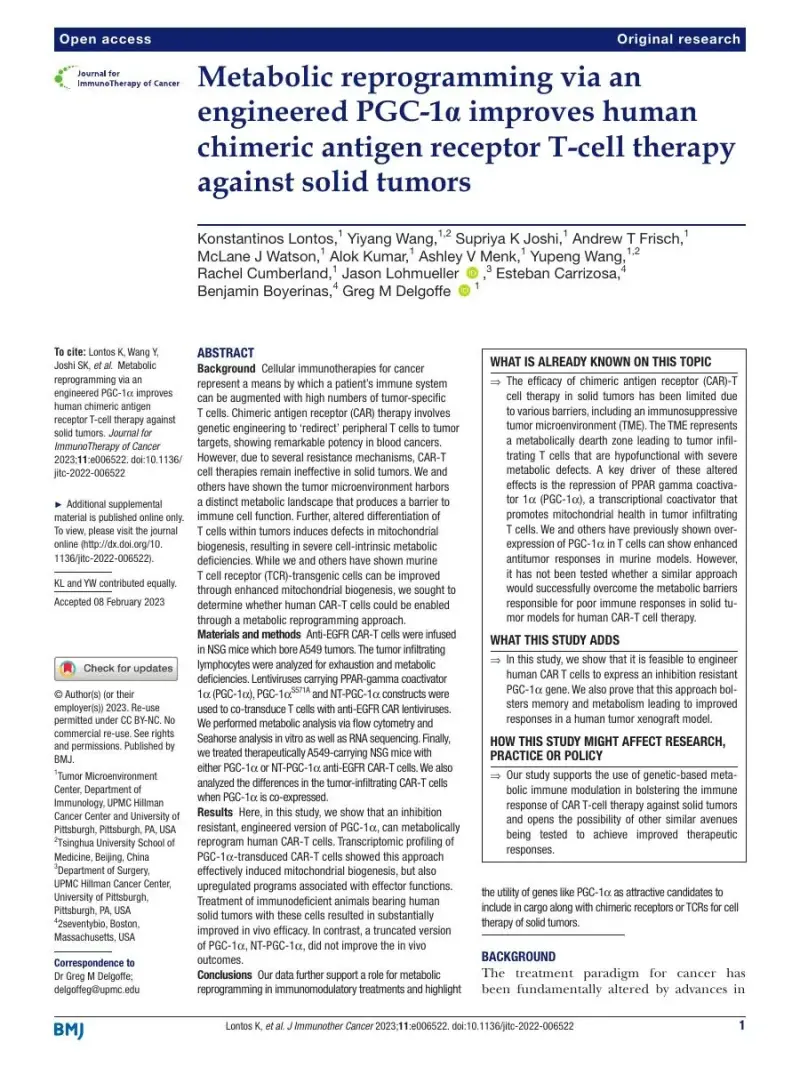
The study shows that overexpression of an engineered PGC-1α improves the metabolic fitness and anti-tumor efficacy of CAR-T cells. During in vitro culture, cells were transferred to G-Rex® 6M Well Plates for rapid expansion.
What this paper found
Human anti-EGFR CAR-T cells engineered to co-express an Akt-resistant PGC-1α (S571A) showed markedly better activity against A549 lung tumors in NSG mice than unmodified CAR-T cells, which had no effect. Unmodified CAR-T cells infiltrating tumors showed lower mitochondrial staining, more inhibitory receptors and less cytokine production than splenic cells. The PGC-1α variant raised mitochondrial mass and respiratory capacity in vitro, and RNA sequencing showed induction of mitochondrial and effector programs. Treated mice received 10^7 CAR-T cells at 100 mm³ tumors; survival was extended. Tumor-infiltrating cells made more cytokines and carried more memory markers. A truncated NT-PGC-1α raised mitochondrial mass but gave no in vivo benefit.
Note: Preclinical xenograft study in immunodeficient mice; responding tumors ultimately relapsed, which the authors attribute possibly to loss of CAR antigen.
Thus, through use of an engineered, highly transcriptionally active PGC-1α construct, mitochondrial reprogramming could be imparted to CAR-T cells, allowing their function within the metabolically restrictive tumor microenvironment. — Konstantinos Lontos, Yiyang Wang, Supriya K Joshi, Andrew T Frisch, McLane J Watson, Alok Kumar, Ashley V Menk, Yupeng Wang, Rachel Cumberland, Jason Lohmueller, Esteban Carrizosa, Benjamin Boyerinas, Greg M Delgoffe, Journal for ImmunoTherapy of Cancer
Study details
- Authors
- Konstantinos Lontos, Yiyang Wang, Supriya K Joshi, Andrew T Frisch, McLane J Watson, Alok Kumar, Ashley V Menk, Yupeng Wang, Rachel Cumberland, Jason Lohmueller, Esteban Carrizosa, Benjamin Boyerinas, Greg M Delgoffe
- Institution
- Tumor Microenvironment Center, Department of Immunology, UPMC Hillman Cancer Center and University of Pittsburgh, Pittsburgh, PA, USA · Tsinghua University School of Medicine, Beijing, China · Department of Surgery, UPMC Hillman Cancer Center, University of Pittsburgh, Pittsburgh, PA, USA · 2seventybio, Boston, Massachusetts, USA
- Journal
- Journal for ImmunoTherapy of Cancer
- Year
- 2023
- G-Rex® model(s)
- G-Rex®6M Well Plate
- Cell type(s)
- CAR T Cells
- Application area
- Solid tumor
- Study phase
- Preclinical
How G-Rex® was used
Anti-EGFR CAR-T cells were activated from PBMCs with anti-CD3/CD28 and IL-2, transduced with lentivirus, cultured initially in normal flasks, then moved on day 4 after activation into a G-Rex® 6M Well Plate for rapid expansion and harvested on day 10 for analysis or adoptive transfer. Anti-CD20 CAR-T cells, FACS-sorted after retroviral transduction, were also expanded in a G-Rex® 6M Well Plate and harvested on day 10 for further analysis.
Explore related

Full citation
Lontos K, Wang Y, Joshi SK, et al. Metabolic reprogramming via an engineered PGC-1α improves human chimeric antigen receptor T-cell therapy against solid tumors. J Immunother Cancer. 2023;11(3):e006522.
Building a similar workflow?
Talk to a ScaleReady specialist about how the G-Rex® platform can support your program — from process development to clinical-scale manufacturing.


