
Signaling via a CD28/CD40 chimeric costimulatory antigen receptor (CoStAR™), targeting folate receptor alpha, enhances T cell activity and augments tumor reactivity of tumor infiltrating lymphocytes
Overview
The study demonstrates that CoStAR, a chimeric costimulatory receptor, enhances the effector function of T cells and TILs. Transgene-expressing cells and TILs were expanded using G-Rex® plates, including G-Rex® 6M, as part of the rapid expansion protocol.
What this paper found
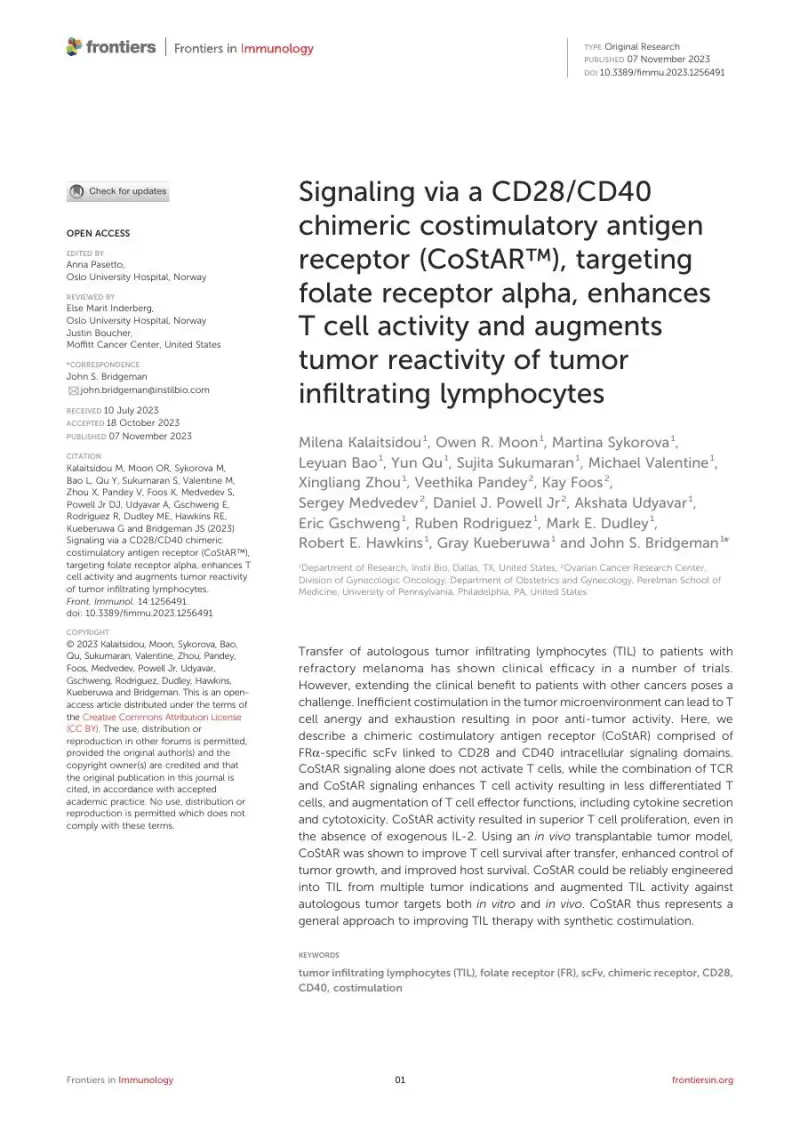
A chimeric costimulatory antigen receptor (CoStAR) that links a folate receptor alpha-specific scFv to CD28 and CD40 signaling domains enhanced T cell function only when the T cell receptor was also engaged. In co-culture with OKT3-expressing targets, CD28.CD40 CoStAR T cells expanded 51.3-fold over four restimulations, versus 13.2-fold for non-transduced cells, and also proliferated without exogenous IL-2 while showing lower PD-1 expression. In mice bearing subcutaneous H508 tumors, T cells carrying a TCR plus CoStAR controlled tumor growth and survived longer, with or without IL-2. CoStAR-engineered TIL from ovarian, renal and lung tumors secreted 2.4- to 6.4-fold more IFNγ against autologous tumor, and survival improved in an ovarian cancer xenograft.
Note: The work is preclinical (in vitro and mouse models); the authors state that FRα CoStAR is next to be evaluated in a phase 1 trial.
CoStAR thus represents a general approach to improving TIL therapy with synthetic costimulation. — Milena Kalaitsidou, Owen R. Moon, Martina Sykorova, Leyuan Bao, Yun Qu, Sujita Sukumaran, Michael Valentine, Xingliang Zhou, Veethika Pandey, Kay Foos, Sergey Medvedev, Daniel J. Powell Jr, Akshata Udyavar, Eric Gschweng, Ruben Rodriguez, Mark E. Dudley, Robert E. Hawkins, Gray Kueberuwa, John S. Bridgeman, Frontiers in Immunology
Study details
- Authors
- Milena Kalaitsidou, Owen R. Moon, Martina Sykorova, Leyuan Bao, Yun Qu, Sujita Sukumaran, Michael Valentine, Xingliang Zhou, Veethika Pandey, Kay Foos, Sergey Medvedev, Daniel J. Powell Jr, Akshata Udyavar, Eric Gschweng, Ruben Rodriguez, Mark E. Dudley, Robert E. Hawkins, Gray Kueberuwa, John S. Bridgeman
- Institution
- Department of Research, Instil Bio, Dallas, TX, United States · Ovarian Cancer Research Center, Division of Gynecologic Oncology, Department of Obstetrics and Gynecology, Perelman School of Medicine, University of Pennsylvania, Philadelphia, PA, United States
- Journal
- Frontiers in Immunology
- Year
- 2023
- G-Rex® model(s)
- G-Rex®6M Well Plate
- Cell type(s)
- TCR T Cells, TIL Cells
- Application area
- Solid tumor
- Study phase
- Preclinical
How G-Rex® was used
Lentivirally transduced T cells sorted for TCR and/or CoStAR expression on a MACSQuant Tyto were expanded in G-Rex® plates using a rapid expansion protocol. The protocol used T cell medium with 200 IU/mL IL-2, 30 ng/mL anti-CD3 and irradiated allogeneic PBMCs at a 1:200 T cell to PBMC ratio for 14 days with regular media changes, after which cells were cryopreserved. For tumor infiltrating lymphocyte production, digested tumor was seeded with 3000 IU/mL IL-2, transduced on days 3 and 4, and rapid expansions were established on day 10 in G-Rex® (6M) plates.
Explore related

Full citation
Kalaitsidou M, Moon OR, Sykorova M, et al. Signaling via a CD28/CD40 chimeric costimulatory antigen receptor (CoStAR™), targeting folate receptor alpha, enhances T cell activity and augments tumor reactivity of tumor infiltrating lymphocytes. Front Immunol. 2023;14:1256491.
Building a similar workflow?
Talk to a ScaleReady specialist about how the G-Rex® platform can support your program — from process development to clinical-scale manufacturing.


