
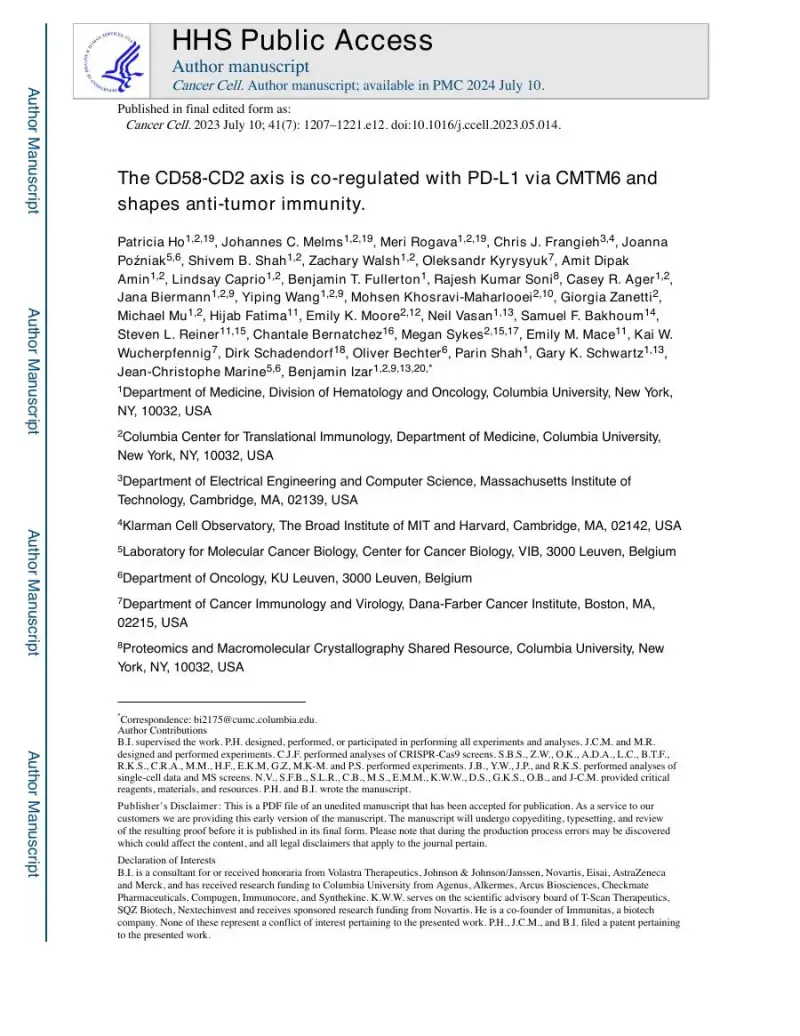
The CD58-CD2 axis is co-regulated with PD-L1 via CMTM6 and shapes anti-tumor immunity
Overview
This research explores the mechanisms of immune evasion related to CD58 loss and PD-L1 upregulation. Patient-derived TILs and CRISPR-engineered T cells used in the experiments were expanded using G-Rex® 10 and G-Rex® 100 bottles.
What this paper found
Loss of CD58 on melanoma cells lets tumors escape T cell attack, and the same loss raises PD-L1 through the shared stabilizer CMTM6. In co-cultures of patient-derived melanoma cells with autologous TILs, CD58 knockout reduced killing and IFN-γ release, while re-expressing either CD58 isoform restored both; blocking CD2 or CD58 prevented the rescue. In partly humanized mice, CD58-knockout tumors showed no responders among eight animals given TIL transfer and about 100-fold fewer CD8+ TILs. A genome-wide CRISPR screen and IP-mass spectrometry identified CMTM6 as a CD58 binding partner; CD58 and PD-L1 compete for CMTM6, so CD58 loss stabilizes PD-L1 and reduces its lysosomal degradation. An intact CD58-CD2 axis was therefore needed for anti-tumor immunity in these preclinical models.
Note: Preclinical study in cell lines, patient-derived co-cultures and mouse xenografts; the authors note that CD58 regulation was examined at the protein level only and that the reason for lower intratumoral T cell numbers in CD58 KO tumors remains unexplained.
Overall, we describe an underappreciated yet critical axis of cancer immunity and provide a molecular basis for how cancer cells balance immune inhibitory and stimulatory cues. — Patricia Ho, Johannes C. Melms, Meri Rogava, Chris J. Frangieh, Joanna Poźniak, Shivem B. Shah, Zachary Walsh, Oleksandr Kyrysyuk, Amit Dipak Amin, Lindsay Caprio, Benjamin T. Fullerton, Rajesh Kumar Soni, Casey R. Ager, Jana Biermann, Yiping Wang, Mohsen Khosravi-Maharlooei, Giorgia Zanetti, Michael Mu, Hijab Fatima, Emily K. Moore, Neil Vasan, Samuel F. Bakhoum, Steven L. Reiner, Chantale Bernatchez, Megan Sykes, Emily M. Mace, Kai W. Wucherpfennig, Dirk Schadendorf, Oliver Bechter, Parin Shah, Gary K. Schwartz, Jean-Christophe Marine, Benjamin Izar, Cancer Cell
Study details
- Authors
- Patricia Ho, Johannes C. Melms, Meri Rogava, Chris J. Frangieh, Joanna Poźniak, Shivem B. Shah, Zachary Walsh, Oleksandr Kyrysyuk, Amit Dipak Amin, Lindsay Caprio, Benjamin T. Fullerton, Rajesh Kumar Soni, Casey R. Ager, Jana Biermann, Yiping Wang, Mohsen Khosravi-Maharlooei, Giorgia Zanetti, Michael Mu, Hijab Fatima, Emily K. Moore, Neil Vasan, Samuel F. Bakhoum, Steven L. Reiner, Chantale Bernatchez, Megan Sykes, Emily M. Mace, Kai W. Wucherpfennig, Dirk Schadendorf, Oliver Bechter, Parin Shah, Gary K. Schwartz, Jean-Christophe Marine, Benjamin Izar
- Institution
- Department of Medicine, Division of Hematology and Oncology, Columbia University, New York, NY, USA · Columbia Center for Translational Immunology, Department of Medicine, Columbia University, New York, NY, USA · Department of Electrical Engineering and Computer Science, Massachusetts Institute of Technology, Cambridge, MA, USA · Klarman Cell Observatory, The Broad Institute of MIT and Harvard, Cambridge, MA, USA · Laboratory for Molecular Cancer Biology, Center for Cancer Biology, VIB, Leuven, Belgium · Department of Oncology, KU Leuven, Leuven, Belgium · Department of Cancer Immunology and Virology, Dana-Farber Cancer Institute, Boston, MA, USA · Proteomics and Macromolecular Crystallography Shared Resource, Columbia University, New York, NY, USA · Program for Mathematical Genomics, Department of Systems Biology, Columbia University, New York, NY, USA · Department of Immunology, Mayo Clinic, Scottsdale, AZ, USA · Department of Pediatrics, Columbia University, New York, NY, USA · Department of Medicine, Division of Rheumatology, Columbia University, New York, NY, USA · Herbert Irving Comprehensive Cancer Center, Columbia University, New York, NY, USA · Department of Radiation Oncology, Memorial Sloan Kettering Cancer Center, New York, NY, USA · Department of Microbiology and Immunology, Columbia University, New York, NY, USA · Department of Medical Oncology, MD Anderson Cancer Center, Houston, TX, USA · Department of Surgery, Columbia University, New York, NY, USA · Department of Dermatology, University Hospital Essen and German Cancer Consortium, Partner Site, Essen, Germany
- Journal
- Cancer Cell
- Year
- 2023
- G-Rex® model(s)
- G-Rex®10, G-Rex®100M
- Cell type(s)
- TCR T Cells, TIL Cells
- Application area
- Solid tumor
- Study phase
- Preclinical
How G-Rex® was used
Patient-derived TILs and NY-ESO-1 TCR T cells were expanded by a rapid-expansion protocol in a G-Rex® 10 bottle, starting on day 0 with 5e5 to 1e6 cells and 100e6 irradiated feeder PBMCs in REP medium with 30 ng/mL anti-CD3 and 3,000 IU/mL IL-2. IL-2 was added on day 2 and half the medium exchanged on day 5. On day 7, more than 60e6 cells moved to a G-Rex® 100 bottle in 600 mL AIM-V with IL-2; 400 mL more was added on day 10. Cells were harvested and cryopreserved on day 14.
Explore related

Full citation
Ho P, Melms JC, Rogava M, et al. The CD58-CD2 axis is co-regulated with PD-L1 via CMTM6 and shapes anti-tumor immunity. Cancer Cell. 2023;41(7):1207-1221.e12.
Building a similar workflow?
Talk to a ScaleReady specialist about how the G-Rex® platform can support your program — from process development to clinical-scale manufacturing.


