
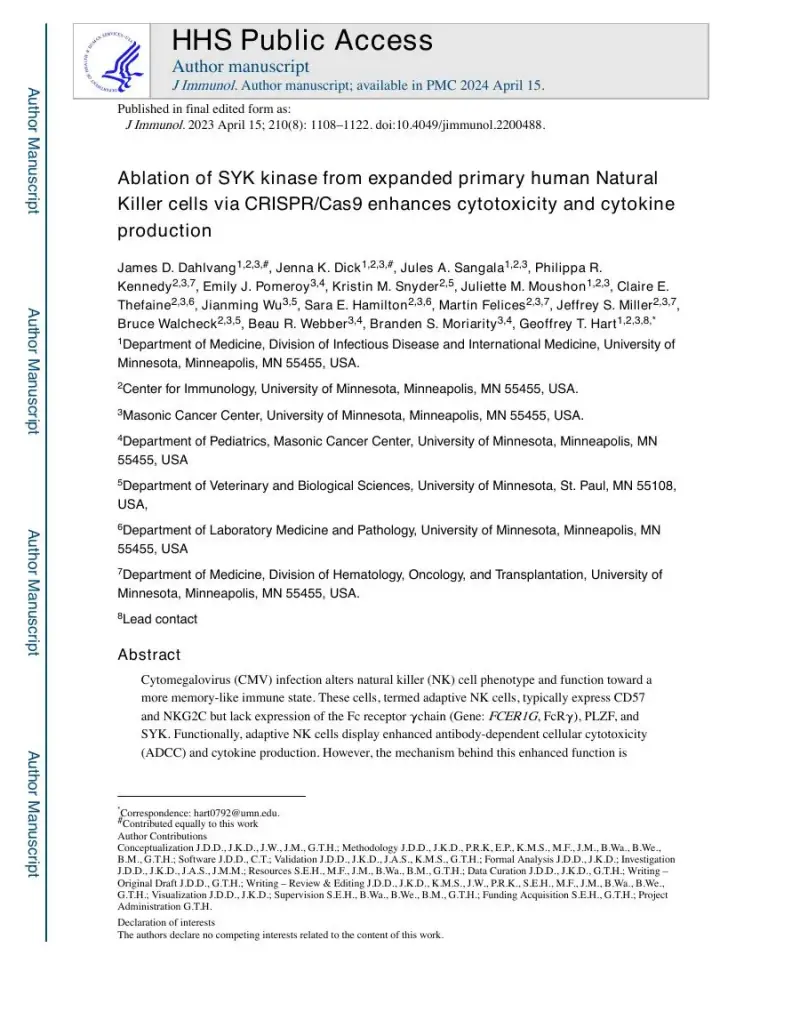
Ablation of SYK kinase from expanded primary human Natural Killer cells via CRISPR/Cas9 enhances cytotoxicity and cytokine production
Overview
This study optimized CRISPR/Cas9 editing of expanded primary human NK cells. Ablation of SYK enhanced ADCC and cytokine production. Post-nucleofection, the edited NK cells were transferred to G-Rex® 24-well plates for culture and recovery.
What this paper found
Deleting the SYK kinase with CRISPR/Cas9 from expanded primary human NK cells increased antibody-dependent cytotoxicity, cytokine production and target-cell binding, whereas deleting ZAP-70 reduced them. The team optimized Amaxa 4D nucleofection (code CA137) of thawed donor NK cells expanded with irradiated K562-aAPC feeders, then ablated FcRγ, CD3ζ, PLZF, SYK, ZAP-70 and SHP-1 and tested the cells against antibody-coated red blood cells and SKOV-3 cells. SYK ablation raised degranulation by an average of 7% over controls, with 26 of 35 samples improving, while SHP-1 loss boosted degranulation and killing but lowered IFNγ and TNFα. SYK-ablated cells kept enhanced function for 27 days, suggesting SYK loss rather than FcRγ or PLZF loss may explain CMV-induced adaptive NK cell activity.
Note: Gene ablation was achieved only in proliferating NK cells; no ablation was detected when CRISPR was applied to freshly isolated resting NK cells, so the findings apply to proliferating cells.
These results indicate that the enhanced cytotoxicity and cytokine production of CMV-induced adaptive NK cells is more likely due to the loss of SYK than the lack of FcR γ or PLZF. — James D Dahlvang, Jenna K Dick, Jules A Sangala, Philippa R Kennedy, Emily J Pomeroy, Kristin M Snyder, Juliette M Moushon, Claire E Thefaine, Jianming Wu, Sara E Hamilton, Martin Felices, Jeffrey S Miller, Bruce Walcheck, Beau R Webber, Branden S Moriarity, Geoffrey T Hart, The Journal of Immunology
Study details
- Authors
- James D Dahlvang, Jenna K Dick, Jules A Sangala, Philippa R Kennedy, Emily J Pomeroy, Kristin M Snyder, Juliette M Moushon, Claire E Thefaine, Jianming Wu, Sara E Hamilton, Martin Felices, Jeffrey S Miller, Bruce Walcheck, Beau R Webber, Branden S Moriarity, Geoffrey T Hart
- Institution
- Department of Medicine, Division of Infectious Disease and International Medicine, University of Minnesota, Minneapolis, MN, USA · Center for Immunology, University of Minnesota, Minneapolis, MN, USA · Masonic Cancer Center, University of Minnesota, Minneapolis, MN, USA · Department of Pediatrics, Masonic Cancer Center, University of Minnesota, Minneapolis, MN, USA · Department of Veterinary and Biological Sciences, University of Minnesota, St. Paul, MN, USA · Department of Laboratory Medicine and Pathology, University of Minnesota, Minneapolis, MN, USA · Department of Medicine, Division of Hematology, Oncology, and Transplantation, University of Minnesota, Minneapolis, MN, USA
- Journal
- The Journal of Immunology
- Year
- 2023
- G-Rex® model(s)
- G-Rex®24 Well Plate, G-Rex®6 Well Plate
- Cell type(s)
- NK Cells
- Application area
- Other
- Study phase
- Preclinical
How G-Rex® was used
Thawed primary NK cells (3 × 10^6) were co-cultured with 6 × 10^6 irradiated K562-aAPC cells in 30 mL X-Vivo 10 with 50 IU/mL IL-2 in a G-Rex® 6-well plate (80240M) for six days of expansion. After CRISPR/Cas9 nucleofection, the cells were transferred to a G-Rex® 24-well plate (80192M) containing 1.9 mL X-Vivo 10, topped up with 4 mL medium containing IL-15 per well (3 ng/mL final), and cultured for six days before functional assays.
Explore related

Full citation
Dahlvang JD, Dick JK, Sangala JA, et al. Ablation of SYK Kinase from Expanded Primary Human NK Cells via CRISPR/Cas9 Enhances Cytotoxicity and Cytokine Production. J Immunol. 2023;210(8):1108-1122.
Building a similar workflow?
Talk to a ScaleReady specialist about how the G-Rex® platform can support your program — from process development to clinical-scale manufacturing.


