
A chemically inducible IL-2 receptor signaling complex allows for effective in vitro and in vivo selection of engineered CD4+ T cells
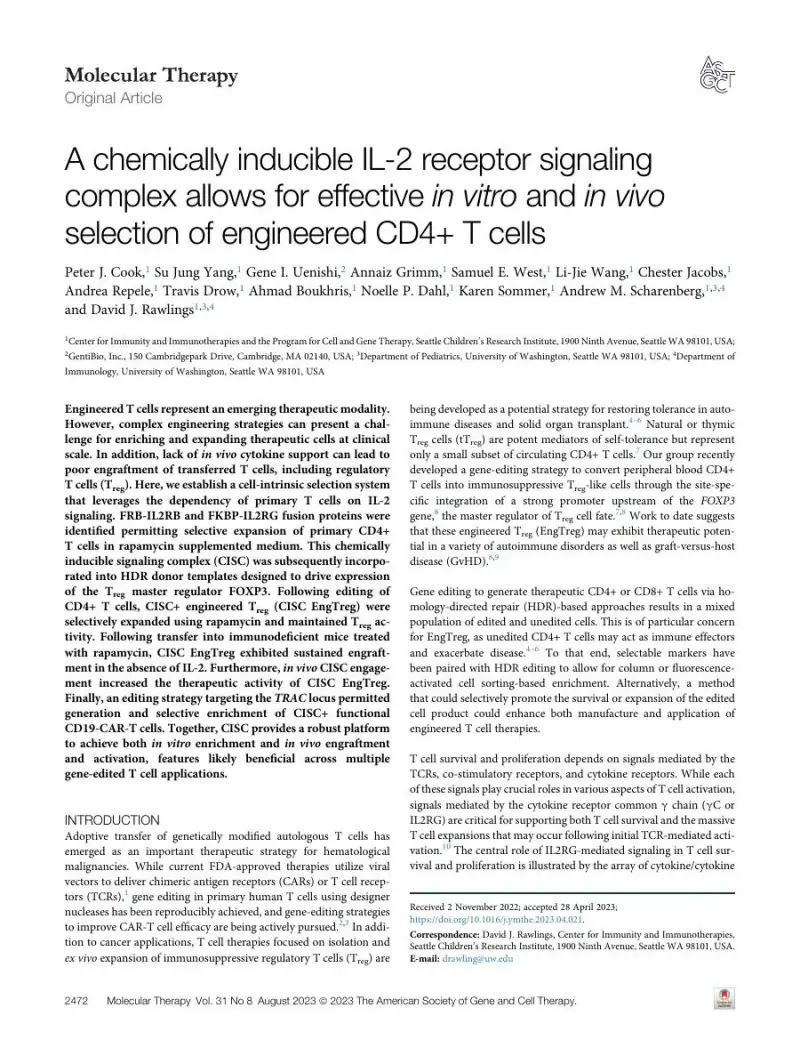
Overview
The paper describes a system (CISC) that allows engineered T cells and Tregs to be selectively expanded using rapamycin. Clinical-scale manufacturing of the engineered cells was demonstrated using G-Rex® 100M CS vessels.
What this paper found
A chemically inducible IL-2 receptor signaling complex (CISC), built from FKBP–IL2RG and FRB–IL2RB fusion proteins, lets researchers select and expand gene-edited primary CD4+ T cells with rapamycin in place of IL-2. Placed at the FOXP3 locus, it enriched engineered Treg from under 20% edited cells to 40%–95% purity across five donors, and the cells showed Treg-like phenotype and suppressed effector T cells similarly to thymic Treg. In immunodeficient mice, rapamycin increased engraftment of CISC Treg without exogenous IL-2, and the dimerizer AP21967 improved GvHD outcomes at a subtherapeutic cell dose. A TRAC-targeted CD19-CAR version reached more than 70% CAR+ cells after 19 days of rapamycin culture.
Note: The in vivo studies used relatively low numbers of recipient animals, and the authors note that larger cohorts will be important in future work.
Cumulatively, these data demonstrate that the IL-2 CISC can effectively promote the in vivo selection and retention of transplanted CISC-expressing cells in the setting of either a therapeutic or subtherapeutic rapamycin dosing regimen. — Peter J. Cook, Su Jung Yang, Gene I. Uenishi, Annaiz Grimm, Samuel E. West, Li-Jie Wang, Chester Jacobs, Andrea Repele, Travis Drow, Ahmad Boukhris, Noelle P. Dahl, Karen Sommer, Andrew M. Scharenberg, David J. Rawlings, Molecular Therapy
Study details
- Authors
- Peter J. Cook, Su Jung Yang, Gene I. Uenishi, Annaiz Grimm, Samuel E. West, Li-Jie Wang, Chester Jacobs, Andrea Repele, Travis Drow, Ahmad Boukhris, Noelle P. Dahl, Karen Sommer, Andrew M. Scharenberg, David J. Rawlings
- Institution
- Center for Immunity and Immunotherapies and the Program for Cell and Gene Therapy, Seattle Children's Research Institute, Seattle, WA, USA · GentiBio, Inc., Cambridge, MA, USA · Department of Pediatrics, University of Washington, Seattle, WA, USA · Department of Immunology, University of Washington, Seattle, WA, USA
- Journal
- Molecular Therapy
- Year
- 2023
- G-Rex® model(s)
- G-Rex®6 Well Plate
- Cell type(s)
- CAR T Cells, Treg Cells
- Application area
- Autoimmune · Hematologic malignancy
- Study phase
- Preclinical
How G-Rex® was used
After gene editing and 3 days of recovery in IL-2, CD4+ T cells were kept in medium with 10 nM rapamycin for 7 days. They were then replated in G-Rex® gas-permeable six-well plates at 1–5 × 10^6 cells per well in medium with 10 nM rapamycin and re-activated with CD3/CD28 Dynabeads for a further 7 days of expansion. This was used to manufacture CISC EngTreg and CISC CD19-CAR-T cells.
Explore related

Full citation
Cook PJ, Yang SJ, Uenishi GI, et al. A chemically inducible IL-2 receptor signaling complex allows for effective in vitro and in vivo selection of engineered CD4+ T cells. Mol Ther. 2023;31(8):2472-2488.
Building a similar workflow?
Talk to a ScaleReady specialist about how the G-Rex® platform can support your program — from process development to clinical-scale manufacturing.


