
Cell surface marker-based capture of neoantigen-reactive CD8+ T-cell receptors from metastatic tumor digests
Overview
The study identifies neoantigen-reactive TCRs from TILs by sorting for CD39, PD-1, and TIGIT co-expression. While these cells are dysfunctional, their TCRs can be used for engineering. Sorted TIL populations were plated in G-Rex® 24-well plates for rapid expansion (REP) to assess functional reactivity.
What this paper found
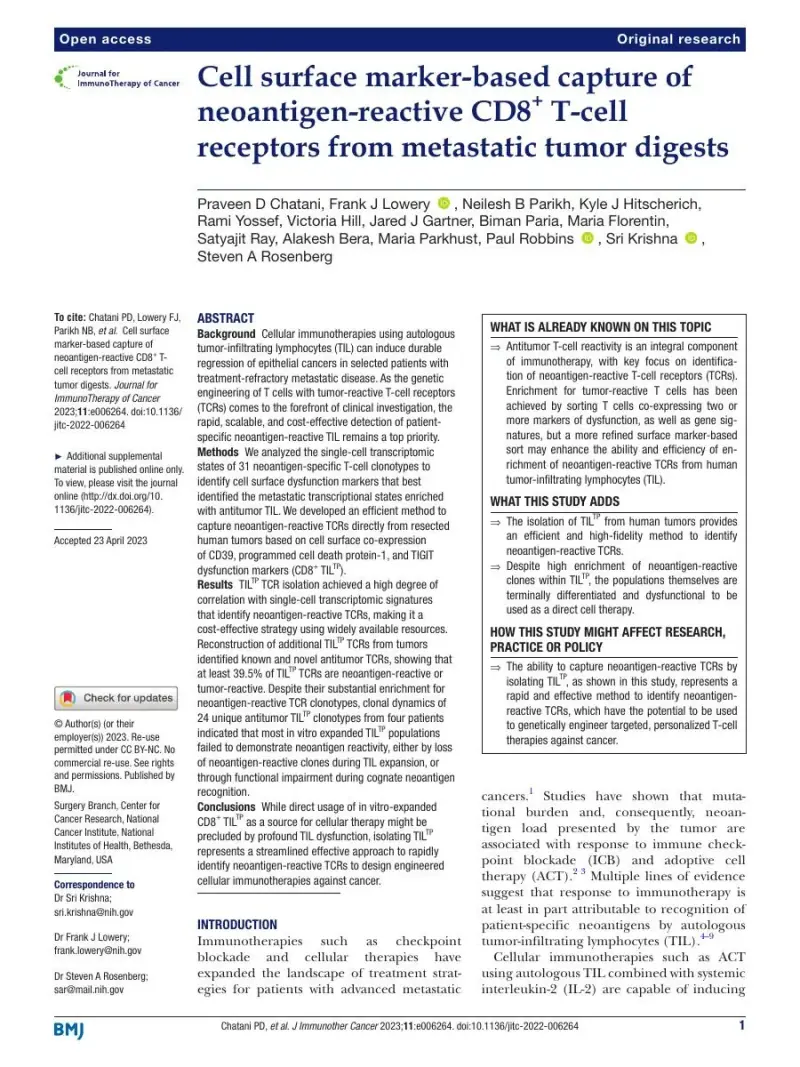
Sorting CD8+ tumor-infiltrating lymphocytes that co-express CD39, PD-1 and TIGIT ("triple positive" TIL) offers a rapid way to capture neoantigen-reactive T-cell receptors directly from metastatic epithelial tumor digests. Clone frequencies in the sorted population correlated strongly with a single-cell transcriptomic neoantigen-reactive state. Of 120 unique CDR3β sequences from five tumors, 39 were already known or met criteria for reconstruction, and reconstruction and testing showed that at least 39.5% of the sorted-population TCRs were neoantigen-reactive or tumor-reactive. After rapid expansion, however, reactive clones were lost or functionally impaired: expanded cells from three of four samples failed to maintain reactivity, so these cells appear poorly suited as a therapy product themselves.
Note: Reactivity was tested ex vivo with TCRs transduced into healthy donor PBL; the authors note that not every clonotype or possible tumor antigen was screened, so the 39.5% figure is likely conservative.
These data demonstrate that while CD8+ PD1+ CD39+ TIGIT+ TIL serve as a highly efficient and reliable source of tumor-reactive TCRs, the cells themselves are phenotypically exhausted and offer limited utility as a treatment product. — Praveen D Chatani, Frank J Lowery, Neilesh B Parikh, Kyle J Hitscherich, Rami Yossef, Victoria Hill, Jared J Gartner, Biman Paria, Maria Florentin, Satyajit Ray, Alakesh Bera, Maria Parkhust, Paul Robbins, Sri Krishna, Steven A Rosenberg, Journal for ImmunoTherapy of Cancer
Study details
- Authors
- Praveen D Chatani, Frank J Lowery, Neilesh B Parikh, Kyle J Hitscherich, Rami Yossef, Victoria Hill, Jared J Gartner, Biman Paria, Maria Florentin, Satyajit Ray, Alakesh Bera, Maria Parkhust, Paul Robbins, Sri Krishna, Steven A Rosenberg
- Institution
- Surgery Branch, Center for Cancer Research, National Cancer Institute, National Institutes of Health, Bethesda, Maryland, USA
- Journal
- Journal for ImmunoTherapy of Cancer
- Year
- 2023
- G-Rex® model(s)
- G-Rex®24 Well Plate
- Cell type(s)
- TCR T Cells, TIL Cells
- Application area
- Solid tumor
- Study phase
- Preclinical
How G-Rex® was used
Sorted CD8+ CD39+PD-1+TIGIT+ TIL (6,000 to 15,000 cells) were plated in a G-Rex® 24-well cell culture plate for rapid expansion with IL-2 (6000 IU/mL), anti-CD3 (OKT3, 50 ng/mL) and 1 × 10^7 irradiated healthy-donor PBL. Cells were cultured for 2 weeks with media changes and expansions adjusted to each population's needs. At day 14 the expanded cells were used for neoantigen co-culture assays and TCRβ survey sequencing.
Explore related

Full citation
Chatani PD, Lowery FJ, Parikh NB, et al. Cell surface marker-based capture of neoantigen-reactive CD8+ T-cell receptors from metastatic tumor digests. J Immunother Cancer. 2023;11(5):e006264.
Building a similar workflow?
Talk to a ScaleReady specialist about how the G-Rex® platform can support your program — from process development to clinical-scale manufacturing.


