
SARS-CoV-2-specific T cells generated for adoptive immunotherapy are capable of recognizing multiple SARS-CoV-2 variants
Overview
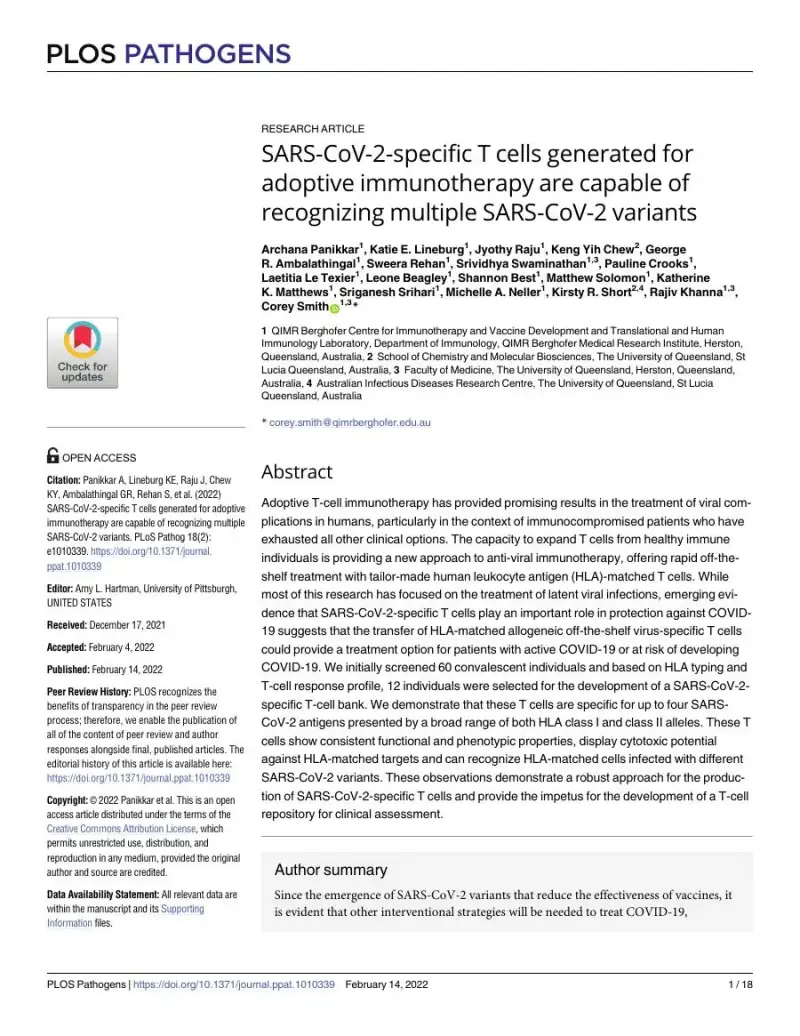
SARS-CoV-2-specific T cells were generated from convalescent donors for adoptive immunotherapy. These cells recognized multiple viral variants and provided broad HLA coverage. G-Rex® culture vessels were used to culture and expand the peptide-stimulated PBMCs.
What this paper found
T cells specific for SARS-CoV-2 can be expanded from a small panel of convalescent donors and recognize cells infected with several viral variants. From 60 convalescent individuals screened, 12 were chosen for their CD4 and CD8 responses and broad HLA coverage. Peptide-stimulated blood cells grew a median 18.4-fold over 14 days in G-Rex® vessels with IL-2, yielding mainly CD4 T cells with polyfunctional cytokine profiles and cytotoxic activity against HLA-matched targets. Analysis of HLA restriction suggested 97.15% combined worldwide HLA coverage. Of 22 defined epitopes, three carried amino acid changes in Omicron. Donor Q-029 T cells released IFN-γ after exposure to cells infected with D614G, Alpha or Beta virus. Two GMP lots reached a mean 40-fold expansion.
Note: Preclinical laboratory study; the authors note that HLA class I coverage would need to be broadened by testing a more HLA class I-diverse cohort of convalescent donors.
Here we demonstrate that a small cohort of donors can be used to generate functionally potent SARS-CoV-2-specific T cells capable of recognizing multiple antigens and with broad HLA coverage across both HLA class I and class II alleles. — Archana Panikkar, Katie E. Lineburg, Jyothy Raju, Keng Yih Chew, George R. Ambalathingal, Sweera Rehan, Srividhya Swaminathan, Pauline Crooks, Laetitia Le Texier, Leone Beagley, Shannon Best, Matthew Solomon, Katherine K. Matthews, Sriganesh Srihari, Michelle A. Neller, Kirsty R. Short, Rajiv Khanna, Corey Smith, PLOS Pathogens
Study details
- Authors
- Archana Panikkar, Katie E. Lineburg, Jyothy Raju, Keng Yih Chew, George R. Ambalathingal, Sweera Rehan, Srividhya Swaminathan, Pauline Crooks, Laetitia Le Texier, Leone Beagley, Shannon Best, Matthew Solomon, Katherine K. Matthews, Sriganesh Srihari, Michelle A. Neller, Kirsty R. Short, Rajiv Khanna, Corey Smith
- Institution
- QIMR Berghofer Centre for Immunotherapy and Vaccine Development and Translational and Human Immunology Laboratory, Department of Immunology, QIMR Berghofer Medical Research Institute, Herston, Queensland, Australia · School of Chemistry and Molecular Biosciences, The University of Queensland, St Lucia, Queensland, Australia · Faculty of Medicine, The University of Queensland, Herston, Queensland, Australia · Australian Infectious Diseases Research Centre, The University of Queensland, St Lucia, Queensland, Australia
- Journal
- PLOS Pathogens
- Year
- 2022
- G-Rex® model(s)
- G-Rex®6 Well Plate
- Cell type(s)
- VST Cells
- Application area
- Infectious disease
- Study phase
- Preclinical
How G-Rex® was used
Donor PBMC were stimulated with overlapping peptide pools covering the N, S, M and ORF3a antigens and cultured for 14 days in G-Rex® 6-well culture plates. Cells were seeded at 2 to 3 × 10^6 cells/cm2 in RPMI with 5% human AB serum; IL-2 (120 IU/mL) was added on day 3 and every 2–3 days thereafter, and cells were counted and re-divided at the same density on days 7 and 11. Across 12 donors the median expansion was 18.4-fold (range 2.6–33.1). Clinical-grade GMP lots made by the same method reached a mean 40-fold expansion.
Note: Clinical-grade lots for the cell bank were made under GMP conditions at Q-Gen Cell Therapeutics using custom CD4 and CD8 epitope peptide pools in place of the overlapping peptide pools.
Explore related

Full citation
Panikkar A, Lineburg KE, Raju J, et al. SARS-CoV-2-specific T cells generated for adoptive immunotherapy are capable of recognizing multiple SARS-CoV-2 variants. PLoS Pathog. 2022;18(2):e1010339.
Building a similar workflow?
Talk to a ScaleReady specialist about how the G-Rex® platform can support your program — from process development to clinical-scale manufacturing.


