
CAR/CXCR5-T cell immunotherapy is safe and potentially efficacious in promoting sustained remission of SIV infection
Overview
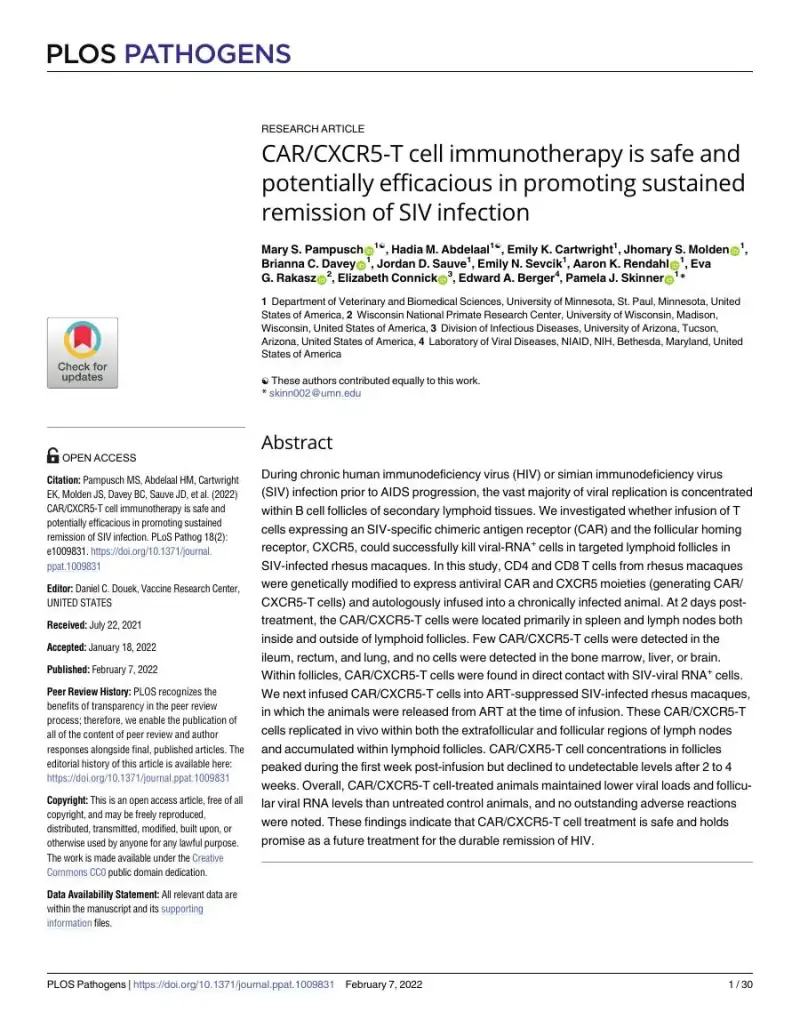
This study evaluates CAR/CXCR5-T cells for treating SIV infection in rhesus macaques. The cells homed to lymphoid follicles and reduced viral loads. Transduced T cells were expanded in G-Rex® 500M-CS containers and 6-well plates during manufacturing.
What this paper found
Autologous rhesus T cells engineered with an SIV-specific CAR and the follicle-homing receptor CXCR5 reached B cell follicles in SIV-infected macaques and were associated with lower viral loads, with no observable adverse effects. The studies used 10 macaques; ART-suppressed animals received 0.8–2.0 × 10^8 cells/kg at the moment ART was stopped. The cells divided in vivo, were present in a median of 96% of lymph node follicles at 6 days after infusion, and were undetectable in sections by day 60. Five of six treated animals had lower viral loads one month after infusion, and two kept loads below 10^4 copies/mL throughout. Groups were too small for statistical comparison.
Note: Pilot study in a small number of rhesus macaques; the authors note that future studies with larger numbers of animals are essential to determine safety and efficacy.
The animals exhibited no observable adverse effects after receiving the immunotherapeutic cells, and their weights were unaffected by the immunotherapeutic infusion. — Mary S. Pampusch, Hadia M. Abdelaal, Emily K. Cartwright, Jhomary S. Molden, Brianna C. Davey, Jordan D. Sauve, Emily N. Sevcik, Aaron K. Rendahl, Eva G. Rakasz, Elizabeth Connick, Edward A. Berger, Pamela J. Skinner, PLOS Pathogens
Study details
- Authors
- Mary S. Pampusch, Hadia M. Abdelaal, Emily K. Cartwright, Jhomary S. Molden, Brianna C. Davey, Jordan D. Sauve, Emily N. Sevcik, Aaron K. Rendahl, Eva G. Rakasz, Elizabeth Connick, Edward A. Berger, Pamela J. Skinner
- Institution
- Department of Veterinary and Biomedical Sciences, University of Minnesota, St. Paul, Minnesota, United States of America · Wisconsin National Primate Research Center, University of Wisconsin, Madison, Wisconsin, United States of America · Division of Infectious Diseases, University of Arizona, Tucson, Arizona, United States of America · Laboratory of Viral Diseases, NIAID, NIH, Bethesda, Maryland, United States of America
- Journal
- PLOS Pathogens
- Year
- 2022
- G-Rex® model(s)
- G-Rex®6 Well Plate
- Cell type(s)
- CAR T Cells
- Application area
- Infectious disease
- Study phase
- Preclinical
How G-Rex® was used
After gammaretroviral transduction, rhesus CD4 and CD8 T cells were placed in G-Rex® 6 well plates and expanded for 4 days in medium containing 50 U/mL IL-2. The expanded CAR/CXCR5-T cells were then collected, washed, labeled and infused into macaques at 0.35 to 2 × 10^8 cells/kg.
Explore related

Full citation
Pampusch MS, Abdelaal HM, Cartwright EK, et al. CAR/CXCR5-T cell immunotherapy is safe and potentially efficacious in promoting sustained remission of SIV infection. PLoS Pathog. 2022;18(2):e1009831.
Building a similar workflow?
Talk to a ScaleReady specialist about how the G-Rex® platform can support your program — from process development to clinical-scale manufacturing.


