
Robust In Vitro Pharmacology of Tmod, a Synthetic Dual-Signal Integrator for Cancer Cell Therapy
Overview
This study characterizes the pharmacology of the Tmod system, which uses an activator (CAR/TCR) and a blocker (LIR-1 based) to discriminate tumor from normal cells. Primary T cells transduced with Tmod constructs were cultured and recovered in G-Rex® 24-well plates.
What this paper found
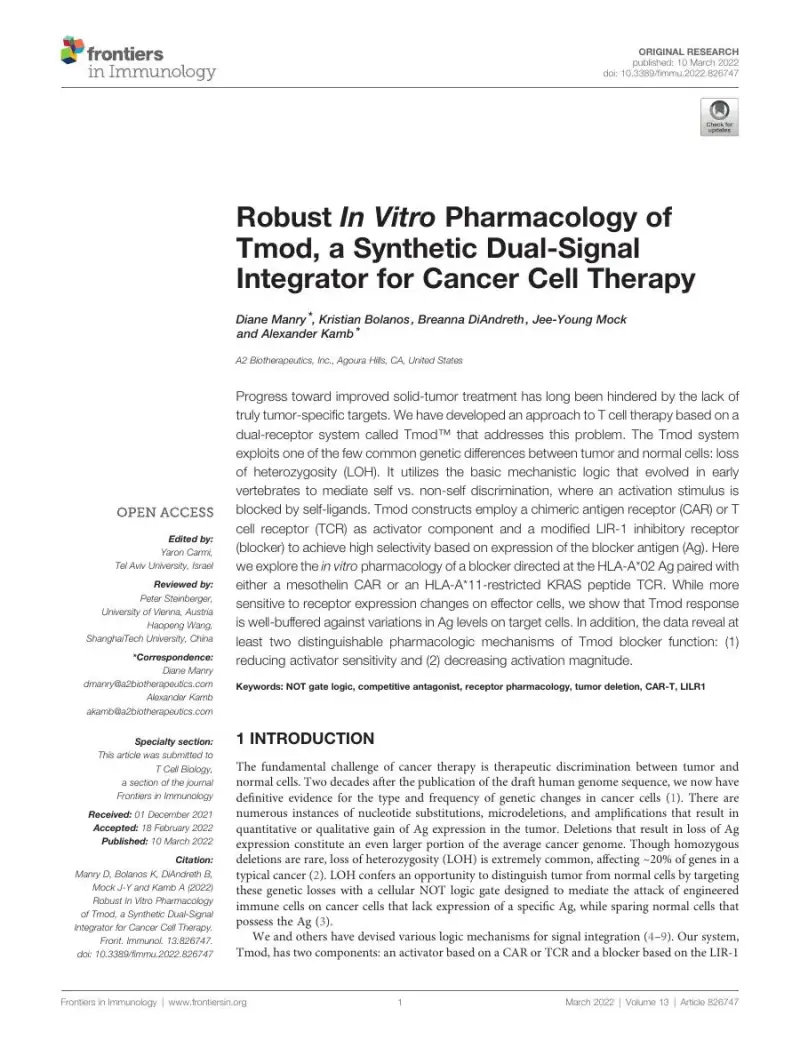
The Tmod dual-receptor system, which pairs a CAR or TCR activator with an HLA-A*02-directed LIR-1 blocker, responds in a buffered, sublinear way to wide changes in antigen and receptor levels in vitro. Across a roughly million-fold range of blocker antigen, the MSLN CAR activator EC50 shifted about 100-fold, while blocker IC50 shifted about 20-fold over a 100-fold range of MSLN antigen; for a KRAS TCR activator, EC50 shifted at least 100-fold over a smaller range. Changing the activator:blocker receptor ratio by 3.5-fold (CAR) or 14-fold (TCR) altered blocker sensitivity only modestly. Jurkat reporter cells and primary T cells from two donors gave similar trends, and the data indicate a mixed inhibition mechanism combining reduced sensitivity and reduced activation magnitude.
Note: In vitro study; the authors note that experiments centered on Jurkat cells, with more limited study of primary T cells, the relevant therapeutic cell type.
Despite the multi-component system of cells, Ags and receptors, quantitative experiments demonstrate a smooth, buffered dose-response over a range of inputs. — Diane Manry, Kristian Bolanos, Breanna DiAndreth, Jee-Young Mock, Alexander Kamb, Frontiers in Immunology
Study details
- Authors
- Diane Manry, Kristian Bolanos, Breanna DiAndreth, Jee-Young Mock, Alexander Kamb
- Institution
- A2 Biotherapeutics, Inc., Agoura Hills, CA, United States
- Journal
- Frontiers in Immunology
- Year
- 2022
- G-Rex® model(s)
- G-Rex®24 Well Plate
- Cell type(s)
- CAR T Cells
- Application area
- Solid tumor
- Study phase
- Preclinical
How G-Rex® was used
Primary human T cells from two PBMC donors were stimulated with TransAct and transduced with lentivirus, then after 5-7 days moved to a 24-well G-Rex® plate (Wilson Wolf) in LymphoONE medium with 1% human serum and 300 IU/mL IL-2. IL-2 at 300 IU/mL was added every 2-3 days and the medium was changed every 7 days; cells were cryofrozen two weeks after the initial thaw. Before each experiment, thawed aliquots from each donor recovered for 1-3 days in a 24-well G-Rex® plate in X-VIVO medium with 5% human serum and 300 IU/mL IL-2, and were then used in the cytotoxicity and cytokine assays.
Explore related

Full citation
Manry D, Bolanos K, DiAndreth B, Mock JY, Kamb A. Robust In Vitro Pharmacology of Tmod, a Synthetic Dual-Signal Integrator for Cancer Cell Therapy. Front Immunol. 2022;13:826747.
Building a similar workflow?
Talk to a ScaleReady specialist about how the G-Rex® platform can support your program — from process development to clinical-scale manufacturing.


