
TEM8 Tri-specific Killer Engager binds both tumor and tumor stroma to specifically engage natural killer cell anti-tumor activity
Overview
A Tri-specific Killer Engager (TriKE) targeting TEM8 (cam1615TEM8) was developed to redirect NK cells against both tumor and stromal cells. The molecule enhanced NK cell proliferation and antitumor efficacy in mouse models. Enriched NK cells for in vivo experiments were expanded in G-Rex® 6-well plates.
What this paper found
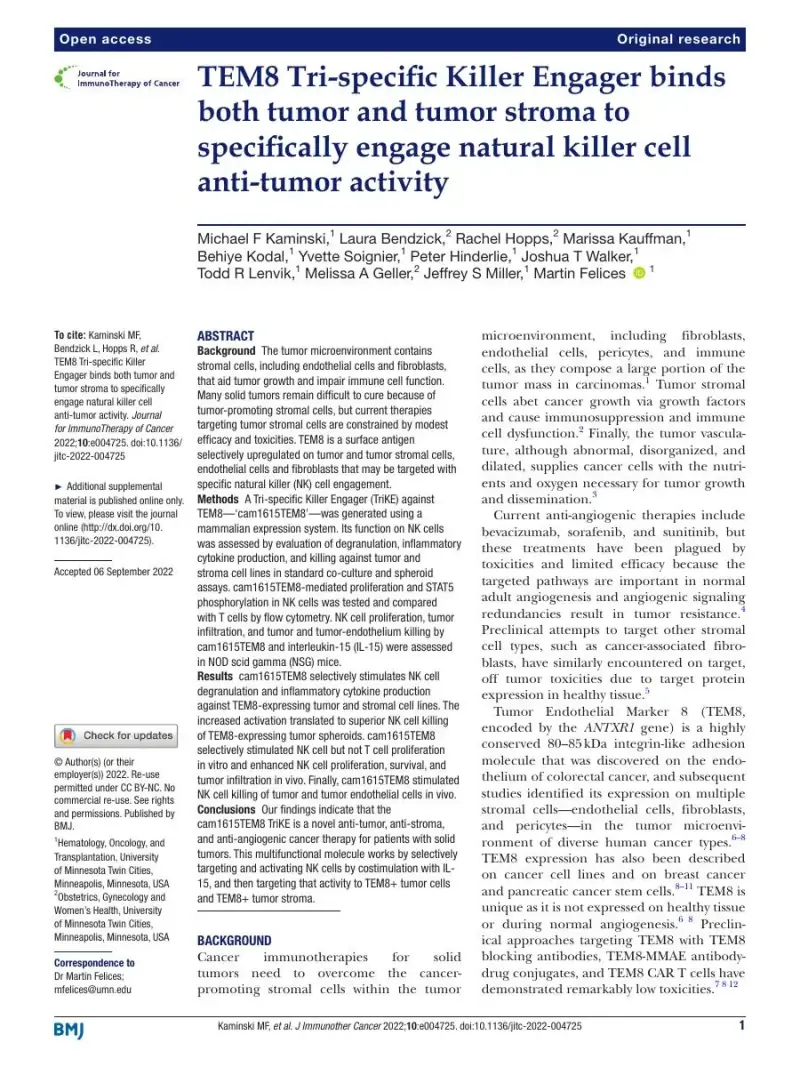
A tri-specific killer engager targeting TEM8, named cam1615TEM8, directs natural killer cells against TEM8-expressing tumor and tumor stromal cells and outperforms IL-15 alone in preclinical models. The molecule combines an anti-CD16 camelid nanobody, an IL-15 moiety and an anti-TEM8 scFv. It triggered NK degranulation and IFNγ production against A549 and DU145 tumor lines, endothelial cells and fibroblasts, but not TEM8-negative HT-29 or Raji, and activity vanished when TEM8 was knocked out in A549. It induced similar NK cell proliferation to IL-15 but far less T cell proliferation. In NSG mice with A549 xenografts, NK cells plus cam1615TEM8 gave smaller tumors, longer survival, more circulating and tumor-infiltrating NK cells, and about threefold lower endothelial density than functionally equivalent IL-15.
Note: Preclinical study in cell lines and a mouse xenograft model; the authors note that clinical translation of any TEM8-targeting therapy would require careful monitoring for toxicities.
In summary, cam1615TEM8 stimulated greater in vivo NK cell number than IL-15 and superior, NK cell-dependent tumor control than IL-15 or cam1615TEM8 in the absence of NK cells. — Michael F Kaminski, Laura Bendzick, Rachel Hopps, Marissa Kauffman, Behiye Kodal, Yvette Soignier, Peter Hinderlie, Joshua T Walker, Todd R Lenvik, Melissa A Geller, Jeffrey S Miller, Martin Felices, Journal for ImmunoTherapy of Cancer
Study details
- Authors
- Michael F Kaminski, Laura Bendzick, Rachel Hopps, Marissa Kauffman, Behiye Kodal, Yvette Soignier, Peter Hinderlie, Joshua T Walker, Todd R Lenvik, Melissa A Geller, Jeffrey S Miller, Martin Felices
- Institution
- Hematology, Oncology, and Transplantation, University of Minnesota Twin Cities, Minneapolis, Minnesota, USA · Obstetrics, Gynecology and Women’s Health, University of Minnesota Twin Cities, Minneapolis, Minnesota, USA
- Journal
- Journal for ImmunoTherapy of Cancer
- Year
- 2022
- G-Rex® model(s)
- G-Rex®6 Well Plate
- Cell type(s)
- NK Cells
- Application area
- Solid tumor
- Study phase
- Preclinical
How G-Rex® was used
Primary NK cells enriched from healthy-donor blood were expanded ex vivo in G-Rex® 6-well plates for the in vivo experiments, following a published protocol with minor modifications. The expanded NK cells were infused intravenously into NSG mice bearing subcutaneous A549 tumors, at 10E6 cells on days 0, 7 and 14, together with intraperitoneal cam1615TEM8 or IL-15. In these mice, NK cells with cam1615TEM8 produced smaller tumors, longer survival and higher circulating NK cell counts than NK cells with functionally equivalent IL-15.
Explore related

Full citation
Kaminski MF, Bendzick L, Hopps R, et al. TEM8 Tri-specific Killer Engager binds both tumor and tumor stroma to specifically engage natural killer cell anti-tumor activity. J Immunother Cancer. 2022;10(9):e004725.
Building a similar workflow?
Talk to a ScaleReady specialist about how the G-Rex® platform can support your program — from process development to clinical-scale manufacturing.


