
Neutralizing antibodies protect mice against Venezuelan equine encephalitis virus aerosol challenge
Overview
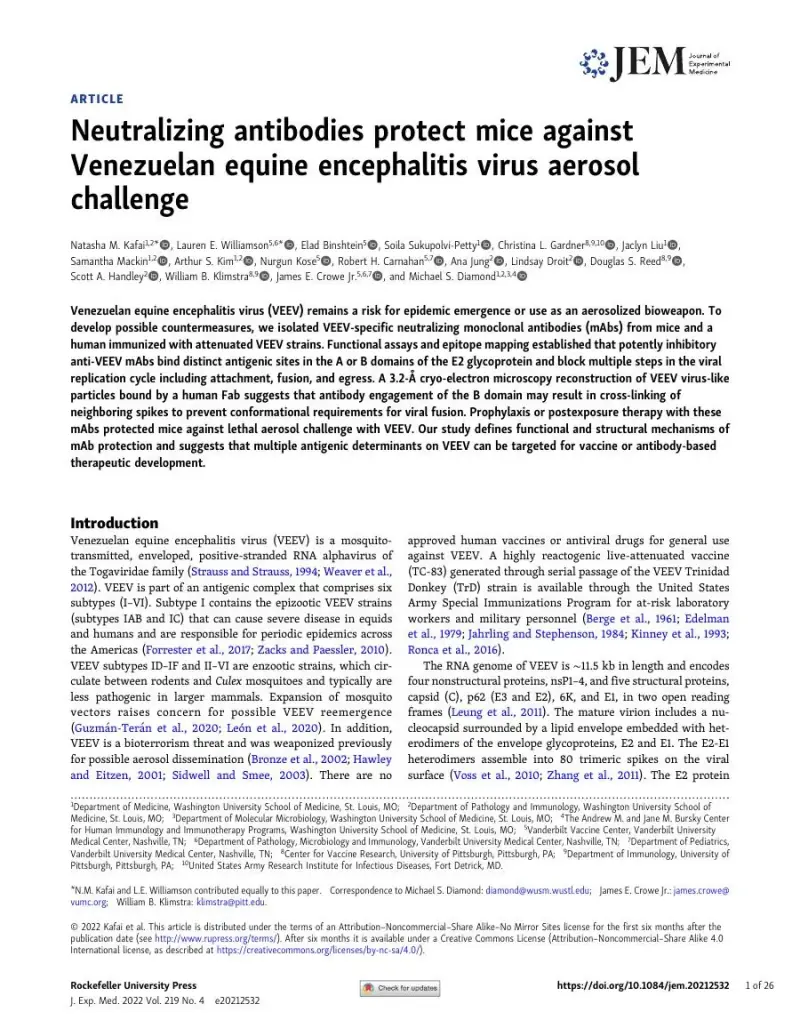
This study isolates and characterizes neutralizing monoclonal antibodies against Venezuelan equine encephalitis virus (VEEV) from mice and humans. These antibodies target the E2 glycoprotein and protect mice from lethal aerosol challenge. G-Rex® devices were used to expand hybridoma clones in serum-free medium.
What this paper found
Neutralizing monoclonal antibodies against Venezuelan equine encephalitis virus, isolated from immunized mice and one vaccinated human donor, protected mice from lethal aerosol challenge. Fourteen murine antibodies and one human antibody were grouped into three competition groups targeting domains A or B of the E2 glycoprotein, and they blocked attachment, fusion or egress. Cryo-EM of the human antibody hVEEV-63 bound to virus-like particles, resolved at 3.2 Å, suggested cross-linking of neighboring spikes. A single 100 μg dose given 24 h before challenge gave 70-100% survival. Given 24 h after challenge, domain A antibodies gave 50-70% survival and most domain B antibodies gave 80%.
Note: The study is in mice; the authors note that future challenge studies with other VEE complex viruses are needed to determine cross-protective activity, and that the neutralizing potency did not directly correlate with protective efficacy.
Overall, the E2 domain B serves as a target for neutralizing and protective anti-VEEV mAbs (Hunt et al., 2010; Weger-Lucarelli et al., 2015) in mice and humans. — Natasha M. Kafai, Lauren E. Williamson, Elad Binshtein, Soila Sukupolvi-Petty, Christina L. Gardner, Jaclyn Liu, Samantha Mackin, Arthur S. Kim, Nurgun Kose, Robert H. Carnahan, Ana Jung, Lindsay Droit, Douglas S. Reed, Scott A. Handley, William B. Klimstra, James E. Crowe Jr., Michael S. Diamond, Journal of Experimental Medicine
Study details
- Authors
- Natasha M. Kafai, Lauren E. Williamson, Elad Binshtein, Soila Sukupolvi-Petty, Christina L. Gardner, Jaclyn Liu, Samantha Mackin, Arthur S. Kim, Nurgun Kose, Robert H. Carnahan, Ana Jung, Lindsay Droit, Douglas S. Reed, Scott A. Handley, William B. Klimstra, James E. Crowe Jr., Michael S. Diamond
- Institution
- Department of Medicine, Washington University School of Medicine, St. Louis, MO, USA · Department of Pathology and Immunology, Washington University School of Medicine, St. Louis, MO, USA · Department of Molecular Microbiology, Washington University School of Medicine, St. Louis, MO, USA · The Andrew M. and Jane M. Bursky Center for Human Immunology and Immunotherapy Programs, Washington University School of Medicine, St. Louis, MO, USA · Vanderbilt Vaccine Center, Vanderbilt University Medical Center, Nashville, TN, USA · Department of Pathology, Microbiology and Immunology, Vanderbilt University Medical Center, Nashville, TN, USA · Department of Pediatrics, Vanderbilt University Medical Center, Nashville, TN, USA · Center for Vaccine Research, University of Pittsburgh, Pittsburgh, PA, USA · Department of Immunology, University of Pittsburgh, Pittsburgh, PA, USA · United States Army Research Institute for Infectious Diseases, Fort Detrick, MD, USA
- Journal
- Journal of Experimental Medicine
- Year
- 2022
- Cell type(s)
- Other
- Application area
- Infectious disease
- Study phase
- Preclinical
How G-Rex® was used
Human hybridoma clones producing the anti-VEEV antibody were first expanded in plates and T-flasks, then further expanded in T-225 cm2 flasks or in G-Rex® devices from Wilson Wolf. The cells were grown in serum-free Hybridoma SFM medium. Supernatants from the G-Rex® cultures were harvested in sets of 3-5 d and passed through a 0.2 μm filter. Antibodies were then purified from the filtrate by affinity chromatography.
Note: Hybridoma clones were expanded serially into 48-well plates, 12-well plates and T-75 flasks before the G-Rex® or T-225 stage.
Explore related
Full citation
Kafai NM, Williamson LE, Binshtein E, et al. Neutralizing antibodies protect mice against Venezuelan equine encephalitis virus aerosol challenge. J Exp Med. 2022;219(4):e20212532.
Building a similar workflow?
Talk to a ScaleReady specialist about how the G-Rex® platform can support your program — from process development to clinical-scale manufacturing.


