
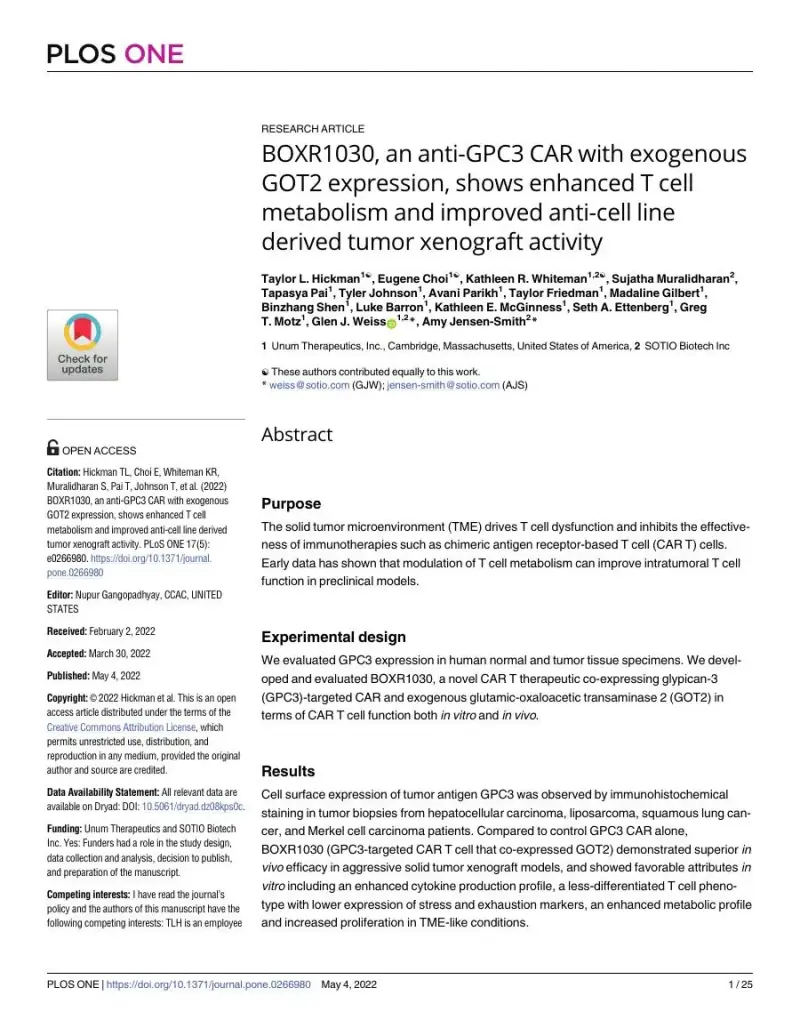
BOXR1030, an anti-GPC3 CAR with exogenous GOT2 expression, shows enhanced T cell metabolism and improved anti-cell line derived tumor xenograft activity
Overview
The authors developed BOXR1030, a GPC3-targeted CAR T cell co-expressing GOT2 to enhance metabolism. T cells were expanded in G-Rex® 10 or 100 units. BOXR1030 demonstrated superior in vivo antitumor activity, reduced exhaustion, and better persistence in solid tumor xenograft models compared to control CARs.
What this paper found
Adding exogenous GOT2, a mitochondrial metabolic enzyme, to a GPC3-targeted CAR (BOXR1030) improved CAR T cell antitumor activity in aggressive solid tumor xenograft models. Two low doses of 1 × 10^6 CAR+ cells caused durable regressions of Hep3B tumors for about 100 days, whereas the CAR alone had little to no activity. BOXR1030 cells showed higher intracellular aspartate and AST activity, a less-differentiated phenotype, lower stress and exhaustion gene expression, and better proliferation under hypoxia or low glucose. GPC3 was detected in more than 30% of hepatocellular carcinoma, lung squamous, Merkel cell and liposarcoma samples tested. A clinical trial is planned.
Note: Preclinical study in cell lines and mouse xenograft models; the authors note that xenogeneic graft-versus-host reactivity of human T cells occurred in NSG mice at late time points.
Together, these results demonstrated that co-expression of GOT2 can substantially improve the overall antitumor activity of CAR T cells by inducing broad changes in cellular function and phenotype. — Taylor L. Hickman, Eugene Choi, Kathleen R. Whiteman, Sujatha Muralidharan, Tapasya Pai, Tyler Johnson, Avani Parikh, Taylor Friedman, Madaline Gilbert, Binzhang Shen, Luke Barron, Kathleen E. McGinness, Seth A. Ettenberg, Greg T. Motz, Glen J. Weiss, Amy Jensen-Smith, PLOS ONE
Study details
- Authors
- Taylor L. Hickman, Eugene Choi, Kathleen R. Whiteman, Sujatha Muralidharan, Tapasya Pai, Tyler Johnson, Avani Parikh, Taylor Friedman, Madaline Gilbert, Binzhang Shen, Luke Barron, Kathleen E. McGinness, Seth A. Ettenberg, Greg T. Motz, Glen J. Weiss, Amy Jensen-Smith
- Institution
- Unum Therapeutics, Inc., Cambridge, Massachusetts, United States of America · SOTIO Biotech Inc
- Journal
- PLOS ONE
- Year
- 2022
- G-Rex® model(s)
- G-Rex®10
- Cell type(s)
- CAR T Cells
- Application area
- Solid tumor
- Study phase
- Preclinical
How G-Rex® was used
For research-scale manufacturing, T cells activated with anti-CD3/anti-CD28 and IL-2 and transduced with retroviral supernatant were transferred 24 hours later into G-Rex® 10 or 100 units and expanded in TexMACS medium with IL-2 (100 U/mL) added every 48-72 hours. CAR products were harvested on day 10 and cryopreserved. GMP-analogous material was instead made in gas-permeable bags.
Note: Research-scale material was used in all evaluations except the safety/biodistribution study, which used GMP-analogous material.
Explore related

Full citation
Hickman TL, Choi E, Whiteman KR, et al. BOXR1030, an anti-GPC3 CAR with exogenous GOT2 expression, shows enhanced T cell metabolism and improved anti-cell line derived tumor xenograft activity. PLoS One. 2022;17(5):e0266980.
Building a similar workflow?
Talk to a ScaleReady specialist about how the G-Rex® platform can support your program — from process development to clinical-scale manufacturing.


