
Generation of non-human primate CAR Tregs using artificial antigen-presenting cells, simian tropic lentiviral vectors, and antigen-specific restimulation
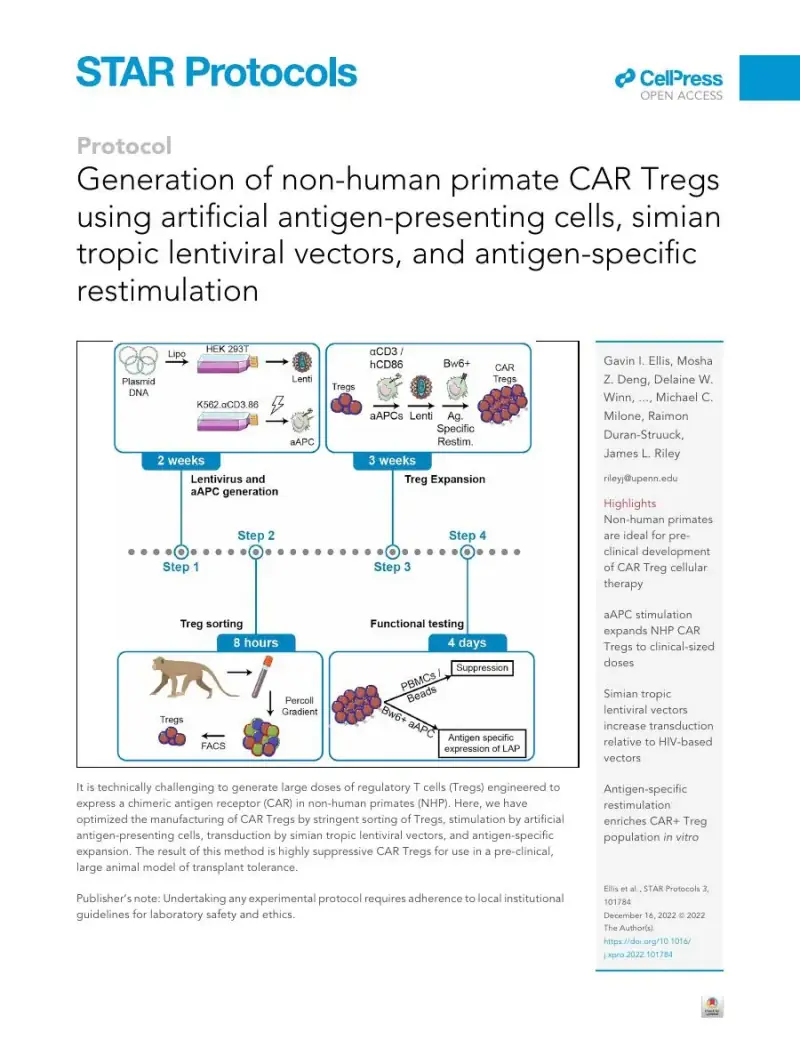
Overview
This protocol details the manufacturing of CAR Tregs for non-human primates. G-Rex® 6-well plates were used to expand K562 artificial antigen-presenting cells (aAPCs), which were subsequently used to stimulate Tregs. The method yields highly suppressive CAR Tregs for pre-clinical studies.
What this paper found
This protocol shows how to manufacture clinical-sized doses of antigen-specific CAR regulatory T cells from Cynomolgus macaque blood. Tregs are sorted stringently, as the top 1%–2% of CD25+ CD127- cells among CD4+ CD8- cells, then stimulated with irradiated K562 artificial antigen-presenting cells and IL-2, transduced with a simian tropic lentiviral vector, and restimulated with Bw6-expressing K562 cells. From 25,000 to 100,000 sorted Tregs, 500–1000 × 10^6 cells are expected by day 18–21, with more than 80% FoxP3+, Helios+ and CAR+. CAR+ cells increased from 32.4% after the first stimulation to 91.7% after the third. Batches are checked with LAP activation, where more than 30% LAP+ cells are expected on target antigen, and suppression assays.
Note: Large batch yield depends on achieving high transduction during the first week of growth; the protocol also notes that IACUC limits the volume and frequency of blood draws from the animals.
Stringent sorting of Tregs is essential to maintaining FoxP3 and suppressor ability in expanded cells. — Gavin I. Ellis, Mosha Z. Deng, Delaine W. Winn, Kimberly E. Coker, Divanshu Shukla, Vijay Bhoj, Michael C. Milone, Raimon Duran-Struuck, James L. Riley, STAR Protocols
Study details
- Authors
- Gavin I. Ellis, Mosha Z. Deng, Delaine W. Winn, Kimberly E. Coker, Divanshu Shukla, Vijay Bhoj, Michael C. Milone, Raimon Duran-Struuck, James L. Riley
- Institution
- Department of Microbiology and Center for Cellular Immunotherapies, University of Pennsylvania, Philadelphia, PA, USA · Department of Pathobiology, University of Pennsylvania, Philadelphia, PA, USA · Department of Pathology and Laboratory Medicine, University of Pennsylvania, Philadelphia, PA, USA
- Journal
- STAR Protocols
- Year
- 2022
- G-Rex® model(s)
- G-Rex®6M Well Plate
- Cell type(s)
- CAR T Cells, Treg Cells
- Application area
- Other
- Study phase
- Preclinical
How G-Rex® was used
A G-Rex® 6 well plate (G-Rex® 6M well plate, Cat#80660M) was used to expand K562 artificial antigen-presenting cells before irradiation. After one week of passaging in flasks, 1.25 × 10^6 K562 cells were added to each well, and each well was filled to 100 mL with fresh R10 medium. Cells grew undisturbed for 1 week. Cells from all wells were then pooled and brought to 50 mL with R10, placed in a T150 flask and irradiated at 100 Gy, then cryopreserved for later stimulation of NHP T cells.
Note: The G-Rex® plate was used only to produce the irradiated K562 feeder cells; the Tregs themselves were expanded in 96-well, 48-well and larger plates or flasks.
Explore related

Full citation
Ellis GI, Deng MZ, Winn DW, et al. Generation of non-human primate CAR Tregs using artificial antigen-presenting cells, simian tropic lentiviral vectors, and antigen-specific restimulation. STAR Protoc. 2022;3(4):101784.
Building a similar workflow?
Talk to a ScaleReady specialist about how the G-Rex® platform can support your program — from process development to clinical-scale manufacturing.


