
Transcriptomic analysis reveals optimal cytokine combinations for SARS-CoV-2-specific T cell therapy products
Overview
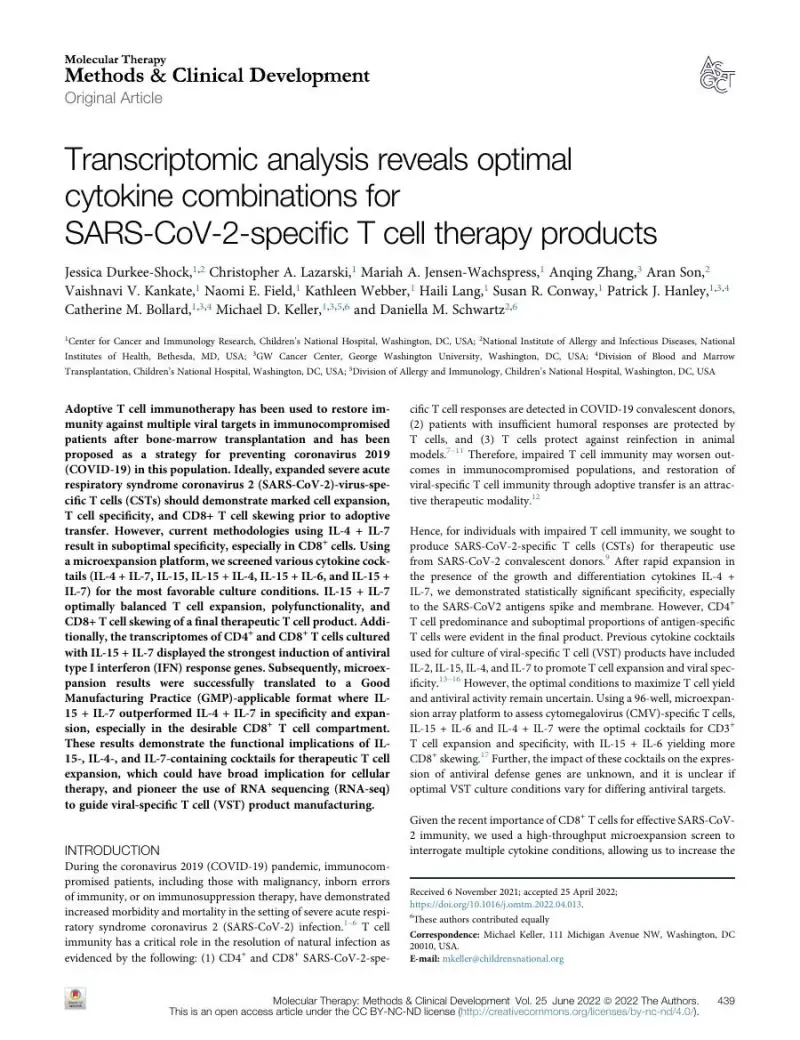
The study identified IL-15 + IL-7 as the optimal cytokine cocktail for expanding SARS-CoV-2-specific T cells (CSTs). Results were translated to a GMP-applicable format using G-Rex® 10, which showed improved expansion and specificity, particularly for CD8+ T cells, compared to IL-4 + IL-7.
What this paper found
Culturing SARS-CoV-2-specific T cells with IL-15 plus IL-7 instead of the standard IL-4 plus IL-7 gave a better balanced product for adoptive therapy. In a 96-well microexpansion screen of five cytokine cocktails with PBMCs from 9 convalescent donors, adding IL-7 or IL-6 to IL-15 raised CD8+ T cells by 24%–40% over non-IL-15 culture, and IL-15 + IL-7 also preserved total T cell and CD4+ expansion. RNA sequencing of CD4+ and CD8+ cells from 4 donors showed the strongest antiviral interferon-stimulated gene enrichment with IL-15 + IL-7 (NES 1.82 and 1.83), whereas IL-4 induced genes negatively regulating host defense. In G-Rex® 10 bioreactors, mean fold expansion was 3.2 versus 1.9 for IL-15 + IL-7 versus IL-4 + IL-7 (p = 0.08), with higher CD4+ and CD8+ specificity.
Note: The study used a relatively small number of donors, and the authors note that other donors could respond differently.
This study provides evidence for the utility of screening culture conditions in microexpansion format and provides an important step in the manufacturing of CSTs for adoptive therapeutic use in individuals with impaired T cell immunity. — Jessica Durkee-Shock, Christopher A. Lazarski, Mariah A. Jensen-Wachspress, Anqing Zhang, Aran Son, Vaishnavi V. Kankate, Naomi E. Field, Kathleen Webber, Haili Lang, Susan R. Conway, Patrick J. Hanley, Catherine M. Bollard, Michael D. Keller, Daniella M. Schwartz, Molecular Therapy - Methods & Clinical Development
Study details
- Authors
- Jessica Durkee-Shock, Christopher A. Lazarski, Mariah A. Jensen-Wachspress, Anqing Zhang, Aran Son, Vaishnavi V. Kankate, Naomi E. Field, Kathleen Webber, Haili Lang, Susan R. Conway, Patrick J. Hanley, Catherine M. Bollard, Michael D. Keller, Daniella M. Schwartz
- Institution
- Center for Cancer and Immunology Research, Children's National Hospital, Washington, DC, USA · National Institute of Allergy and Infectious Diseases, National Institutes of Health, Bethesda, MD, USA · GW Cancer Center, George Washington University, Washington, DC, USA · Division of Blood and Marrow Transplantation, Children's National Hospital, Washington, DC, USA · Division of Allergy and Immunology, Children's National Hospital, Washington, DC, USA
- Journal
- Molecular Therapy - Methods & Clinical Development
- Year
- 2022
- G-Rex® model(s)
- G-Rex®10
- Cell type(s)
- VST Cells
- Application area
- Infectious disease
- Study phase
- Preclinical
How G-Rex® was used
Stimulated PBMCs from SARS-CoV-2 convalescent donors, pulsed with spike and membrane peptide libraries, were seeded into G-Rex® 10 bioreactors at 10–20 million cells each, in 30 mL medium containing either IL-4 (400 IU/mL) + IL-7 (10 ng/mL) or IL-7 (10 ng/mL) + IL-15 (5 ng/mL). Cultures were supplemented with additional media and cytokines on day 7 and harvested and counted on day 10. Harvested cells were analyzed by intracellular flow cytometry for antigen specificity. Six of 7 donor-derived products expanded more with IL-15 + IL-7, giving mean fold expansion of 3.2 versus 1.9 with IL-4 + IL-7.
Explore related

Full citation
Durkee-Shock J, Lazarski CA, Jensen-Wachspress MA, et al. Transcriptomic analysis reveals optimal cytokine combinations for SARS-CoV-2-specific T cell therapy products. Mol Ther Methods Clin Dev. 2022;25:439-447.
Building a similar workflow?
Talk to a ScaleReady specialist about how the G-Rex® platform can support your program — from process development to clinical-scale manufacturing.


