
Rapid Generation of TCR and CD8αβ Transgenic Virus Specific T Cells for Immunotherapy of Leukemia
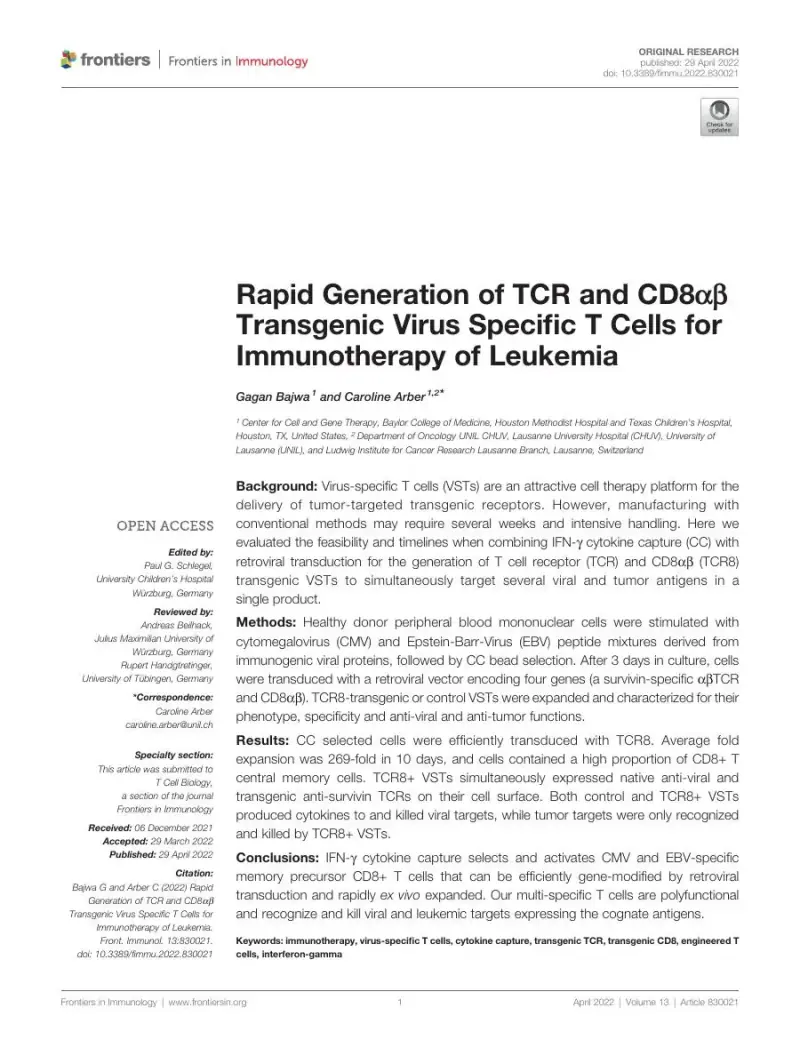
Overview
The authors describe a method to generate TCR and CD8ab transgenic VSTs using IFN-g cytokine capture. G-Rex® devices were utilized for the second stimulation expansion phase, yielding high numbers of polyfunctional T cells with simultaneous anti-viral and anti-tumor activity in a shortened timeframe.
What this paper found
Combining IFN-γ cytokine capture with retroviral transduction allows virus-specific T cells carrying a survivin-specific TCR and CD8αβ to be generated from healthy donor blood in about ten days. PBMCs were stimulated with CMV and EBV peptide mixtures, IFN-γ-secreting cells were isolated, cultured for 3 days and transduced. Transduction reached 66% mTCR-positive cells, and expansion averaged 269-fold in 10 days, with products predominantly CD8+ and rich in central memory cells (81%). Transgenic cells kept anti-viral reactivity while gaining survivin-directed IFN-γ production and killing of BV173 leukemia cells (residual tumor cells 0.04 vs 2.3 × 10^6 with non-transduced cells). Yield of IFN-γ-secreting cells from 50 × 10^6 PBMCs ranged from 3.13 × 10^4 to 2.2 × 10^6 across eight donors.
Note: Small-scale study with healthy donor cells in vitro; the authors note almost exclusive enrichment for CD8+ T cells and high donor variability in yield after cytokine capture.
Thus, we show that the combination of IFN-g capture and retroviral transduction can rapidly generate engineered T cell products with simultaneous anti-viral and antitumor specificities that are highly enriched in CD8+ TCM cells. — Gagan Bajwa, Caroline Arber, Frontiers in Immunology
Study details
- Authors
- Gagan Bajwa, Caroline Arber
- Institution
- Center for Cell and Gene Therapy, Baylor College of Medicine, Houston Methodist Hospital and Texas Children's Hospital, Houston, TX, United States · Department of Oncology UNIL CHUV, Lausanne University Hospital (CHUV), University of Lausanne (UNIL), and Ludwig Institute for Cancer Research Lausanne Branch, Lausanne, Switzerland
- Journal
- Frontiers in Immunology
- Year
- 2022
- Cell type(s)
- TCR T Cells, VST Cells
- Application area
- Hematologic malignancy · Infectious disease
- Study phase
- Preclinical
How G-Rex® was used
After the first expansion, virus-specific T cells received a second stimulation (S2) in G-Rex® gas permeable culture devices to test their further expansion potential. S2 used CMV/EBV pepmix/peptide and survivin LMLGEFLKL peptide-pulsed irradiated (40 Gy) autologous activated T cells together with irradiated (100 Gy) K562cs cells at a ratio of 1:1:5. Non-transduced and TCR8+ cells reached mean fold expansions of 6284 and 5877 respectively after S2 (n=5), compared with 294 and 269 after the first stimulation.
Explore related
Full citation
Bajwa G, Arber C. Rapid Generation of TCR and CD8αβ Transgenic Virus Specific T Cells for Immunotherapy of Leukemia. Front Immunol. 2022;13:830021.
Building a similar workflow?
Talk to a ScaleReady specialist about how the G-Rex® platform can support your program — from process development to clinical-scale manufacturing.


