
CAR-NK Cells Effectively Target SARS-CoV-2-Spike-Expressing Cell Lines In Vitro
Overview
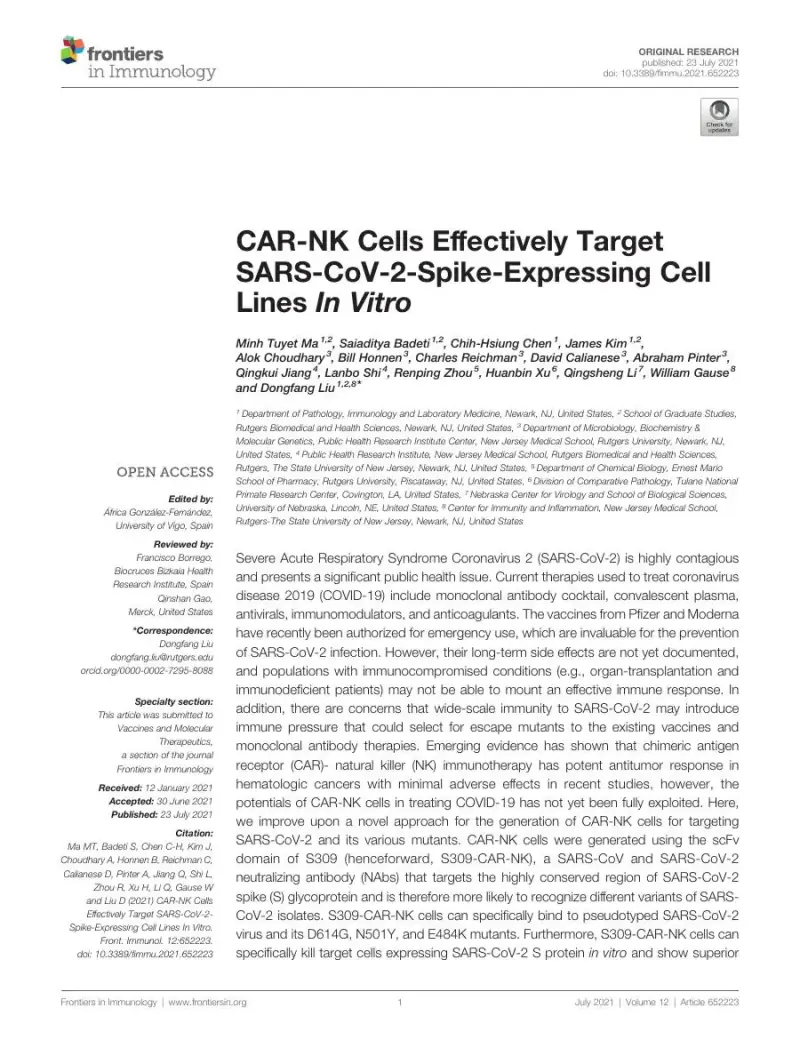
The authors developed CAR-NK cells using the S309 antibody to target SARS-CoV-2. Primary S309-CAR-NK cells were expanded in G-Rex® plates for 21 days following transduction. These cells demonstrated effective binding and killing of spike-protein expressing target cells in vitro.
What this paper found
CAR-NK cells built from the S309 neutralizing-antibody scFv recognized and killed cells expressing the SARS-CoV-2 spike protein in vitro, including spike carrying D614G, E484K and N501Y changes. S309 CAR-expressing NK-92MI cells bound the receptor-binding domain and pseudotyped viral particles, with binding efficiency above 90%. They degranulated and lysed 293T-hACE2-RBD and A549-Spike targets in 4-hour chromium release assays, while irrelevant HepG2 targets showed no significant difference from parental NK-92MI cells. Primary NK cells expanded from blood reached about 90% purity and roughly 80% CAR transduction, and killed A549-Spike and A549-Spike D614G cells. S309 CAR-NK cells outperformed CR3022 CAR-NK cells against A549-Spike targets in NK-92MI assays, and primary cells showed a higher trend.
Note: In vitro study using pseudotyped virus and spike-expressing cell lines; the authors note that future work with wild-type SARS-CoV-2 in preclinical animal models is needed to test efficacy and toxicity.
In summary, S309-CAR-NK-92MI cells can strongly and specifically bind to the RBD-containing S1 subunit recombinant protein and the full-length pseudotyped SARS-CoV-2 S viral particles. — Minh Tuyet Ma, Saiaditya Badeti, Chih-Hsiung Chen, James Kim, Alok Choudhary, Bill Honnen, Charles Reichman, David Calianese, Abraham Pinter, Qingkui Jiang, Lanbo Shi, Renping Zhou, Huanbin Xu, Qingsheng Li, William Gause, Dongfang Liu, Frontiers in Immunology
Study details
- Authors
- Minh Tuyet Ma, Saiaditya Badeti, Chih-Hsiung Chen, James Kim, Alok Choudhary, Bill Honnen, Charles Reichman, David Calianese, Abraham Pinter, Qingkui Jiang, Lanbo Shi, Renping Zhou, Huanbin Xu, Qingsheng Li, William Gause, Dongfang Liu
- Institution
- Department of Pathology, Immunology and Laboratory Medicine, Newark, NJ, United States · School of Graduate Studies, Rutgers Biomedical and Health Sciences, Newark, NJ, United States · Department of Microbiology, Biochemistry & Molecular Genetics, Public Health Research Institute Center, New Jersey Medical School, Rutgers University, Newark, NJ, United States · Public Health Research Institute, New Jersey Medical School, Rutgers Biomedical and Health Sciences, Rutgers, The State University of New Jersey, Newark, NJ, United States · Department of Chemical Biology, Ernest Mario School of Pharmacy, Rutgers University, Piscataway, NJ, United States · Division of Comparative Pathology, Tulane National Primate Research Center, Covington, LA, United States · Nebraska Center for Virology and School of Biological Sciences, University of Nebraska, Lincoln, NE, United States · Center for Immunity and Inflammation, New Jersey Medical School, Rutgers-The State University of New Jersey, Newark, NJ, United States
- Journal
- Frontiers in Immunology
- Year
- 2021
- Cell type(s)
- NK Cells
- Application area
- Infectious disease
- Study phase
- Preclinical
How G-Rex® was used
Primary NK cells from healthy-donor PBMCs were co-cultured with irradiated 221-mIL21 feeder cells plus IL-2 and IL-15, and transduced with S309-CAR retrovirus on day 4. Forty-eight hours later, the primary S309-CAR-NK cells were transferred to a G-Rex® plate and cultured for 21 days of continued expansion.
Explore related
Full citation
Ma MT, Badeti S, Chen CH, et al. CAR-NK Cells Effectively Target SARS-CoV-2-Spike-Expressing Cell Lines In Vitro. Front Immunol. 2021;12:652223.
Building a similar workflow?
Talk to a ScaleReady specialist about how the G-Rex® platform can support your program — from process development to clinical-scale manufacturing.


