
Oncolytic adeno-immunotherapy modulates the immune system enabling CAR T-cells to cure pancreatic tumors
Overview
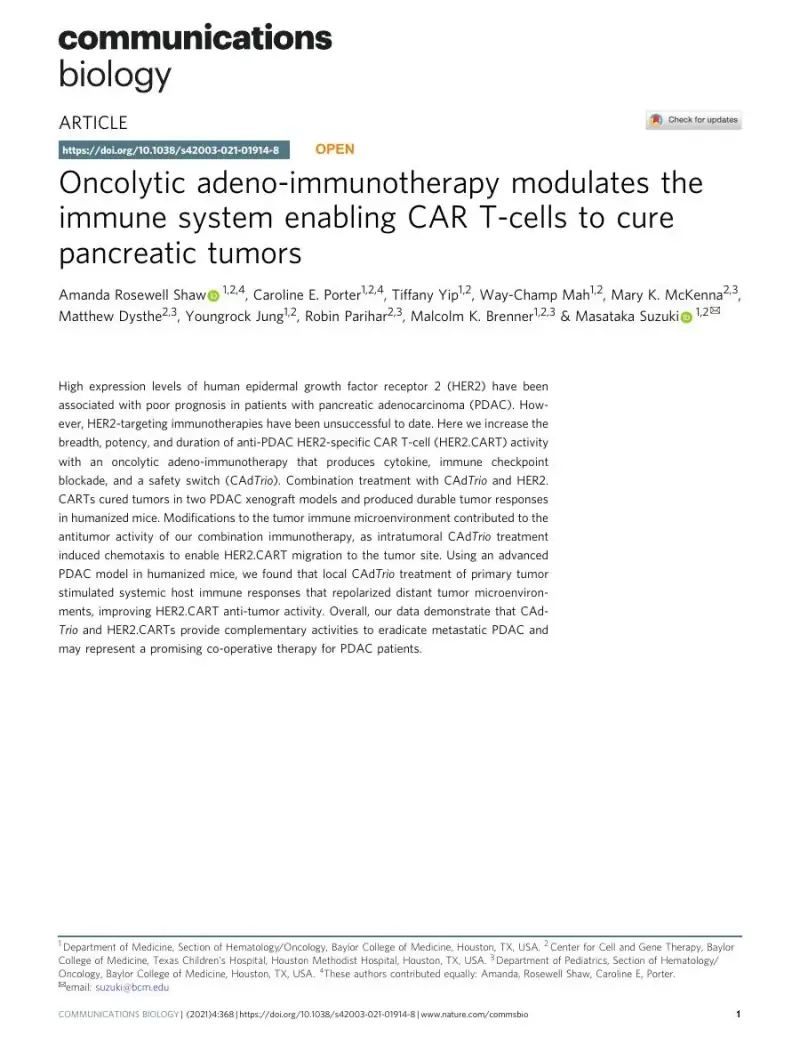
The study combines oncolytic adenovirus (CAdTrio) with HER2-CAR T cells to treat pancreatic cancer. NK cells, expanded in G-Rex® devices with feeder cells, were also used in experiments. The combination therapy modulated the tumor microenvironment and improved CAR-T infiltration and efficacy.
What this paper found
Combining an oncolytic adenoviral immunotherapy encoding IL-12p70, a PD-L1 blocking mini-antibody and an HSVtk safety switch (CAdTrio) with HER2-specific CAR T-cells eradicated pancreatic adenocarcinoma tumors in mouse models. Mice bearing subcutaneous CFPAC-1 or CAPAN-1 tumors received 1 x 10^7 viral particles of CAdTrio intratumorally, followed three days later by 1 x 10^6 HER2.CARTs intravenously. In CAPAN-1 xenografts, CAR T-cells alone gave complete responses in 3 of 5 mice with relapses from HER2 loss, while the combination cured 5 of 5. Pre-treatment raised CAR T-cell infiltration at the tumor site and circulating IFN gamma. In humanized mice, the combination achieved complete responses in 4 of 6 animals and also controlled distant untreated tumors.
Note: Work was carried out in cell lines and in xenograft and humanized mouse models; the authors state that clinical trials will ultimately show whether the combination delivers the desired systemic antitumor effects.
Overall, we demonstrate that combining CAdTrio and HER2. CARTs is a curative immunotherapy in several PDAC models, including humanized mouse models. — Amanda Rosewell Shaw, Caroline E. Porter, Tiffany Yip, Way-Champ Mah, Mary K. McKenna, Matthew Dysthe, Youngrock Jung, Robin Parihar, Malcolm K. Brenner, Masataka Suzuki, Communications Biology
Study details
- Authors
- Amanda Rosewell Shaw, Caroline E. Porter, Tiffany Yip, Way-Champ Mah, Mary K. McKenna, Matthew Dysthe, Youngrock Jung, Robin Parihar, Malcolm K. Brenner, Masataka Suzuki
- Institution
- Department of Medicine, Section of Hematology/Oncology, Baylor College of Medicine, Houston, TX, USA · Center for Cell and Gene Therapy, Baylor College of Medicine, Texas Children's Hospital, Houston Methodist Hospital, Houston, TX, USA · Department of Pediatrics, Section of Hematology/Oncology, Baylor College of Medicine, Houston, TX, USA
- Journal
- Communications Biology
- Year
- 2021
- Cell type(s)
- CAR T Cells, NK Cells
- Application area
- Solid tumor
- Study phase
- Preclinical
How G-Rex® was used
G-Rex® cell culture devices from Wilson Wolf were used to expand human NK cells for the in vitro anti-PDAC experiments. CD56-positive PBMCs enriched by positive magnetic column selection were co-cultured in the devices with irradiated K562-mb15-41BBL feeder cells at a 1:10 NK cell to K562 ratio. The culture medium was Stem Cell Growth Medium (CellGenix) supplemented with 500 IU/mL recombinant human interleukin-2 from the NIH.
Note: The NK cells expanded this way were then used in co-culture assays against PANC-1, CAPAN-1 and CFPAC-1 at an effector to target ratio of 1:10, with and without recombinant type I interferon and HDAdTrio-derived molecules.
Explore related
Full citation
Rosewell Shaw A, Porter CE, Yip T, et al. Oncolytic adeno-immunotherapy modulates the immune system enabling CAR T-cells to cure pancreatic tumors. Commun Biol. 2021;4(1):368.
Building a similar workflow?
Talk to a ScaleReady specialist about how the G-Rex® platform can support your program — from process development to clinical-scale manufacturing.


