
Re-examination of MAGE-A3 as a T-cell Therapeutic Target
Overview
The authors investigate MAGE-A3 as a therapeutic target, proposing EPS8L2 as the source of prior TCR-T neurotoxicity. They developed MAGE-A3-directed CARs and TCRs, expanding transduced primary T cells in G-Rex® plates. The CARs showed improved selectivity against the off-target peptide.
What this paper found
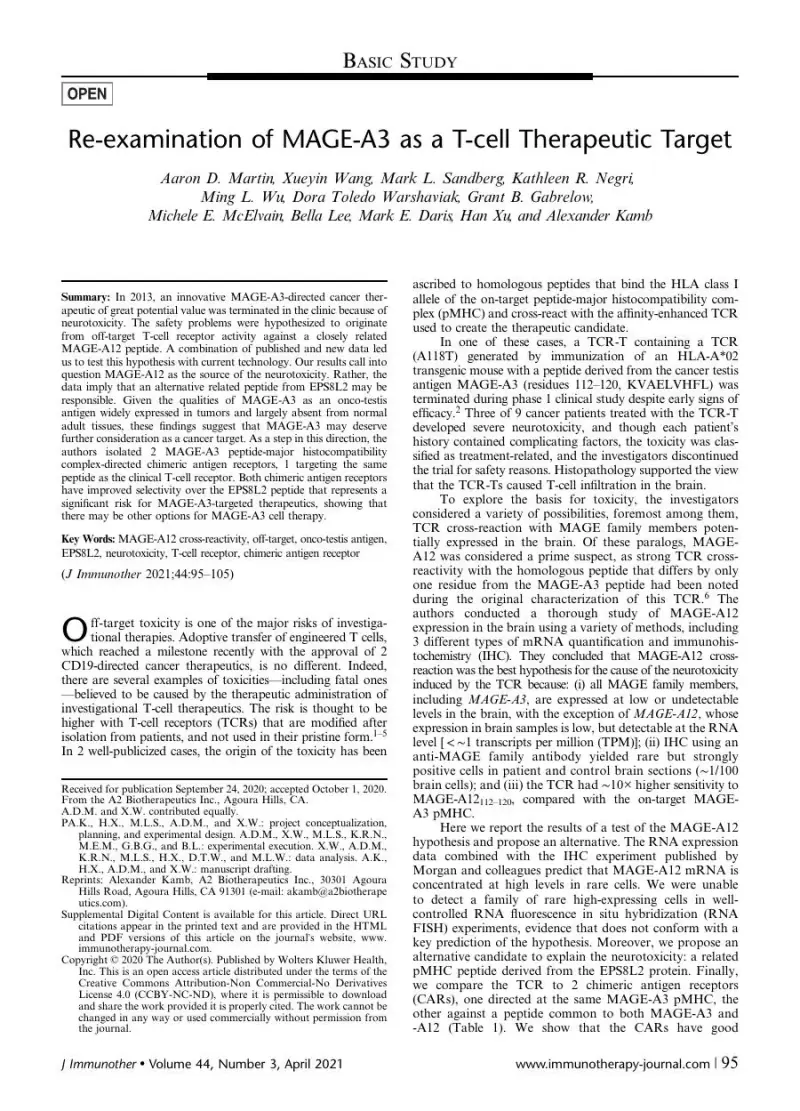
Testing of the MAGE-A12 cross-reactivity hypothesis for the neurotoxicity that halted a clinical MAGE-A3 TCR-T found no rare MAGE-A12 high-expressing cells in the brain, and pointed instead to a homologous EPS8L2 peptide. RNA FISH across about 3.2 million brain cells from 8 postmortem donors detected only a single cell with multiple dots. Public RNA-Seq showed MAGE-A12 at most 0.3 TPM in basal ganglia, while EPS8L2 reached 64 TPM in cerebellum. The A118T TCR killed HLA-A*02-expressing CAPAN-2 cells, which express EPS8L2 but not MAGE-A3 or -A12. Two newly isolated MAGE-A3 pMHC-directed CARs discriminated better against EPS8L2, the MAGE-A3112-120 CAR showing no detectable primary T-cell activity against it.
Note: The authors note that MAGE-A12 cannot be excluded completely: rare MAGE-A12-expressing cells could have been missed, and RNA FISH has its own sensitivity limitations.
Given the totality of the results presented here and by Morgan et al, it seems more likely that the rare stain-positive cells imaged previously are false positives caused by, for example, spurious aggregation of dye. — Aaron D. Martin, Xueyin Wang, Mark L. Sandberg, Kathleen R. Negri, Ming L. Wu, Dora Toledo Warshaviak, Grant B. Gabrelow, Michele E. McElvain, Bella Lee, Mark E. Daris, Han Xu, Alexander Kamb, Journal of Immunotherapy
Study details
- Authors
- Aaron D. Martin, Xueyin Wang, Mark L. Sandberg, Kathleen R. Negri, Ming L. Wu, Dora Toledo Warshaviak, Grant B. Gabrelow, Michele E. McElvain, Bella Lee, Mark E. Daris, Han Xu, Alexander Kamb
- Institution
- A2 Biotherapeutics Inc., Agoura Hills, CA
- Journal
- Journal of Immunotherapy
- Year
- 2020
- G-Rex® model(s)
- G-Rex®24 Well Plate
- Cell type(s)
- CAR T Cells, TCR T Cells
- Application area
- Solid tumor
- Study phase
- Preclinical
How G-Rex® was used
Primary human T cells transduced with lentivirus encoding a CAR or TCR were expanded in a 24-well G-Rex® plate (Wilson Wolf 80192M). Cells were cultured for 3 days in LymphoONE with IL-2 at 300 IU/mL before transfer to the plate. During expansion in the G-Rex® plates, fresh IL-2 at 300 IU/mL was added every 48 hours and the medium was changed every 7 days. Cells enriched by magnetic separation were grown in G-Rex® plates until harvest.
Explore related

Full citation
Martin AD, Wang X, Sandberg ML, et al. Re-examination of MAGE-A3 as a T-cell Therapeutic Target. J Immunother. 2021;44(3):95-105.
Building a similar workflow?
Talk to a ScaleReady specialist about how the G-Rex® platform can support your program — from process development to clinical-scale manufacturing.


