
Microfluidic transfection of mRNA into human primary lymphocytes and hematopoietic stem and progenitor cells using ultra‑fast physical deformations
Overview
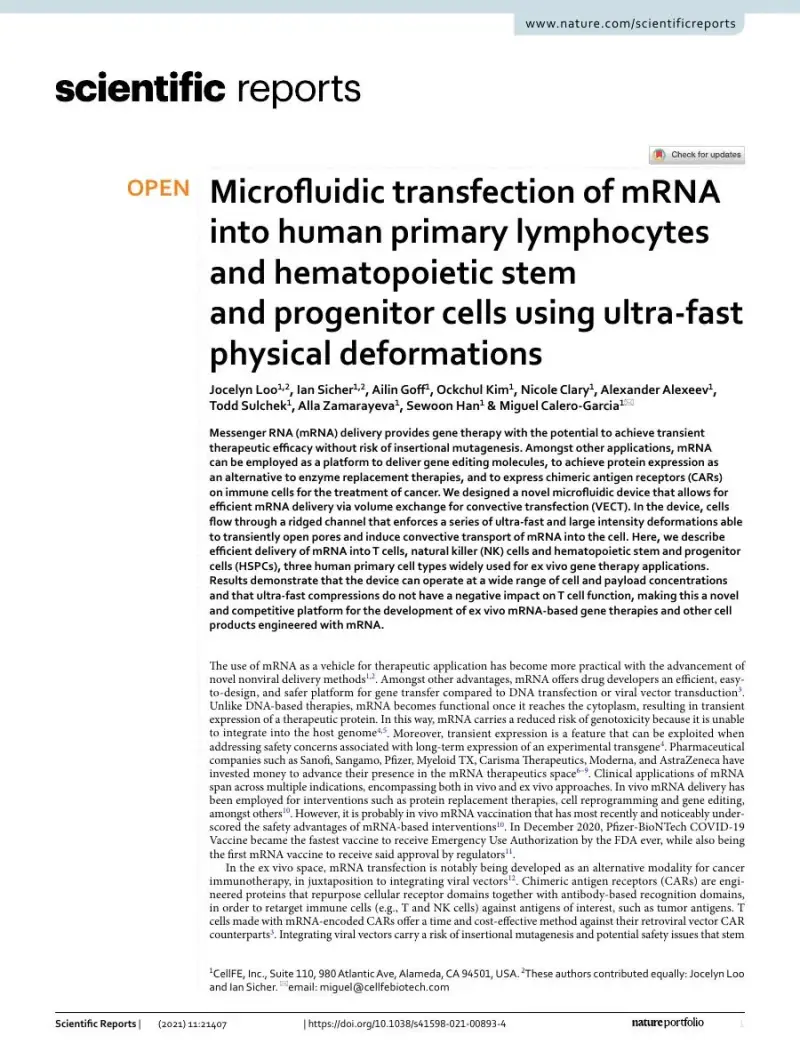
The study presents a microfluidic device (VECT) for mRNA delivery into primary T cells, NK cells, and HSPCs. G-Rex® plates were used for the culture of NK cells during the expansion phase. The method achieved high transfection efficiency and viability without compromising cell function.
What this paper found
A ridged microfluidic channel that briefly compresses cells, termed volume exchange for convective transfection (VECT), delivered mRNA into human primary T cells, NK cells and CD34+ hematopoietic stem and progenitor cells (HSPCs) with high efficiency. In optimized runs, T cells reached about 80% transfection efficiency and about 70% product yield, with relative viability and recovery near 75%. NK cells reached about 60% efficiency with viability and recovery above 80%, and mobilized peripheral blood HSPCs about 75% efficiency with viability and recovery above 90%. The gap under the ridges was a critical variable. T cell efficiency held when mRNA was cut from 160 to 40 μg/ml, and transfected T cells expanded about 25-fold over 15 days, matching no-device controls, with comparable exhaustion and differentiation profiles.
Note: Bench-scale study; the authors state that their next aim is to show transfection at clinical scale, producing hundreds of millions of mRNA-transfected T cells and NK cells.
Approximately 70% of T cells and 50% of NK cells put into the device were transfected and recovered successfully from the system. — Jocelyn Loo, Ian Sicher, Ailin Goff, Ockchul Kim, Nicole Clary, Alexander Alexeev, Todd Sulchek, Alla Zamarayeva, Sewoon Han, Miguel Calero-Garcia, Scientific Reports
Study details
- Authors
- Jocelyn Loo, Ian Sicher, Ailin Goff, Ockchul Kim, Nicole Clary, Alexander Alexeev, Todd Sulchek, Alla Zamarayeva, Sewoon Han, Miguel Calero-Garcia
- Institution
- CellFE, Inc., Alameda, CA, USA
- Journal
- Scientific Reports
- Year
- 2021
- G-Rex® model(s)
- G-Rex®24 Well Plate
- Cell type(s)
- CD34 Cells, NK Cells, T-Cells
- Application area
- Other
- Study phase
- Preclinical
How G-Rex® was used
Primary NK cells isolated from PBMCs were cultured in NK MACS medium with IL-2 (500 IU/ml) and transferred into a 24-well G-Rex® (Wilson Wolf) five days after isolation, with fresh NK medium added every 2–3 days. The expanded NK cells were then transfected with mRNA in the microfluidic device 15 to 18 days after isolation.
Explore related

Full citation
Loo J, Sicher I, Goff A, et al. Microfluidic transfection of mRNA into human primary lymphocytes and hematopoietic stem and progenitor cells using ultra-fast physical deformations. Sci Rep. 2021;11(1):21407.
Building a similar workflow?
Talk to a ScaleReady specialist about how the G-Rex® platform can support your program — from process development to clinical-scale manufacturing.


