
“Cerberus” T Cells: A Glucocorticoid-Resistant, Multi-Pathogen Specific T Cell Product to Fight Infections in Severely Immunocompromised Patients
Overview
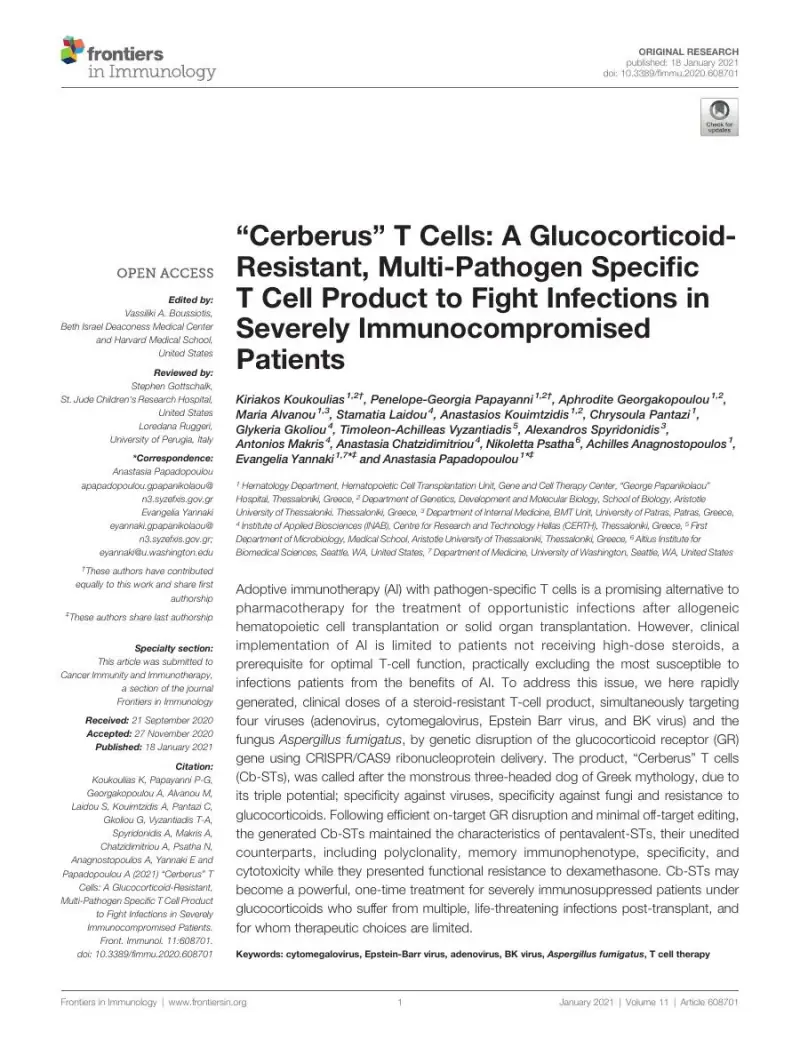
The authors generated "Cerberus" T cells (Cb-STs) targeting multiple viruses and Aspergillus fumigatus, with CRISPR/Cas9-mediated glucocorticoid receptor disruption. G-Rex®10 devices were used for the culture and expansion of these multi-pathogen specific T cells. Cb-STs maintained function in the presence of dexamethasone.
What this paper found
A single T-cell product simultaneously specific for four viruses (adenovirus, cytomegalovirus, Epstein-Barr virus and BK virus) and for Aspergillus fumigatus kept working in the presence of high-dose glucocorticoids after CRISPR/Cas9 disruption of the glucocorticoid receptor. Starting from 4.5 x 10^7 peripheral blood mononuclear cells drawn from 35 ml of donor blood, cells were pulsed with viral and fungal peptides, electroporated on day 3 with Cas9 ribonucleoproteins carrying the e2b guide RNA, and harvested after a 10-day culture, yielding on average 1.94 ± 0.5 x 10^8 cells. On-target cleavage averaged 21.4 ± 2.2% and 25.7 ± 2.6% of cells were receptor-negative. Edited cells retained memory phenotype, pathogen specificity and cytotoxicity, showed no alloreactivity, remained lysed by ATG, and carried minimal off-target editing at seven predicted loci.
Note: In vitro study with cells from healthy donors; the authors position the product for future clinical use rather than reporting patient treatment.
Cb-STs as a powerful, “five-in-one” T-cell product could considerably reduce the transplant-related mortality associated with opportunistic infections and ultimately improve the outcome of allo-HCT. — Kiriakos Koukoulias, Penelope-Georgia Papayanni, Aphrodite Georgakopoulou, Maria Alvanou, Stamatia Laidou, Anastasios Kouimtzidis, Chrysoula Pantazi, Glykeria Gkoliou, Timoleon-Achilleas Vyzantiadis, Alexandros Spyridonidis, Antonios Makris, Anastasia Chatzidimitriou, Nikoletta Psatha, Achilles Anagnostopoulos, Evangelia Yannaki, Anastasia Papadopoulou, Frontiers in Immunology
Study details
- Authors
- Kiriakos Koukoulias, Penelope-Georgia Papayanni, Aphrodite Georgakopoulou, Maria Alvanou, Stamatia Laidou, Anastasios Kouimtzidis, Chrysoula Pantazi, Glykeria Gkoliou, Timoleon-Achilleas Vyzantiadis, Alexandros Spyridonidis, Antonios Makris, Anastasia Chatzidimitriou, Nikoletta Psatha, Achilles Anagnostopoulos, Evangelia Yannaki, Anastasia Papadopoulou
- Institution
- Hematology Department, Hematopoietic Cell Transplantation Unit, Gene and Cell Therapy Center, “George Papanikolaou” Hospital, Thessaloniki, Greece · Department of Genetics, Development and Molecular Biology, School of Biology, Aristotle University of Thessaloniki, Thessaloniki, Greece · Department of Internal Medicine, BMT Unit, University of Patras, Patras, Greece · Institute of Applied Biosciences (INAB), Centre for Research and Technology Hellas (CERTH), Thessaloniki, Greece · First Department of Microbiology, Medical School, Aristotle University of Thessaloniki, Thessaloniki, Greece · Altius Institute for Biomedical Sciences, Seattle, WA, United States · Department of Medicine, University of Washington, Seattle, WA, United States
- Journal
- Frontiers in Immunology
- Year
- 2021
- G-Rex® model(s)
- G-Rex®10
- Cell type(s)
- VST Cells
- Application area
- Infectious disease
- Study phase
- Preclinical
How G-Rex® was used
Peripheral blood mononuclear cells pulsed with adenovirus, CMV, EBV, BK virus and Aspergillus fumigatus peptides were cultured in G-Rex®10 devices (Wilson Wolf Manufacturing Corporation) in VST media supplemented with IL-7 and IL-4. A total of 4.5 x 10^7 PBMCs from 35 ml of donor blood started each culture, and on day 6-8 cultures that had reached a density above 5 x 10^7 per G-Rex®10 were split and fed. After a 10-day culture in the G-Rex® bioreactors, an average of 1.94 ± 0.5 x 10^8 cells was obtained.
Explore related

Full citation
Koukoulias K, Papayanni PG, Georgakopoulou A, et al. “Cerberus” T Cells: A Glucocorticoid-Resistant, Multi-Pathogen Specific T Cell Product to Fight Infections in Severely Immunocompromised Patients. Front Immunol. 2021;11:608701.
Building a similar workflow?
Talk to a ScaleReady specialist about how the G-Rex® platform can support your program — from process development to clinical-scale manufacturing.


