
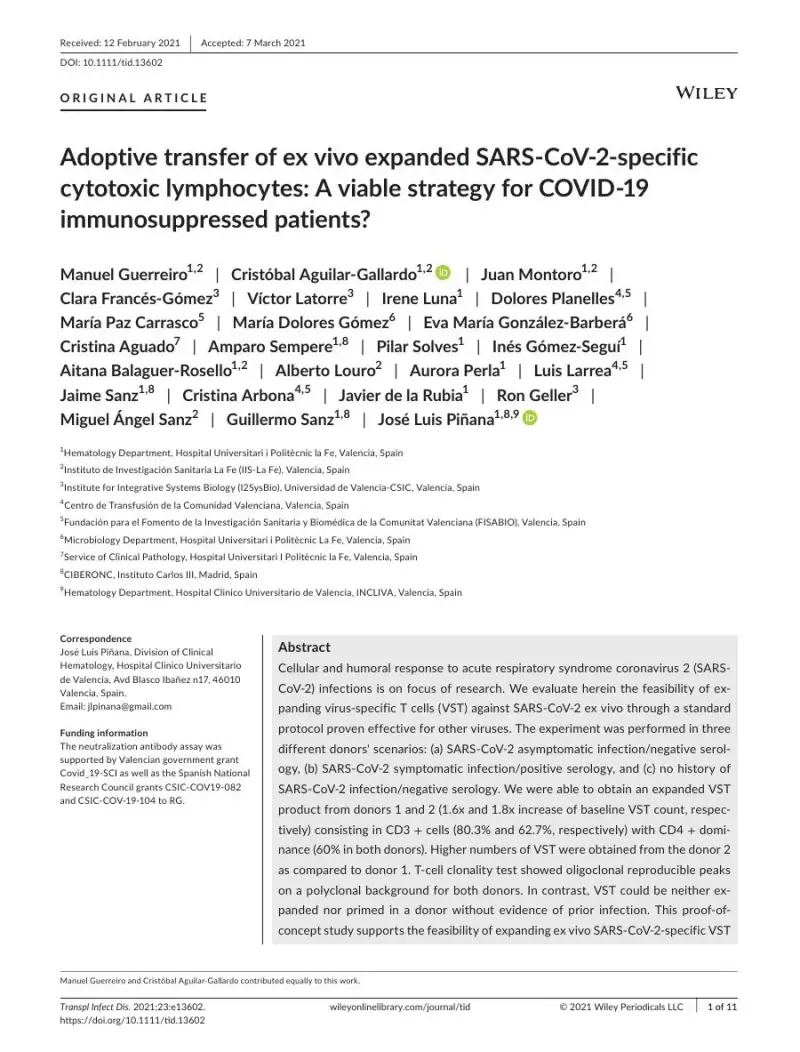
Adoptive transfer of ex vivo expanded SARS-CoV-2-specific cytotoxic lymphocytes: A viable strategy for COVID-19 immunosuppressed patients?
Overview
This study shows the feasibility of expanding SARS-CoV-2 VSTs from convalescent donors. CD14 negative fractions were seeded in a G-Rex® system for a 21-day expansion protocol involving peptide-loaded DCs and PHA blasts, yielding specific T cell products.
What this paper found
Virus-specific T cells against SARS-CoV-2 can be expanded ex vivo from convalescent donors using a protocol originally optimized for CMV and EBV, but not from a donor never exposed to the virus. Cells from three donors were stimulated with peptide-loaded dendritic cells and then twice with peptide-loaded PHA blasts in a G-Rex® over 21 days. The asymptomatic and mildly symptomatic donors reached 1.6-fold and 1.8-fold expansion by day 14, with CD4 cells dominant at about 60% of CD3. The mildly symptomatic, antibody-positive donor gave the stronger response, while the unexposed donor's culture was stopped at day 14.
Note: Proof-of-concept study with three donors and 50 mL of blood; the authors note the peptides used do not cover all SARS-CoV-2 proteins.
In this proof-of-concept study, we conclude that it is possible to expand ex vivo SARS-CoV-2 VSTs from convalescent donors of SARS-CoV-2 infection, using a standard protocol to obtain virus-specific VSTs. — Manuel Guerreiro, Cristóbal Aguilar-Gallardo, Juan Montoro, Clara Francés-Gómez, Víctor Latorre, Irene Luna, Dolores Planelles, María Paz Carrasco, María Dolores Gómez, Eva María González-Barberá, Cristina Aguado, Amparo Sempere, Pilar Solves, Inés Gómez-Seguí, Aitana Balaguer-Rosello, Alberto Louro, Aurora Perla, Luis Larrea, Jaime Sanz, Cristina Arbona, Javier de la Rubia, Ron Geller, Miguel Ángel Sanz, Guillermo Sanz, José Luis Piñana, Transplant Infectious Disease
Study details
- Authors
- Manuel Guerreiro, Cristóbal Aguilar-Gallardo, Juan Montoro, Clara Francés-Gómez, Víctor Latorre, Irene Luna, Dolores Planelles, María Paz Carrasco, María Dolores Gómez, Eva María González-Barberá, Cristina Aguado, Amparo Sempere, Pilar Solves, Inés Gómez-Seguí, Aitana Balaguer-Rosello, Alberto Louro, Aurora Perla, Luis Larrea, Jaime Sanz, Cristina Arbona, Javier de la Rubia, Ron Geller, Miguel Ángel Sanz, Guillermo Sanz, José Luis Piñana
- Institution
- Hematology Department, Hospital Universitari i Politècnic la Fe, Valencia, Spain · Instituto de Investigación Sanitaria La Fe (IIS-La Fe), Valencia, Spain · Institute for Integrative Systems Biology (I2SysBio), Universidad de Valencia-CSIC, Valencia, Spain · Centro de Transfusión de la Comunidad Valenciana, Valencia, Spain · Fundación para el Fomento de la Investigación Sanitaria y Biomédica de la Comunitat Valenciana (FISABIO), Valencia, Spain · Microbiology Department, Hospital Universitari i Politècnic La Fe, Valencia, Spain · Service of Clinical Pathology, Hospital Universitari I Politècnic la Fe, Valencia, Spain · CIBERONC, Instituto Carlos III, Madrid, Spain · Hematology Department, Hospital Clinico Universitario de Valencia, INCLIVA, Valencia, Spain
- Journal
- Transplant Infectious Disease
- Year
- 2021
- Cell type(s)
- VST Cells
- Application area
- Infectious disease
- Study phase
- Preclinical
How G-Rex® was used
Thawed CD14-negative cells were seeded in a G-Rex® gas-permeable culture device at 1 × 10^6 cells/cm2 in X-VIVO 15 medium with 5% human AB serum. They were co-cultured with peptide-pulsed dendritic cells at a 10:1 PBMC/DC ratio for 7 days. Peptide-loaded PHA-blasts were added to the same G-Rex® on days 7 and 14, with IL-2 fed through to day 21, when VST were harvested.
Explore related
Full citation
Guerreiro M, Aguilar-Gallardo C, Montoro J, et al. Adoptive transfer of ex vivo expanded SARS-CoV-2-specific cytotoxic lymphocytes: A viable strategy for COVID-19 immunosuppressed patients?. Transpl Infect Dis. 2021;23(4):e13602.
Building a similar workflow?
Talk to a ScaleReady specialist about how the G-Rex® platform can support your program — from process development to clinical-scale manufacturing.


