
Innovative therapeutic strategy for B-cell malignancies that combines obinutuzumab and cytokine-induced killer cells
Overview
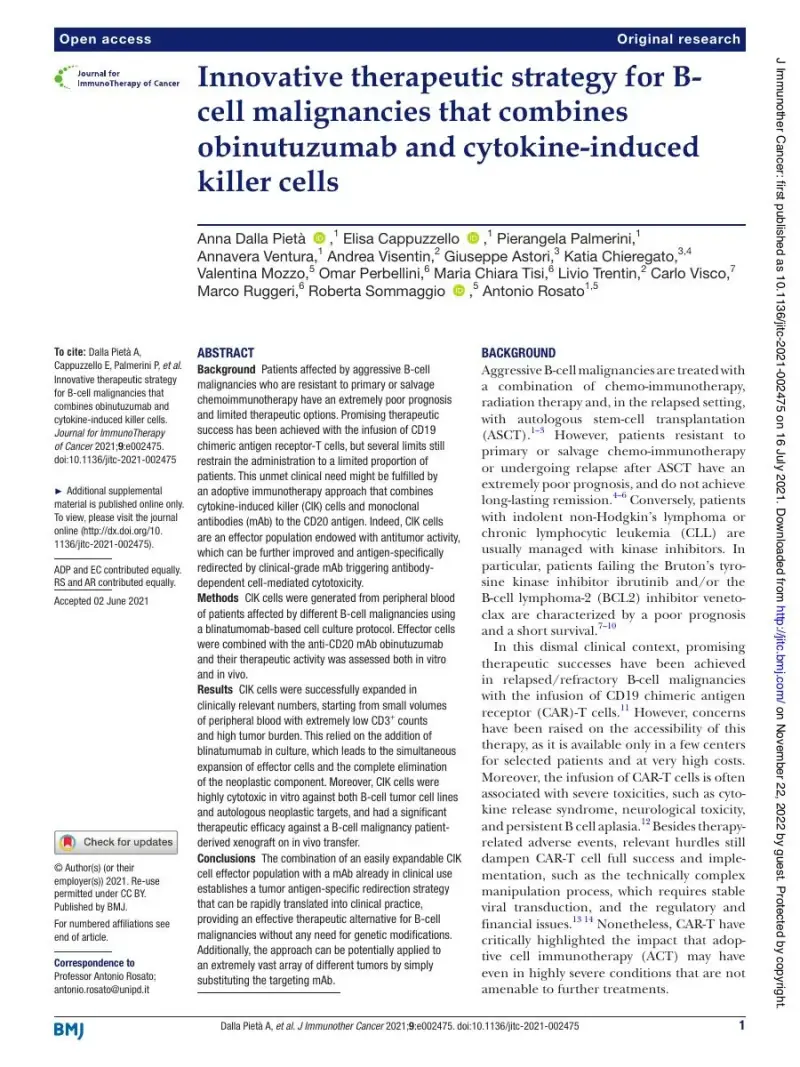
This study presents a therapeutic strategy combining CIK cells with the anti-CD20 antibody obinutuzumab. CIK cells were successfully expanded from patient PBMCs using G-Rex® gas-permeable. The combination showed high cytotoxicity against B-cell malignancies in vitro and in vivo.
What this paper found
Adding the bispecific antibody blinatumomab to cytokine-induced killer (CIK) cell cultures allowed patient-derived effector cells to expand while eliminating malignant B cells, and the resulting cells could be redirected against CD20-positive lymphoma by obinutuzumab. In nine patients with B-cell malignancies, 5 × 10^6 PBMCs yielded 59.3 × 10^6 cells with blinatumomab versus 11.2 × 10^6 with the standard protocol after two weeks, and CD19-positive and CD20-positive cells were eradicated by day 14. Healthy-donor CIK cells combined with obinutuzumab lysed seven B-cell lines and primary patient samples. In mice carrying a mantle cell lymphoma xenograft, only CIK plus obinutuzumab delayed tumor growth and prolonged survival. Blinatumomab-expanded cells also showed higher CD27 expression (74.8% versus 31%).
Note: Preclinical study; the in vivo effect was tested in a single mantle cell lymphoma xenograft model, and the authors note that in the clinical setting the outcome could also depend on additive effects of obinutuzumab alone.
Thus, our data strongly support the application of CIK cells and OBI combination for the treatment of B-cell malignancies. — Anna Dalla Pietà, Elisa Cappuzzello, Pierangela Palmerini, Annavera Ventura, Andrea Visentin, Giuseppe Astori, Katia Chieregato, Valentina Mozzo, Omar Perbellini, Maria Chiara Tisi, Livio Trentin, Carlo Visco, Marco Ruggeri, Roberta Sommaggio, Antonio Rosato, Journal for ImmunoTherapy of Cancer
Study details
- Authors
- Anna Dalla Pietà, Elisa Cappuzzello, Pierangela Palmerini, Annavera Ventura, Andrea Visentin, Giuseppe Astori, Katia Chieregato, Valentina Mozzo, Omar Perbellini, Maria Chiara Tisi, Livio Trentin, Carlo Visco, Marco Ruggeri, Roberta Sommaggio, Antonio Rosato
- Institution
- Department of Surgery, Oncology and Gastroenterology, Immunology and Oncology Section, University of Padua, Padova, Italy · Hematology and Clinical Immunology Unit, Department of Medicine, University of Padua, Padova, Italy · Advanced Cellular Therapy Laboratory, Department of Hematology, San Bortolo Hospital of Vicenza, Vicenza, Italy · Consorzio per la Ricerca Sanitaria (CORIS) of Veneto Region, Padova, Italy · Veneto Institute of Oncology IOV - IRCCS, Padova, Italy · Cell Therapy and Hematology, San Bortolo Hospital, Vicenza, Italy · Department of Medicine, Section of Hematology, University of Verona, Verona, Italy
- Journal
- Journal for ImmunoTherapy of Cancer
- Year
- 2021
- G-Rex® model(s)
- G-Rex®6 Well Plate
- Cell type(s)
- Other
- Application area
- Hematologic malignancy
- Study phase
- Preclinical
How G-Rex® was used
Patient PBMCs were expanded in G-Rex®6M gas-permeable flasks, seeded at 5 × 10^5 cells/cm2 (5 × 10^6 cells per well) in 40 mL of serum-free X-VIVO 10 medium with 1000 U/mL IFN-γ. After 24 hours, anti-CD3 antibody (50 ng/mL) and IL-2 (500 IU/mL) were added, with fresh IL-2 every 3–4 days; in the BL-CIK protocol, blinatumomab at 1 ng/mL was added together with the anti-CD3 antibody. Starting from 5 × 10^6 PBMCs, two-week cultures yielded 59.3 × 10^6 cells with blinatumomab versus 11.2 × 10^6 with the standard protocol, a mean fold increase of 11.9 versus 2.5.
Explore related

Full citation
Dalla Pietà A, Cappuzzello E, Palmerini P, et al. Innovative therapeutic strategy for B-cell malignancies that combines obinutuzumab and cytokine-induced killer cells. J Immunother Cancer. 2021;9(7):e002475.
Building a similar workflow?
Talk to a ScaleReady specialist about how the G-Rex® platform can support your program — from process development to clinical-scale manufacturing.


