
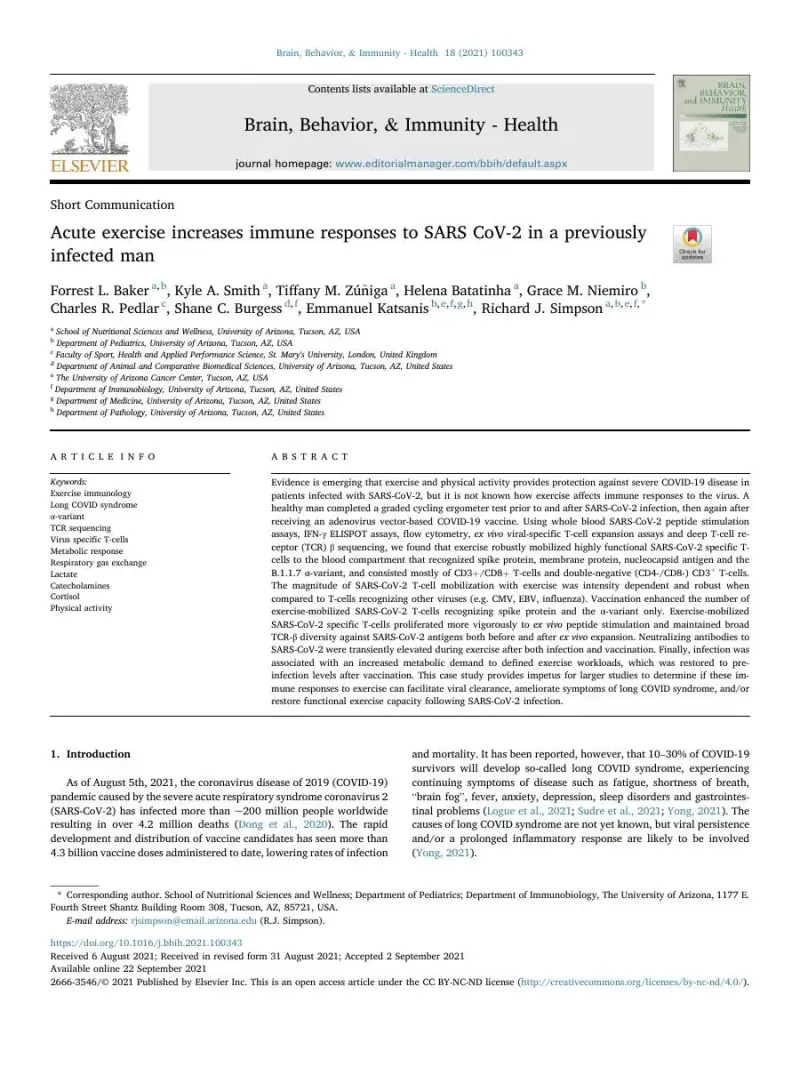
Acute exercise increases immune responses to SARS CoV-2 in a previously infected man
Overview
This study found that exercise mobilizes SARS-CoV-2 specific T-cells and antibodies. To assess T-cell function, SARS-CoV-2 virus-specific T-cells were expanded ex vivo from PBMCs using gas-permeable G-Rex® devices for 7 days.
What this paper found
In one healthy 42-year-old man, a single bout of graded cycling mobilized SARS-CoV-2 specific T-cells into the blood and transiently raised neutralizing antibodies, both after natural infection and after adenovirus-vector vaccination. The T-cell response to spike, membrane and nucleocapsid peptides and to the α-variant increased with exercise intensity and exceeded responses to peptides from nine other viruses. Mobilized cells proliferated more vigorously during 10-day ex vivo expansion and kept broad TCR-β diversity. Expansion was greatest for cells recognizing the membrane protein. The exercise T-cell response was 1.25-fold higher after vaccination. Infection lowered predicted peak oxygen uptake by about 9% and raised metabolic demand, which returned to pre-infection levels after vaccination.
Note: Single-participant case study; the authors note the limited sample size and lack of statistical sampling, and call for larger studies.
In conclusion, the findings from this case study indicate that a single exercise bout mobilizes large numbers of SARS-CoV-2 specific T-cells with broad TCR diversity against COVID antigens and an enhanced ability to respond to recall antigens. — Forrest L. Baker, Kyle A. Smith, Tiffany M. Zúñiga, Helena Batatinha, Grace M. Niemiro, Charles R. Pedlar, Shane C. Burgess, Emmanuel Katsanis, Richard J. Simpson, Brain, Behavior, & Immunity - Health
Study details
- Authors
- Forrest L. Baker, Kyle A. Smith, Tiffany M. Zúñiga, Helena Batatinha, Grace M. Niemiro, Charles R. Pedlar, Shane C. Burgess, Emmanuel Katsanis, Richard J. Simpson
- Institution
- School of Nutritional Sciences and Wellness, University of Arizona, Tucson, AZ, USA · Department of Pediatrics, University of Arizona, Tucson, AZ, USA · Faculty of Sport, Health and Applied Performance Science, St. Mary's University, London, United Kingdom · Department of Animal and Comparative Biomedical Sciences, University of Arizona, Tucson, AZ, United States · The University of Arizona Cancer Center, Tucson, AZ, USA · Department of Immunobiology, University of Arizona, Tucson, AZ, United States · Department of Medicine, University of Arizona, Tucson, AZ, United States · Department of Pathology, University of Arizona, Tucson, AZ, United States
- Journal
- Brain, Behavior, & Immunity - Health
- Year
- 2021
- Cell type(s)
- VST Cells
- Application area
- Infectious disease
- Study phase
- Preclinical
How G-Rex® was used
SARS-CoV-2 virus-specific T-cells were expanded in gas-permeable G-Rex® devices from PBMCs collected in the post-infection trial. 1 × 10^7 PBMCs were pulsed with 700 ng each of S, M and N pepmix pools in 100 μL RPMI with 10% fetal bovine serum for 1 h. Medium with IL-4 (1000 IU/mL) and IL-7 (10 ng/mL) was then added to 1 × 10^6 cells/mL, and cells were cultured in the devices for 7 days. On day 7 cells were counted and resuspended at 1 × 10^6 cells/mL with IL-4, IL-7 and IL-15 (5 ng/mL) until harvest on day 10 for phenotyping and functional assays.
Explore related
Full citation
Baker FL, Smith KA, Zúñiga TM, et al. Acute exercise increases immune responses to SARS CoV-2 in a previously infected man. Brain Behav Immun Health. 2021;18:100343.
Building a similar workflow?
Talk to a ScaleReady specialist about how the G-Rex® platform can support your program — from process development to clinical-scale manufacturing.


