Superior Expansion and Cytotoxicity of Human Primary NK and CAR-NK Cells from Various Sources via Enriched Metabolic Pathways
Overview
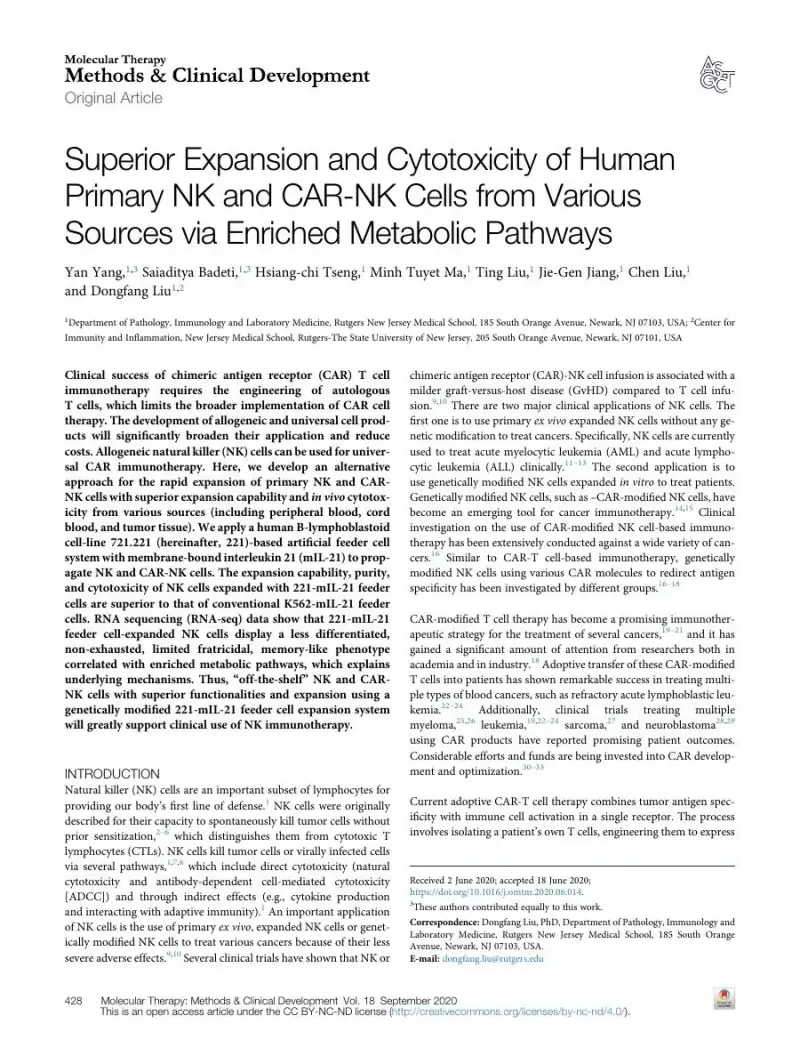
This article reports a superior method for expanding NK and CAR-NK cells using 221-mIL-21 feeder cells. The expanded cells showed enhanced cytotoxicity and metabolic function. G-Rex® 6 multi-well plates were utilized for the culture and maintenance of the expanding NK cells.
What this paper found
A B-lymphoblastoid 721.221 feeder cell line engineered to display membrane-bound IL-21 expanded human NK and CD19 CAR-NK cells better than the conventional K562-based equivalent. Peripheral blood mononuclear cells were stimulated with irradiated feeder cells plus IL-2 and IL-15 for 21 days; across 11 donors the 221-mIL-21 feeders gave higher fold expansion and NK purity than K562-mIL-21, with reported averages of 39,663-fold versus 3,588-fold. Cord blood NK cells expanded more on 221-mIL-21 feeders, and CD19-CAR-NK cells expanded on them killed Raji and Daudi targets better in vitro and in mouse lymphoma models. RNA sequencing linked the superior expansion to upregulated amino acid metabolism and glycolysis and a less differentiated, memory-like phenotype.
Note: Preclinical study; the authors note that a side-by-side comparison with K562-mIL-21 feeder lines made by other groups was outside the scope of this work.
Total NK number and purity as well as functionality of these expanded NK cells are superior to those expanded using the existing K562-mIL-21 expansion system. — Yan Yang, Saiaditya Badeti, Hsiang-chi Tseng, Minh Tuyet Ma, Ting Liu, Jie-Gen Jiang, Chen Liu, Dongfang Liu, Molecular Therapy - Methods & Clinical Development
Study details
- Authors
- Yan Yang, Saiaditya Badeti, Hsiang-chi Tseng, Minh Tuyet Ma, Ting Liu, Jie-Gen Jiang, Chen Liu, Dongfang Liu
- Institution
- Department of Pathology, Immunology and Laboratory Medicine, Rutgers New Jersey Medical School, Newark, NJ, USA · Center for Immunity and Inflammation, New Jersey Medical School, Rutgers-The State University of New Jersey, Newark, NJ, USA
- Journal
- Molecular Therapy - Methods & Clinical Development
- Year
- 2020
- G-Rex® model(s)
- G-Rex®6 Well Plate
- Cell type(s)
- NK Cells
- Application area
- Hematologic malignancy
- Study phase
- Preclinical
How G-Rex® was used
Healthy-donor PBMCs (5 × 10^6) were co-cultured with 1 × 10^7 irradiated feeder cells in G-Rex® 6 multi-well plates, in 35 mL RPMI 1640 with 10% FBS, 200 U/mL IL-2 and 5 ng/mL IL-15. Medium was changed every 3–4 days, keeping 2 × 10^7 cells per well, over a 21-day expansion. For CAR-NK production, cells harvested on day 7 were transduced with CD19-CAR retrovirus and, two days later, moved to a G-Rex® 6 multi-well plate with 35 mL complete medium plus the same cytokines, again fed every 3–4 days. Feeders with membrane-bound IL-21 on 221 cells gave an average 39,663-fold NK expansion versus 3,588-fold with K562-mIL-21.
Explore related
Full citation
Yang Y, Badeti S, Tseng HC, et al. Superior Expansion and Cytotoxicity of Human Primary NK and CAR-NK Cells from Various Sources via Enriched Metabolic Pathways. Mol Ther Methods Clin Dev. 2020;18:428-445.
Building a similar workflow?
Talk to a ScaleReady specialist about how the G-Rex® platform can support your program — from process development to clinical-scale manufacturing.