
Discovery of CD80 and CD86 as recent activation markers on regulatory T cells by protein-RNA single-cell analysis
Overview
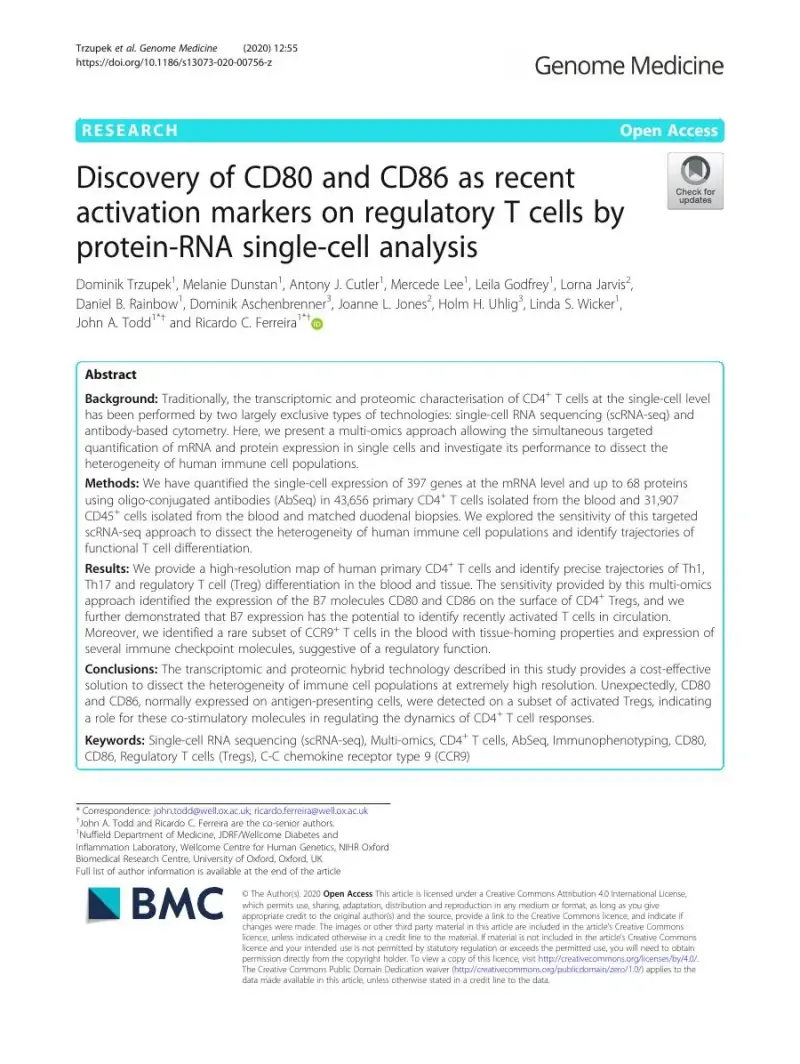
This study uses targeted scRNA-seq and protein analysis to characterize human CD4+ T cells. It identifies CD80 and CD86 as markers of activated Tregs. Tregs were expanded in G-Rex®, confirming that activation induces B7 molecule expression, revealing new insights into Treg biology and heterogeneity.
What this paper found
Combining targeted single-cell RNA sequencing of 397 genes with oligo-conjugated antibodies revealed that the co-stimulatory molecules CD80 and CD86, normally found on antigen-presenting cells, mark a subset of recently activated regulatory T cells in human blood. The approach profiled 43,656 CD4+ T cells and 31,907 CD45+ cells from blood and duodenal biopsies, using up to 68 protein targets. Flow cytometry in four healthy donors confirmed B7 expression mainly on memory Tregs, and in vitro IL-2 alone induced and sustained it. Targeted sequencing detected FOXP3 in 68.3% of Tregs versus 23.2% and 18.3% in whole-transcriptome datasets, and mean mRNA-protein correlation in resting CD4+ T cells was only 0.214. The work also identified a rare circulating CCR9+ T cell subset expressing immune checkpoint molecules.
Note: The authors note that exogenous acquisition of CD80/CD86 by Tregs, for example through CTLA-4-mediated trans-endocytosis, cannot be ruled out, although they consider long-lasting surface expression by such mechanisms unlikely.
Unexpectedly, CD80 and CD86, normally expressed on antigen-presenting cells, were detected on a subset of activated Tregs, indicating a role for these co-stimulatory molecules in regulating the dynamics of CD4 [+] T cell responses. — Dominik Trzupek, Melanie Dunstan, Antony J. Cutler, Mercede Lee, Leila Godfrey, Lorna Jarvis, Daniel B. Rainbow, Dominik Aschenbrenner, Joanne L. Jones, Holm H. Uhlig, Linda S. Wicker, John A. Todd, Ricardo C. Ferreira, Genome Medicine
Study details
- Authors
- Dominik Trzupek, Melanie Dunstan, Antony J. Cutler, Mercede Lee, Leila Godfrey, Lorna Jarvis, Daniel B. Rainbow, Dominik Aschenbrenner, Joanne L. Jones, Holm H. Uhlig, Linda S. Wicker, John A. Todd, Ricardo C. Ferreira
- Institution
- Nuffield Department of Medicine, JDRF/Wellcome Diabetes and Inflammation Laboratory, Wellcome Centre for Human Genetics, NIHR Oxford Biomedical Research Centre, University of Oxford, Oxford, UK · Department of Clinical Neurosciences, University of Cambridge, Cambridge, UK · Translational Gastroenterology Unit and Department of Paediatrics, John Radcliffe Hospital, NIHR Oxford Biomedical Research Centre, University of Oxford, Oxford, UK
- Journal
- Genome Medicine
- Year
- 2020
- Cell type(s)
- T-Cells, Treg Cells
- Application area
- Other
- Study phase
- Preclinical
How G-Rex® was used
Flow-sorted CD25hi CD127low Tregs from three healthy donors were expanded in G-rex G10 flasks using the Miltenyi Treg expansion kit in X-VIVO medium with 1% human AB serum and 500 U/mL IL-2. Cultures ran in two-week cycles with up to six additional rounds of re-stimulation. Cells were harvested either while actively expanding, 8 days after re-stimulation, or at the end of the cycle, on day 15. Expansion beads were then removed and cells were frozen for flow cytometry or lysed in RLT buffer for mRNA analysis. Expanded Tregs showed very high CD80 and CD86 expression, maintained in cycling cells.
Explore related
Full citation
Trzupek D, Dunstan M, Cutler AJ, et al. Discovery of CD80 and CD86 as recent activation markers on regulatory T cells by protein-RNA single-cell analysis. Genome Med. 2020;12(1):55.
Building a similar workflow?
Talk to a ScaleReady specialist about how the G-Rex® platform can support your program — from process development to clinical-scale manufacturing.


