
The Art and Science of Selecting a CD123-Specific Chimeric Antigen Receptor for Clinical Testing
Overview
This study compares five CD123-CAR constructs to select a candidate for clinical trials in AML. Using G-Rex® plates for expansion, researchers identified a CD28.CD28z CAR with superior expression and function. This construct was selected for a phase 1 clinical study targeting relapsed/refractory AML.
What this paper found
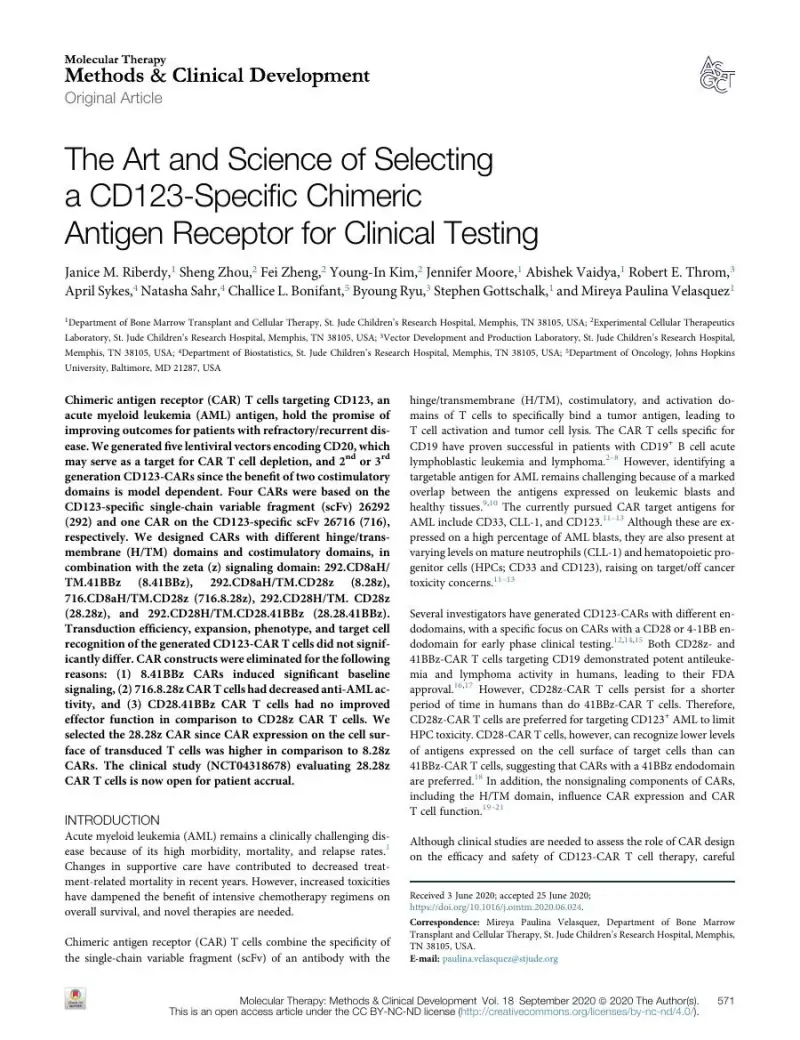
Five lentiviral CD123-specific CAR constructs, each co-expressing CD20 as a safety switch, were compared head to head to choose one for clinical testing in acute myeloid leukemia, and the CAR with a CD28 hinge/transmembrane domain and CD28z signaling (28.28z) was selected. Transduced T cells from healthy donors expanded more than 50-fold in 7 days with viability above 80%, and all constructs killed CD123-positive Molm13 cells in vitro. The 8.41BBz construct showed baseline interferon-γ release, mice given the 716-based CAR had lower survival at 3 × 10^6 cells, and adding 41BB to CD28 gave no benefit. The 28.28z CAR was chosen for its higher surface expression, a mean 2.3-fold higher MFI than CD8a hinge CARs; trial NCT04318678 is open for accrual.
Note: Preclinical study in vitro and in a mouse xenograft model; the authors note that in vivo expansion and persistence of the infused CD123-CAR T cells was not determined.
In conclusion, no clear winner emerged from our evaluation of the five CAR constructs. — Janice M. Riberdy, Sheng Zhou, Fei Zheng, Young-In Kim, Jennifer Moore, Abishek Vaidya, Robert E. Throm, April Sykes, Natasha Sahr, Challice L. Bonifant, Byoung Ryu, Stephen Gottschalk, Mireya Paulina Velasquez, Molecular Therapy - Methods & Clinical Development
Study details
- Authors
- Janice M. Riberdy, Sheng Zhou, Fei Zheng, Young-In Kim, Jennifer Moore, Abishek Vaidya, Robert E. Throm, April Sykes, Natasha Sahr, Challice L. Bonifant, Byoung Ryu, Stephen Gottschalk, Mireya Paulina Velasquez
- Institution
- Department of Bone Marrow Transplant and Cellular Therapy, St. Jude Children’s Research Hospital, Memphis, TN, USA · Experimental Cellular Therapeutics Laboratory, St. Jude Children’s Research Hospital, Memphis, TN, USA · Vector Development and Production Laboratory, St. Jude Children’s Research Hospital, Memphis, TN, USA · Department of Biostatistics, St. Jude Children’s Research Hospital, Memphis, TN, USA · Department of Oncology, Johns Hopkins University, Baltimore, MD, USA
- Journal
- Molecular Therapy - Methods & Clinical Development
- Year
- 2020
- G-Rex® model(s)
- G-Rex®6 Well Plate
- Cell type(s)
- CAR T Cells
- Application area
- Hematologic malignancy
- Study phase
- Preclinical
How G-Rex® was used
After overnight lentiviral transduction of CD4/CD8-enriched T cells, the cells were moved to 6-well G-Rex® plates and expanded for 7–10 days. On day 6, half of the medium was replaced with complete medium containing cytokines (IL-7 and IL-15). This G-Rex® based expansion step mirrors the group's clinical-grade CAR T cell production process.
Explore related

Full citation
Riberdy JM, Zhou S, Zheng F, et al. The Art and Science of Selecting a CD123-Specific Chimeric Antigen Receptor for Clinical Testing. Mol Ther Methods Clin Dev. 2020;18:571-581.
Building a similar workflow?
Talk to a ScaleReady specialist about how the G-Rex® platform can support your program — from process development to clinical-scale manufacturing.


